
Purchase Letter of Intent Template
Express your desire to buy products, services, or assets and show you are eager to come to an agreement. Use our Letter of Intent to Purchase Template to help you during the transaction process.

Who will send the letter of intent?
Fill forms in a few steps
Save, print & download
Done in 5 minutes
What Is a Letter of Intent to Purchase?
This legal instrument, often referred to as an LOI, functions as a legal document that outlines a buyer's intention to acquire a seller's goods, assets, or services.
This document serves as a preliminary agreement between the parties, preceding the formal purchase agreement and setting the stage for a more detailed and binding purchase agreement to follow.
It outlines the basic terms and conditions of the sale, such as the:
- Purchase price
- Payment methods
- Transaction timeline
It establishes a non-binding framework that commits parties to negotiate in good faith.
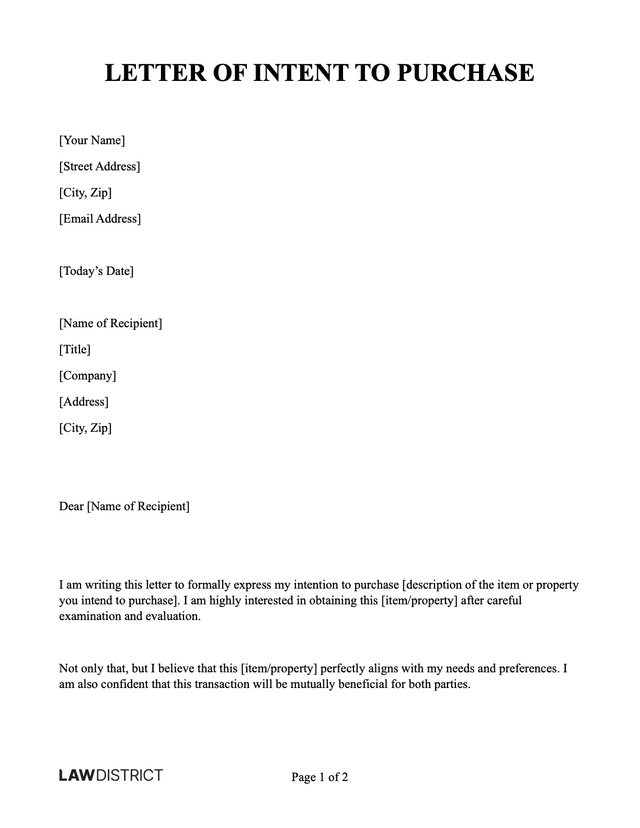
Sample of Letter of Intent to Purchase
Examining a finished example is among the most effective methods to learn the structuring of your document.
Consider the sample Letter of Intent to Purchase below as a guide to crafting a comprehensive and effective written agreement.
Types of Purchase LOI
The Letter of Intent to Purchase (LOI) can vary significantly depending on the type of the transaction.
LOI structures vary based on the specific asset class involved. Each tailored to the specific needs and legal requirements of the transaction at hand.
Market standard LOIs typically fall into these categories:
- Letter of Intent to Purchase Real Estate: Outlines intent to buy property, detailing price, deposit, and inspection terms.
- Letter of Intent to Purchase Commercial Real Estate: Specifies the intention to acquire commercial properties, including details on pricing, deposits, and terms of the transaction.
- Letter of Intent to Purchase a Business: Specifies interest in buying a business, including purchase terms and confidentiality clauses.
- General Property Purchase LOI: For buying assets like equipment or vehicles, detailing items, and price.
- Confidential Business Acquisition LOI: Similar to the business acquisition LOI, with a focus on keeping transaction details private.
While these documents are not legally binding in their entirety, certain sections, such as confidentiality and exclusivity clauses, can be enforceable.
What Should Be Included in a Letter of Intent to Purchase?
A Letter of Intent to Purchase outlines the preliminary understanding between a buyer and a seller regarding a potential transaction.
To prevent litigation and clarify intent, ensure the draft contains:
- Parties information: Full legal names and contact details of both the buyer and the seller involved in the transaction.
- Description of the transaction: A clear description of the assets, business, or property being purchased, including any relevant details that identify the subject of the purchase.
- Purchase price: The agreed-upon or proposed purchase price, including any formulas or methods for determining the final price if not yet finalized.
- Terms of payment: Details on how the purchase price will be paid, including down payment, financing arrangements, and any contingencies affecting the final amount.
- Due diligence: A clause that allows the buyer to conduct due diligence within a specified timeframe, detailing the scope and any access rights to information.
- Confidentiality: Provisions to protect sensitive information shared during the negotiation and due diligence process.
- Exclusivity: A period during which the seller agrees not to negotiate with other potential buyers, giving the current buyer exclusive rights to pursue the transaction.
- Conditions precedent: Any conditions that must be met before the transaction can proceed, such as regulatory approvals or the completion of due diligence.
- Timeline: Key dates and milestones for the transaction, including due diligence completion, signing of the definitive agreement, and closing date.
- Binding and non-binding provisions: Clearly state which parts of the LOI are legally binding, such as confidentiality and exclusivity, and affirm that the rest of the document is non-binding.
- Signatures: The LOI should be signed by authorized representatives of both parties, indicating their agreement to the terms outlined in the document.
Use our printable Letter of Intent to Purchase to set a solid foundation for moving forward with a formal agreement.
Once you create your letter, it’s recommended to get the assistance of a licensed attorney to ensure compliance with applicable laws.
What You Should Avoid in a Letter of Intent to Purchase
When drafting a Letter of Intent to Purchase (LOI), it's crucial to not only include all necessary information, but also to avoid common pitfalls. Poorly drafted LOIs often fail due to these specific structural errors.
Each case can be different, and what you should or should not include will depend on your specific case.
Here are key elements and practices you will likely need to avoid in an LOI:
- Vague language: Use clear, specific terms to avoid misinterpretation.
- Overcommitment: Commit only to what you can fulfill, noting the binding nature of certain clauses like confidentiality.
- Non-binding clarity: Clearly distinguish non-binding sections from binding ones like confidentiality and exclusivity.
- Complete descriptions: Accurately detail the transaction's assets, business, or property to prevent misunderstandings.
- Including contingencies: Incorporate essential contingencies for due diligence, financing, and approvals.
- Defined timelines: Establish clear deadlines for due diligence, signing, and closing to avoid indefinite delays.
- Termination conditions: Outline conditions for LOI termination to protect both parties.
- Confidentiality clause: Include to safeguard sensitive information.
By avoiding these common mistakes, you can ensures the document functions as a robust preliminary framework.
FAQs About Letter of Intent to Purchase
When considering making a purchase, you might have questions about using a Letter of Intent to Purchase or obtaining one.
Review these common legal inquiries regarding LOI enforceability:
While the transaction itself remains non-obligatory, specific clauses in terms of the transaction's completion. However, it can contain binding provisions, such as confidentiality and exclusivity clauses, which are enforceable.
The main body of the letter outlines the preliminary agreement and intentions of both parties, serving as a foundation for future negotiations rather than a definitive contract.
It's crucial to clearly state which parts are binding to avoid any legal confusion or unintended commitments.
No, a Letter of Intent (LOI) is not the same as a Purchase Agreement. An LOI is a preliminary document that outlines the basic terms and intentions of both parties to enter into a transaction, serving as a foundation for negotiation.
It is generally non-binding, except for certain clauses like confidentiality.
A Purchase Agreement, on the other hand, is a legally binding contract that finalizes the terms of the purchase, including payment details, delivery conditions, and warranties, committing both parties to the transaction.
Proof of intent to purchase is a document or action that demonstrates a buyer's serious commitment to buying a product, asset, or service.
This can include a Letter of Intent (LOI), which outlines the preliminary terms of a deal, earnest money deposits, or a pre-approval letter from a financial institution for financing.
These proofs are used to show the seller that the buyer is earnest and prepared to proceed with the transaction, thereby facilitating trust and advancing the negotiation process.
Try Lawdistrict Now
Instant and complete access to our entire library of legal forms
Edit, download and print in PDF from any device
Save time and money on legal document creation