
Free Business Plan Template
Whether you’re a large or small business, a good Business Plan can help you grow in an organized manner and help secure the right financial backing. Take the next steps as an entrepreneur with our easy business plan maker.

Fill forms in a few steps
Save, print & download
Done in 5 minutes
What Is a Business Plan?
A Business Plan is a detailed document that explains the key features of a new or current company. It contains critical information about how the business is to be structured, financed, and how it will run operationally.
These essential planning documents can also help companies see the bigger picture of their strategy. Enterprises and entrepreneurs will often also create detailed Business Plans for the following reasons:
- Growing faster by using this essential tool for scaling in competitive industries
- Studying the market to find strengths and weaknesses with your strategy
- Finding new opportunities to pursue within your startup or business
- Getting a better, in-depth idea of the competition and sector
- Planning strategies for any potential issues that could arise
- Mitigating risk by identifying potential pitfalls
- Working out when your business will reach profitability
- Learning more about your target market
- Allocating resources within the company efficiently
- Having a full 360º view of your business and its goals
- Convincing new investors to finance your business
- Aligning all team members and employees so that everyone is working towards the same goals
Most entrepreneurs follow a standardized template. However, there's more than one way to organize your final document. There are two main types of Business Plans:
- Traditional Business Plans: These are the most in-depth and detailed forms of Business Plans. They will normally span over 10 pages, and each section will provide essential information about a feature of the enterprise.
- Lean Business Plans: This type of Business Plan, on the other hand, is a much more concise document. They can be as little as one page long and can provide a quick introduction to the company and its plans to investors or other interested parties.
An important thing to keep in mind is that a Business Plan is a perspective from a snapshot in time. It is a good idea to update your Business Plan as things evolve and, at a bare minimum, review it for updates on a quarterly basis. Also, there are different business plan focuses depending on the phase of the company, such as:
- Feasibility business plan
- Startup business plan
- Operations business plan
- Expansion business plan
- Strategic business plan
The different organizational types and focuses show that this can be as simple or complex as a business strategy team needs.
Business Plan Examples
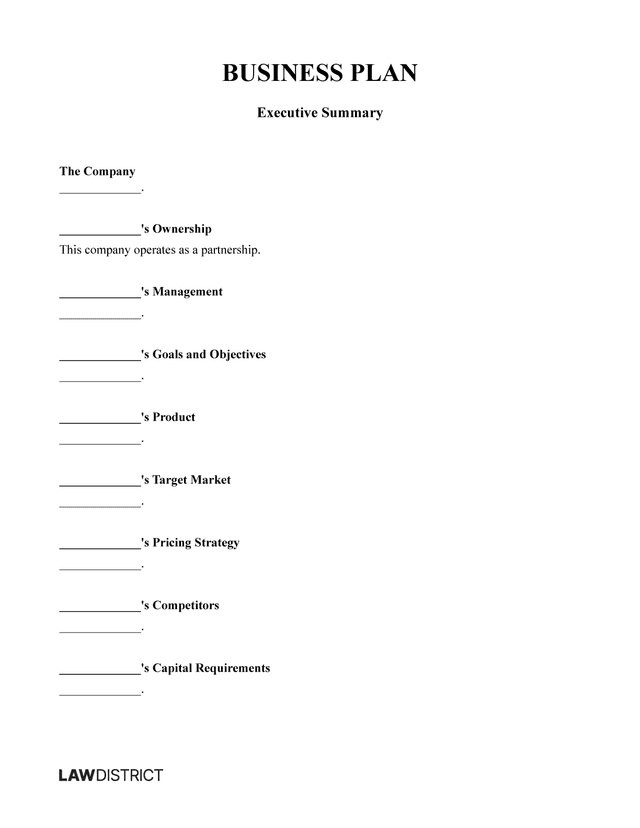
When you’re figuring out how to make a business plan, it can help to see a real-life example before you get started. Take a look through our sample below to understand how a completed business plan should appear before you meet with a bank manager or financial investor.
Why Does a Company Need a Business Plan?
Business plans are often expected by lenders and investors when owners wish to secure loans and finance capital to start a business. These will help the financer to see that your company is a serious venture and that you have planned out all the necessary details for its running.
They are primarily used for the following benefits:
- Decision-making guide: knowing company priorities aids in making clearly informed decisions
- Funding: a well-structured business plan signals to investors potential viability and builds investor confidence by showing focus on customers and processes
- Efficiency: setting goals reveals weaknesses early and keeps teams aligned on metrics
- Positioning: goals clarify the target market, who the competition is, and increase market fit
- Allocation: time and money need to be focused where they have the most impact on company growth
How To Write a Business Plan
The different parts of a Business Plan work to communicate the key necessities that financiers need to know about your organization before offering the investment. This will help you gain a better chance of securing capital to get your operation off the ground or to grow an existing operation.
When you write your Business Plan, you'll need to focus on creating an informative yet convincing document. This will help you spark interest in your proposal.
The text you draft should come across as well-researched and authoritative. It also should answer questions before they even arise in the mind of the potential investor, and ideally be written in a clear and comprehensible way.
Online pre-prepared Business Plan templates can help take a lot of the time and effort out of this task.
Business Plan Format
The majority of Business Plans will follow a standard format containing ten important sections. These will often be found in Business Plan templates and cover every essential detail that investors will need to know to have confidence in your plans.
A traditional Business Plan outline will normally contain the following areas:
- Executive Summary: This should be a simple description of what your business is and why it'll be a success.
- Company Description: Following on from the summary, you should go into further detail about what your company will do, who it will target, and the main strengths it has in its market.
- Products and Services: This should be a description of how the company makes money, including pricing structure and profit margins.
- Market Analysis: You should show that you've carefully investigated the market you wish to enter. In this section, you'll be able to show how you measure up against the competition and the key trends that you'll be looking to exploit in the sector.
- Organization and Management: In this part of the plan, you'll explain how your new business will be structured and who will be in charge. This should clarify the legal framework of your organization (such as whether it's a partnership, corporation or LLC)
- Operational Plan: At this stage of the plan, you should give the reader some idea about how your company will function. It should go into the types of services or products that you will offer, as well as how you will provide them functionally. This section should also consider essential legal protections such as patents, copyrights, and trademarks that will need to be acquired.
- Marketing and Advertising Plan: You should give an explanation of how you're going to communicate the new business and its services to the public, as well as the marketing channels you'll go through. This will also be essential for making your financial projections later in the document, as this will help you calculate the cost of a sale.
- Financial Backing: In this section of the plan, you'll need to explain what financial backing you need and what you've already secured. This should indicate the amount of time you'll need the money for (for example, over 5 years) and for which precise necessities it will be put to use.
- Financial Projections: An investor's key goal in putting money into your business is to eventually turn a profit. Therefore, in this part of the plan, you need to show when you expect to make your first profits and what needs to happen to reach that goal.
- Appendices: In this last part of the Business Plan, you should attach any supporting material. This could include patents, legal documentation, licenses, or credit histories. The precise documents will normally be requested by the lender or investor before the Business Plan is presented.
Business Plan Vs. Business Model Canvas
When you set out the plans for your business, another crucial consideration is the way you present the information.
There are a couple of ways to prepare your plan with this in mind.
The first option is to use a traditional business plan. This comprises a written document containing information about the goals, structure, and potential market sector of your company.
A conventional business plan is what most financial entities expect from entrepreneurs when applying for loans. This is because it is a more comprehensive document that covers your prospective venture in depth.
However, another option is to use a Business Model Canvas (BMC). This is an example of a lean business plan and presents the same information in a much more concise, visual format on a single page.
This can be advantageous when trying to summarize the nature of your business quickly and easily. It can also prove useful if you’re seeking to create interest with potential investors or stakeholders before presenting them with a more detailed proposal.
| Key Facts | Business Plan | Business Model Canvas |
|---|---|---|
| Level of Detail | In-depth information | Quick summary |
| Length | Multiple pages | Single Page |
| Appearance | Formal written document | Visual template |
| Best For | Securing financial backing | Creating interest amongst external stakeholders |
Business Plan - FAQs
There are a lot of questions that arise when starting business plans. We’ve taken a look at some of the most common queries below with our answers to some of the most frequently asked questions about these essential planning documents.
Company managers will often develop business plans for numerous reasons. The most important of these is to demonstrate that a company is a serious venture to a potential financer.
However, another reason that a manager or business owner could produce a plan is to properly analyze the marketplace of their company and its profitability.
This is because these documents often create projections of the organization’s financial future. This then allows those in charge of strategy to get a clearer picture of what options are available to them. Over time, the business plan can be looked at to see how projections panned out, which helps those in charge of strategy to better plan for the future business needs.
There are a number of reasons that companies may need to produce a business plan. The three main purposes of these documents include:
- Securing financial investment
- Assessing the feasibility of management goals
- Planning future strategy for the business
There are nine sections that will often be found in a complete and detailed business plan. However, not every one of these segments has to be used. It is possible to produce a document with fewer sections.
If, for any reason one of ten doesn’t apply to your situation or you are looking to produce a quick and simple business plan in a hurry, the following five sections should appear at the very least:
- Executive Summary
- Company Description
- Marketing and Advertising Plan
- Operational Plan
- Financial Plan
A business continuity plan is quite different from a conventional business plan. It is designed for a more established enterprise, to strategize for situations where a company must function following a crisis or major operating issues.
This will normally include details on identifying risks that are within and outside your power of control. It will also set out a recovery plan for the event that any of these situations occur.
Try Lawdistrict Now
Instant and complete access to our entire library of legal forms
Edit, download and print in PDF from any device
Save time and money on legal document creation