
Free Leave of Absence Letter (LOA)
A Leave of Absence Letter enables an employee to formally request approval for a scheduled break from work. This can include reasons such as medical leave, family obligations, or personal matters. Employers should process these requests promptly, with approval based on company policies or managerial discretion.

Fill forms in a few steps
Save, print & download
Done in 5 minutes
What Is a Leave of Absence?
A Leave of Absence (LOA) is permission given to you when you need a long-term period away from studying or work.
You will need to provide a Leave of Absence Letter to formally ask for time off, which is typically provided on an unpaid basis absent a contractual provision or legal protection providing for paid time off, depending on the circumstances.
Always consult with a locally licensed attorney in your jurisdiction if you believe your circumstances warrant paid time off. Some employers may have a policy to pay a part, or even your entire salary, during the time off depending on the circumstances.
If you need more days off than what your given personal days allow, you must request a LOA to miss work for that amount of time.
Normally, a Leave of Absence is given if there are medical or family reasons. However, there are other reasons you could take a LOA.
Before you get started, though, make sure you know what is written in your employment contract regarding your company’s Leave of Absence policy.
Leave of Absence reasons
To be granted a Leave of Absence, you generally need a qualifying reason.
Note that for leave protected by law (such as FMLA or state leave statutes), you have a legal right to take leave if you meet the eligibility requirements. Such approval is not purely at your employer's discretion.
The main reasons that people ask for a Leave of Absence are:
- Medical
- Mental health
- Family member care
- Personal
If you feel that you need to ask for a long period off from work, you should write a formal Leave of Absence Letter requesting permission.
Note that employees who qualify for protected leave under federal or state law (such as FMLA or ADA) have legal rights that cannot be denied simply because of a procedural deficiency, though a written request is still best practice.
While creating your Leave of Absence Letter, remember to include what specific reason or reasons you're asking for time away from work.
Leave of Absence example
Below, you can find our example template that outlines exactly what to include in your letter to professionally request your employer for a Leave of Absence.
[Date]
[Recipient's Name]
[Company Name and Address]
Dear [Name]
I am writing to formally inform you that I will need to be absent from work for a period of time.
Therefore, please accept this letter as a formal request for a leave of absence.
I am requesting a leave of [length of leave]. The leave shall begin on
[start date] and end on [end date]. I plan to return to
work on [date].
The reason for my requested absence is [medical/personal/academic/family/mental health].
During my absence, I will be available to assist with any work-related questions. I can be reached at the following email: [email address] and/or phone number:
[phone number].
Please let me know if you have any questions or need further information.
Thank you very much for your consideration.
Sincerely,
[Signature]
[Your name]
[Title]
Remember to include what specific reason or reasons you're asking for time away from work.
Types of Leave of Absence
There are various types of leave of absence that employees can request, each catering to different needs and circumstances.
Understanding the specific type required ensures that the request aligns with company policies and personal situations.
Medical Leave of Absence
If there is a medical reason that you should not or cannot go to work, you have to request a Medical Leave of Absence.
Some health issues that may require you to request a LOA include:
- Surgery
- Trauma/injury
- Long-term illnesses
- Rehabilitation
- Treatment that requires travel or rest
Your employer may request proof such as a medical certification from your healthcare provider, particularly for FMLA leave, and you should be prepared to provide it if asked. Such proof is protected by state and federal privacy laws.
Mental Health Leave of Absence
Without your mental health, you cannot work properly. For that reason, you can submit a request for a LOA for your mental health.
Depression and anxiety are 2 mental health problems that may cause you to need time away from work.
Personal Leave of Absence
Apart from mental and physical issues, there might be personal issues that cause you to request time away from your job. If that’s the case, you will need to ask for a Personal Leave of Absence.
Education and military service are examples of situations that can require you to be away from work for an extended period of time.
Note that military service leave carries strong federal protections under USERRA (Uniformed Services Employment and Reemployment Rights Act), including reemployment rights, and should not be treated as ordinary personal leave.
Family Leave of Absence
A Leave of Absence Letter for family reasons is written when someone has to be at home with their family and cannot be at the workplace.
You can use this request if you need time off for:
- Death in the family
- Birth of a child
- Caring for a dying family member
Intermittent Leave of Absence
Under the FMLA, you may be entitled to take leave intermittently or on a reduced schedule when medically necessary, rather than taking all of your leave at once. This allows you to work on a part-time basis or take leave in separate blocks of time.
Doing this is a good way to keep working and receiving pay while being able to attend to your family or medical treatments.
Unpaid Leave of Absence
An Unpaid Leave of Absence is used when you need more time off work than your benefits allow.
If you have to request more days away from work than you have vacation, sick, and personal days, your needs most likely fit into this category of Leave of Absence.
How To Ask for a Leave of Absence
If you are planning to submit a request for a Leave of Absence, it is important to go over some details before handing it in.
- Review your job’s Leave of Absence policy: Your company should have an explanation of what is covered and how to formally apply.
- Calculate how long your LOA is going to be: If possible, give an estimate to your employer of how long your absence will be.
- Schedule a meeting with your employer: Once you know how long your absence will be, talk to your boss.
- Submit a written request: After going through the details and speaking with your supervisor, submit a Leave of Absence Letter.
Prepare your document with our Leave of Absence Letter template to create a well-written letter.
How To Write a Leave of Absence Letter
Ensure your LOA Letter is clear and precise. This will increase the chances of your request being approved.
In order to write a convincing document, you must know what to include in a Leave of Absence Letter from work and how to outline it.
Writing a clear and well-organized LOA Letter can help ensure your request is processed smoothly, though procedural issues alone generally cannot be used to deny leave that is protected by law.
Details to include may differ depending on your school or company and the specific circumstances of your case, but some common elements include:
- Date: Put the current date at the top of the document.
- Personal information: Fill in your personal information, your address, email, and phone number.
- Your supervisor/employer’s information: Fill in your supervisor’s information, e.g. the person the LOA Letter is made out to.
- Why you are writing the request: Include the reason you need to be absent. Medical, personal, or otherwise.
- The dates you plan to be absent from work: Write the exact dates you are going to miss work(both the starting and ending dates). If you cannot provide a definitive end date, then explain how and when it will be determined.
-
- Work transition plan: Explain how assignments, deadlines, clients, records and responsibilities can be transferred.
- Availability during leave: If you wish, you may indicate limited availability for critical questions only, but you are generally not required to work or be available during FMLA-protected leave. Do not promise ongoing availability, as this could undermine your leave protections.
- Benefits and administrative arrangements: Request confirmation concerning health coverage, paid leave balances, payroll deductions, equipment and required forms.
- Return-to-work coordination: Offer to provide reasonable notice of changes, required fitness for duty documentation or requests for accommodations when returning. If your leave is FMLA protected, note that you are generally entitled to be restored to your same or an equivalent position upon return.
- Confirmation: Ask for written confirmation of the approval, dates, applicable conditions and any additional steps required that you must take prior to the leave commencing.
- Your thanks and signature: Leave a message of gratitude and then sign the document.
Please note that for medical leave, detailed diagnoses should ordinarily be submitted through the employer’s confidential HR process rather than included in a manager-facing LOA request letter.
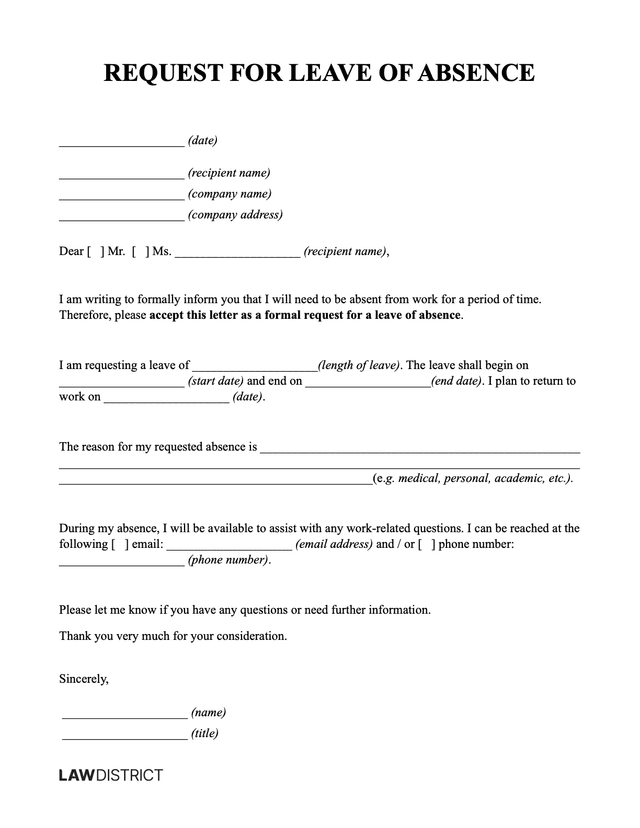
Leave of Absence Letter Sample
Before submitting any legal document, it is a good idea to go over a sample.
Review our sample Letter of a Leave of Absence from work before creating your document.
FAQs About Leave of Absence Letters
Writing a Leave of Absence Letter can be difficult to do considering all the information that’s needed.
Below, we have included the most commonly asked questions and answers regarding a LOA.
The Family and Medical Leave Act (FMLA) allows eligible employees up to 12 weeks of unpaid, job-protected leave in a 12-month period for reasons like childbirth, adoption, caring for a spouse, child, or parent with a serious health condition, or the employee's own serious health condition.
Military caregiver leave under the FMLA may provide up to 26 weeks in a single 12-month period.
Eligibility requires working for a covered employer for at least 12 months, having completed at least 1,250 hours of service during the 12 months immediately preceding the leave, and being employed at a worksite where the employer has 50 or more employees within a 75-mile radius.
A Leave of Absence can be mandatory or voluntary. Mandatory leave, under the Family and Medical Leave Act or applicable state leave laws, requires employers to grant time off if the employee is eligible.
Many states have enacted their own family and medical leave statutes (e.g., California's CFRA, New York PFL, New Jersey FLA) that may provide broader protections than federal FMLA, including covering smaller employers or offering paid leave. Employees should be alerted that state laws may provide additional or different protections.
Voluntary leave is offered at the employer's discretion and may not provide the same statutory job protections as FMLA leave. However, employees may still have protections under the ADA, state leave laws, or their employment agreements, so it is advisable to consult an attorney before assuming no protections apply.
Importantly, regardless of leave type, employers are prohibited from retaliating against employees for requesting or taking leave they are legally entitled to.
In the U.S., federal FMLA leave is unpaid. However, a growing number of states and localities have enacted paid family and medical leave laws that may entitle you to partial or full wage replacement during qualifying leave. Voluntary Leave may also be paid, depending on employer policy, circumstances, and your contract.
Some employers might cover part or all of your salary, or you can request to use paid time off during your leave. An organized request can improve your chances.
Try Lawdistrict Now
Instant and complete access to our entire library of legal forms
Edit, download and print in PDF from any device
Save time and money on legal document creation