
Free Child Medical Consent Form
Child medical consent allows parents and legal guardians to grant authority over their child’s healthcare decisions to a caregiver. Create your own printable, free child medical consent form now.

Who will be the Temporary Caregiver?
Fill forms in a few steps
Save, print & download
Done in 5 minutes
What Is a Child Medical Consent Form?
A child medical consent form is a legal document used by parents and guardians to grant healthcare decision-making authority to non-parental caregivers. It may also be commonly known by one of its alternative names, such as:
- Emergency medical consent form
- Minor medical consent form
- Caregiver consent form
- Parental medical consent form
- Medical treatment authorization form
- Child medical release form
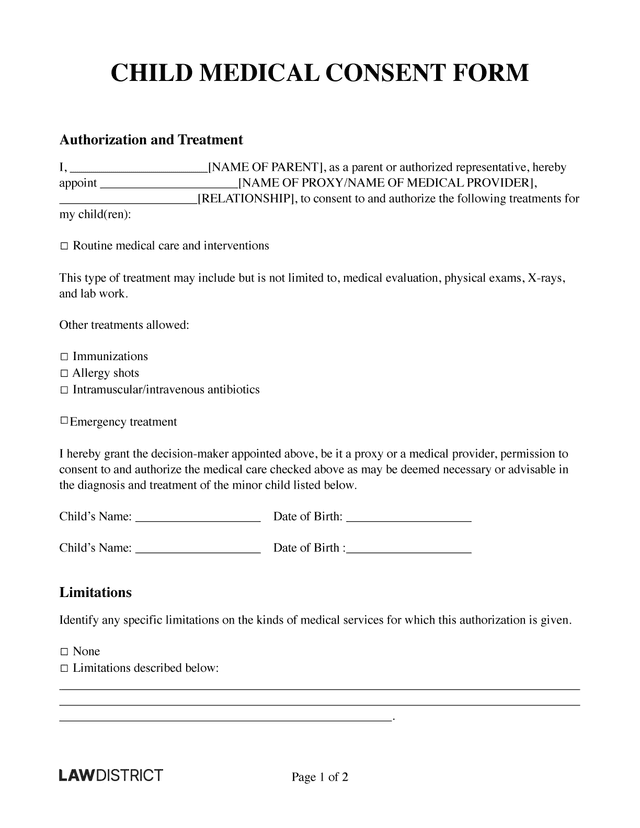
Child Medical Consent Sample
Before starting a child medical consent form, it is a good idea to familiarize yourself with what the finished template will look like. Use our sample document below to get a better idea of how your completed form will appear.
When Is a Medical Consent Form Needed for a Minor?
In many cases, a child medical consent form is needed if a minor will be under the care of a caregiver - such as daycare staff or a family friend - for a prolonged period of time. The form grants the holder parental consent over medical and healthcare decisions that may need to be made during the care of the child.
In most cases, a medical consent form is usually necessary if any of the following is true:
- The child is under 16 years old.
- The child is attending daycare.
- The child will travel or spend a period of time with a non-parental care provider.
- Parents need to leave their child in the care of someone else temporarily.
This can be especially important if the minor in question has any medical problems such as allergies and illnesses that could require urgent treatment.
An authorized child medical consent form ensures the caregiver has the authority needed to seek medical help and make child healthcare decisions for the minor, so they can quickly respond to emergencies.
It is important to note that children who are over 16 can generally seek and obtain healthcare treatment without parental consent for many matters, especially sensitive health care decisions [1].
Basic Information To Include in a Child Medical Consent Form
To complete a child medical consent form, it is necessary to include some important information about the child, parents or guardians, and the selected caregiver. This allows the final document to be legally effective so it can be used properly.
The details that must be included on the form are as follows:
- Name(s) and address(es) of the child’s parents or guardians
- Name(s) of the child/children
- Birthdate(s) of the child/children
- Health information about any children listed
- Name of the temporary guardian
- Permitted medical treatment
- The form’s end date (as required in some states)
- Witnessed and notarized signatures of the parents or guardians
When Is it Necessary to Notarize a Child Medical Consent?
A child medical consent form must be witnessed (by two witnesses) and notarized by a notary public depending on state laws and circumstances.
While notarizing a Child Medical Consent form is not always required, it is strongly recommended in the following situations:
- Cross-border or international travel: If your child is traveling out of state or to another country without a parent or legal guardian, many authorities require a notarized form at customs or border control.
- School or camp policies: Some schools, camps, or sports organizations may require a notarized consent to administer medical care during programs.
- Medical provider request: Hospitals and clinics may ask for notarized documentation before treating your child without parent or legal guardian present.
- Legal clarity: A notarized form helps confirm the identity and intent of the signer, reducing the chance of disputes or issues in the event of an emergency.
Informed consent laws by state
Certain states have laws regarding informed consent. Below is a table with states that have informed consent statutes.
| State | Statute |
|---|---|
| Alaska | §09.55.556 |
| Arkansas | §16-114-206 |
| Delaware | §6852 |
| Florida | §766.103 |
| Georgia | §31-9-6.1 |
| Hawaii | §671-3 |
| Indiana | §34-18-12-3 |
| Iowa | §147.137 |
| Kentucky | §304.40-320 |
| Louisiana | §40:1299.40 |
| Maine | § 2905 |
| Nebraska | §44-2816 |
| Nevada | §41A.110 |
| New Hampshire | §507-E:2 |
| New York | §2805-d |
| North Carolina | §90-21.13 |
| Ohio | §2317.54 |
| Oregon | §677.097 |
| Pennsylvania | §1303.504 |
| Rhode Island | §9-19-32 (Tentative) |
| South Dakota | §34-23A-1.7 |
| Texas | §74.104 and §74.105 |
| Utah | §78-14-5 |
| Vermont | §1909 |
| Washington | §7.70.050 |
| Wisconsin | §448.30 |
How To Write a Child Medical Consent Form
A Child Medical Consent form must be carefully written in order to be valid. This process can be made simpler by using our online form template and instructions to fill in the right data.
The step-by-step guidelines will assist you in adding the correct information and completing the template effectively. It will also provide further instructions on what to do when the form is completed and ready to print and sign.
- Name the child and parent/guardian: Include full names, birthdate of the child, and address of the parent or legal guardian.
- Identify the authorized caregiver: Provide the full name, relationship to the child, and contact information of the person who can make medical decisions.
- Include the scope of consent: Clearly state what treatments are permitted (e.g., emergency care, hospitalization) and list any restrictions.
- Add medical details: Include the insurance provider and policy number, current medications, allergies, and physician contact if available.
- Mention the effective dates: Specify the start and end date of the consent period, or indicate that it remains in effect until revoked.
- Specify emergency contacts: List at least one backup contact in case the guardian cannot be contacted.
- Sign and notarize: The parent/guardian must sign and date the form. A witness or notary is recommended for legal validity.
Child Medical Consent FAQs
There are many important considerations to be mindful of when creating a child medical consent form. Use our selection of FAQs below understand the requirements of these essential legal documents.
Child medical consent forms can be found and completed online. Our own pre-prepared template and guidance instructions can help you through each step of the process.
This will help you avoid common mistakes and include the essential information needed for this kind of document. Once the form is completed it just needs to be printed off, signed (in the presence of two witnesses), and notarized.
Note that our forms complement but do not replace the services of a lawyer.
The most important consideration when completing a child medical consent form is choosing a caregiver you trust. They must be over 18 years old, they should demonstrate a clear concern for the wellbeing of your child and ideally should align with your moral beliefs and healthcare choices.
Child medical consent forms and child travel consent forms are both important documents when granting parental consent to a caregiver. However, they are quite different in their individual uses.
A child medical consent form may only be used to permit caregivers to make medical decisions for a minor. Travel consent forms, on the other hand, are used to allow a child to travel alone or with someone who is not their parent or guardian.
In many cases, however, both forms may be required if a child is to travel across states or internationally without their primary caregiver.
Try Lawdistrict Now
Instant and complete access to our entire library of legal forms
Edit, download and print in PDF from any device
Save time and money on legal document creation