
Free Living Will Form
A Living Will is a document that explains your wishes for medical care if you can’t speak for yourself. It helps doctors and family understand what treatments you want or don’t want in serious health situations..

What type of document you want to create?
Fill forms in a few steps
Save, print & download
Done in 5 minutes
What Is a Living Will?
The purpose of a Living Will, or Health Care Directive or Advance Directive, is to permit you to be in charge of your medical treatments for end-of-life medical care [1].
There may be a moment when you become incapacitated and cannot make any decisions for your health. Planning for such a moment is crucial while possible.
By writing a Living Will, you as the "declarant" can ask for or refuse specific medical treatments. What that means for you is that doctors and other health care providers will know whether to perform any life-saving procedures or not.
What Should You Include in Your Living Will?
There are different decisions regarding advance care planning and situations where you feel life-saving measures are necessary or, perhaps, you would prefer to pass on peacefully.
- Treatment options
- End-of-life decisions
- Agent
You may wish to have a religious leader by your side in your final moments.
You may also want to choose someone you can rely on to make any important medical decisions.
Adding these terms helps you feel more comfortable about your future and any unfortunate situation.
Living Will Sample
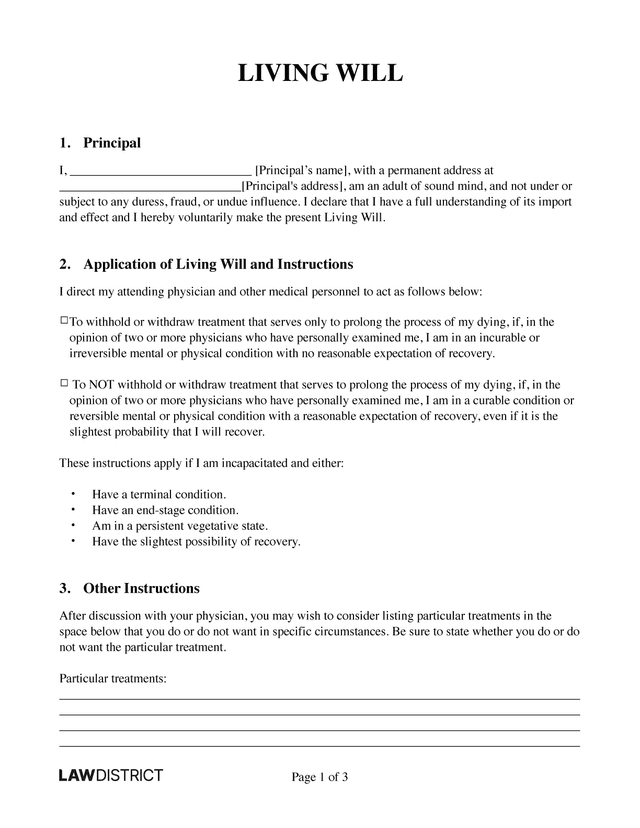
Before making your own document, it would be helpful to see a sample. Get an idea of what your document should look like with our Living Will example.
How To Make a Living Will
Quite a few accidents or diseases can leave us needing life-saving medical attention or life-sustaining treatment.
It is an unfortunate part of life, however, it is something we need to plan for.
That is why Lawdistrict provides a template that makes the process much easier, especially if you want to provide clarity to medical personnel and your family if you ever find yourself in that situation.
Choosing Between Treatment Options
Deciding what medical treatment or procedures you’d want if you have a terminal condition or cannot eat or breathe on your own is one of the most important parts of creating your Living Will.
The best way of deciding on what treatments you would accept or refuse is to discuss it with your family.
Electing End-of-Life Options
Apart from medical decisions, there are other possibilities that you can choose from.
For instance, you may request that a spiritual leader, such as a priest or rabbi, be present to read you your last rights.
Documenting your desire for organ or tissue donation, and planning for funeral arrangements is also recommended [2].
Deciding on a Health Care Agent
Choosing to include a health care agent is advisable, as you may need someone who can advise your family on certain choices. For instance,
- Judgments based on your chance of survival
- Judgments based on your preferences
Living Will Statutory Laws by State
Each state has specific signing requirements and laws regarding Living Wills that you must follow.
If you wish to write a Living Will, look at your state’s requirements below.
| State | Signing Requirements | Statute Law |
|---|---|---|
| Alabama | Two Witnesses | § 22-8A-4 |
| Alaska | No Witnesses required | § 13.52.010 |
| Arizona | One Witness or Notary | § 36-3262 |
| Arkansas | Two Witnesses | § 20-17-202 |
| California | Two Witnesses or Notary | § 4701 |
| Colorado | Two Witnesses | § 15-18-104 |
| Connecticut | Two Witnesses | § 19a-575 |
| Delaware | Two Witnesses | § 2505 |
| Florida | Two Witnesses | § 765.303 |
| Georgia | Two Witnesses | § 31-32-4 |
| Hawaii | Two Witnesses or Notary | § 327E-3 |
| Idaho | No Witnesses Required | § 39-4510 |
| Illinois | Two Witnesses | 755 ILCS 35 |
| Indiana | Two Witnesses | § 16-36-4-10 |
| Iowa | Two Witnesses or a Notary | § 144A.3 |
| Kansas | Two Witnesses or a Notary | § 65-28,103 |
| Kentucky | Two Witnesses or a Notary | § 311.625 |
| Louisiana | Two Witnesses | § 40:1151.2 |
| Maine | Two Witnesses | § 5-803 |
| Maryland | Two Witnesses | § 5-603 |
| Massachusetts | Two Witnesses (For Health Care Proxy) | No statute |
| Michigan | No State Law for Living Will | No statute |
| Minnesota | Two Witnesses or Notary | § 145C.16 |
| Mississippi | Two Witnesses or Notary | § 41-41-209 |
| Missouri | Two Witnesses | § 459.015 |
| Montana | Two Witnesses | § 50-9-103 |
| Nebraska | Two Witnesses | § 20-404 |
| Nevada | Two Witnesses | § 449A.439 |
| New Hampshire | Two Witnesses or Notary | Section 137-J:20 |
| New Jersey | Two Witnesses or Notary | Section 26:2H-54 |
| New Mexico | No Witnesses Required | § 24-7A-4 |
| New York | Two Witnesses | § 400.21 |
| North Carolina | Two Witnesses and Notary | § 90-321 |
| North Dakota | Two Witnesses or a Notary | § 23-06.5-17 |
| Ohio | Two Witnesses or a Notary | § 2133.02(A)(1) |
| Oklahoma | Two Witnesses | § 63-3101.4 |
| Oregon | Two Witnesses | § 127.702 |
| Pennsylvania | Two Witnesses | § 5471 |
| Rhode Island | Two Witnesses | § 23-4.11-3 |
| South Carolina | Two Witnesses and Notary | § 44-77-50 |
| South Dakota | Two Witnesses | § 34-12D-3 |
| Tennessee | Two Witnesses or Notary | § 68-11-1803 |
| Texas | Two Witnesses or a Notary | § 166.033 |
| Utah | One Witness | § 75-2a-117 |
| Vermont | Two Witnesses | § 9703 |
| Virginia | Two Witnesses | § 54.1-2983 |
| Washington | Two Witnesses | § 70.122.030 |
| West Virginia | Two Witnesses and a Notary | § 16-30-4 |
| Wisconsin | Two Witnesses | § 154.03(2) |
| Wyoming | Two Witnesses or a Notary | § 35-22-403 |
How To Write a Living Will
If you feel that it is a wise choice to create a Living Will, then you should know what you need to include in the document.
Here is what should be included in a Living Will:
- Principal: Include the principal’s(Patient) name and address

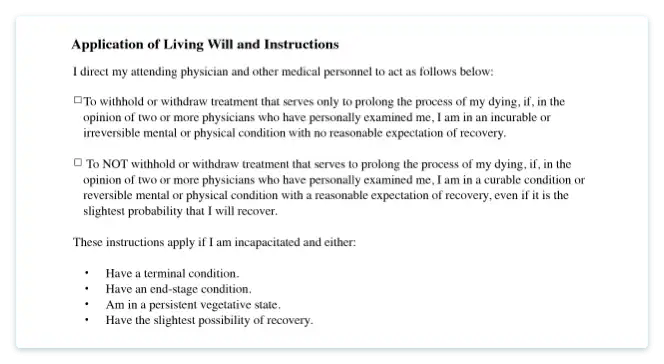
- Application of living will: Explains which treatment to withhold or to go ahead with any other preferences for end-of-life care
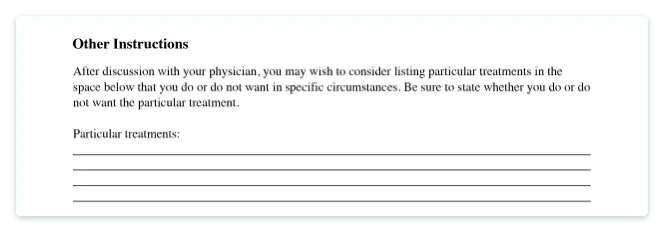
- Further instructions: List any other instructions, such as other terminal illness treatment requests you feel are necessary
- Signature: The signature must fill in the date and sign

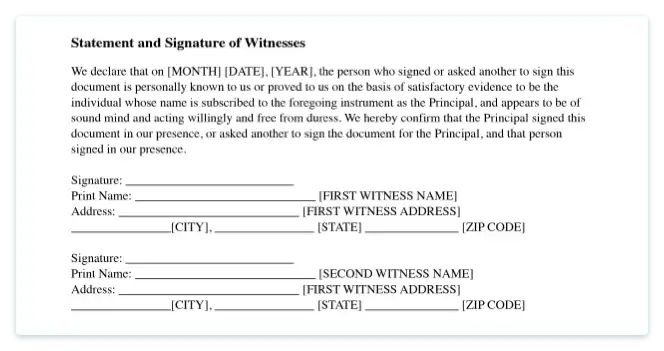
- Statement & signature of witnesses: Witnesses sign a declaration stating that everyone is of sound mind
- Statement & signature of Notary Public: If necessary, a notary public also signs the document

What Is the Difference Between a Living Will and a Will?
A Will, or Last Will and Testament, is an important document for adults to consider.
While the name may be similar, a Will and a Living Will have some key differences.
A Will focuses on what happens after you pass away. It explains your wishes for how your assets will be distributed distributed. It also name the person responsible for managing your estate.
In contrast, a Living Will applies while you're still alive but unable to make decisions. It sets out your medical care preference.
You can see the main differences in the table below:
| Living Will | Last Will and Testament |
|---|---|
| Preferences for medical treatments | Who receives your possessions after death |
| Applies if you become unable to decide | Takes effect after death |
| Focuses on health care decisions | Focuses on finances and property |
| Used by a health care proxy | Managed by an executor |
| Private document | Can be reviewed by probate court |
| Ends when you pass away | Remains active until estate is settled |
| Guides doctors and caregivers | Can name guardians for children |
Advance Directive vs Living Will
Depending on the state that you live in, both an Advance Directive and a Living Will could be used interchangeably. Some states use only one of the terms and not the other.
Both Advance Directives and Living Wills are used to decide your health care if needed.
Advance Directives not only include a Living Will, but also a Medical Power of Attorney.
This means that Advance Care Directives include not only your treatment preferences but also give authority to the health care proxy person you choose to make medical decisions on your behalf [3].
FAQs About Living Wills
If you still have doubts about how to create your own Living Will, don’t worry. We have information on the most common questions about this important legal document below.
A Living Trust is more concerned with your possessions than your health.
It is used to select a trustee to manage your assets and make financial decisions if you become incapacitated. This person can then distribute your possessions after your death.
Once you know the healthcare preferences that you want to include in your Living Will, you can use our expert legal guidance as well as create your own free Living Will.
Lawyer fees for a Living Will range anywhere from $200 to $1,000, depending on where you live.
Our free Living Will template provides a cost-effective and solid foundation for your legal journey.
While you are planning for the future, don’t let cost get in the way of your peace of mind.
Try Lawdistrict Now
Instant and complete access to our entire library of legal forms
Edit, download and print in PDF from any device
Save time and money on legal document creation