
Free Power of Attorney for Child Form
Take advantage of our easy-to-use Power of Attorney for Child template. Safely give someone you trust the authority to be your child’s caretaker for a period of time.

Fill forms in a few steps
Save, print & download
Done in 5 minutes
What Is a Power of Attorney for a Child?
A Power of Attorney for a Child is a legal form used by parents to grant temporary delegation of parental authority to a trusted adult third party.
This individual is referred to as an “attorney-in-fact” or “agent” and is legally authorized to act on behalf of the minor child. They are temporarily granted the power to make daily care and custody decisions for a minor without giving up permanent parental rights.
A POA for Minors is less permanent than guardianship and can be used to grant more limited legal authority in specific situations.
The authority is usually granted for a period of around 6 to 12 months, but many states impose shorter statutory caps. Confirm the maximum duration allowed in your jurisdiction before setting the term of your power of attorney.
Since you are giving parental power and authority to make decisions for your child to another person it is also essential to choose an agent that you completely trust.
When to use a Power of Attorney for a minor
A Power of Attorney for Minors is appropriate when there is a need to grant authority to another person or organization to make decisions regarding your child.
It is used when the parent or legal guardian is unavailable, typically due to one of the following reasons:
- Military service
- Medical care (surgery)
- Business or recreational travel
- Imprisonment
- Education
However, assignment of a Minor Power of Attorney can be used for any reason a parent cannot be present to make crucial decisions on their child’s behalf [1].
While a POA for Minors grants an individual right to make decisions for your child, it does not give them custody.
If you would like to transfer legal custody to someone else, you should use a Temporary Guardianship form.
Powers Granted in a Minor POA
The appointed individual can make certain important decisions concerning the minor's medical care and education.
As a parent, you can grant the following powers to your agent:
- Health Care: With health care powers, the attorney-in-fact can approve routine medical and dental care and treatments for your child. Parents should specify whether the agent may also authorize major medical procedures (e.g., surgery, psychiatric treatment) or whether such decisions are reserved to the parent(s).
- Education: The agent is allowed to register your child in school or daycare and receive academic records to make school-related decisions.
- Day-to-day Care: These powers cover the child's general well-being and daily care decisions. If the agent will travel internationally with the child, you should also execute a separate Child Travel Consent form, and the power of attorney should explicitly authorize international travel.
For an international trip, a Child Travel Consent form should be used to provide additional authority to the adult traveling with your child [2].
Powers not granted
While a Power of Attorney for Minors or Power of Attorney for Care of a Minor Child grants a caretaker a lot of authority, there are notable powers not given.
The agent in the Child POA will not be given the following powers:
- Authorize the marriage or adoption of the minor
- Consent to the termination of a pregnancy on behalf of the minor (Note: laws governing parental and third-party consent for this procedure vary significantly by state)
- Renounce your parental rights
- Authority to make financial decisions on behalf of the legal parent(s) or to manage the minor's financial assets (e.g., custodial accounts, trust funds, or savings accounts held for the minor's benefit)
With these exceptions, your agent's authority will be appropriately limited, and you can create a secure arrangement [3].
How To Write a Power of Attorney for Child
-
Include parent and child details: Begin the document by identifying the parent(s) and child by their full names, addresses, and other important identifying information such as birthdates. If both parents share legal custody, both may need to sign the power of attorney depending on your state’s requirements.
-
Name the agent: Identify the person who will be acting as the agent or attorney-in-fact on behalf of the child. Include the agent's full name, address, and contact information. The chosen agent must be an adult of sound mind who formally agrees to accept the temporary parental responsibilities.
-
List the agent's powers: Specify the powers you are granting to the agent. These may include making decisions related to significant aspects of the child's life(e.g., authorizing medical treatments, handling school enrollments, arranging daily transportation). Be sure to include any limitations on the agent's powers if necessary.
-
Indicate the time period: Specify the temporary period of time for which the Power of Attorney will be valid. You may choose to make it effective immediately, or you may set a specific date or event that will trigger the agent's powers. Most states place a statutory cap on how long a parental power of attorney can last, requiring renewal if the power is longer.
-
State the governing law: Include a statement specifying the governing law of the Power of Attorney. This will typically be the laws of the state where the child resides.
-
Add signatures: Sign and date the Power of Attorney. The agent may also need to sign the document to indicate their acceptance of the appointment.
-
Include the agent's acceptance: Add a section for an agent statement indicating their acceptance of the appointment and their willingness to act in the best interests of the child.
-
Add witness and notary signatures: Include a section for witnesses and a notary public to sign the document. Nearly all jurisdictions require the parent to sign the original form in the presence of a notary public to certify their identity.
⚠️ Check your state’s specific requirements for the number of witnesses needed. Certain states require up to 2 adult witnesses who are not the notary and are not the person being appointed as the agent. Even if your state does not require witnesses, including them is recommended as a best practice.
Once you have completed these steps, you will have a strong foundation for your Power of Attorney. However, validity and enforceability depend on compliance with your state’s specific execution requirements, including potential witnessing, notarization, and filing requirements. You should consult with a licensed attorney in your jurisdiction to confirm that all applicable requirements have been met.
Be sure to keep a copy of the document for your records and provide a copy to the agent as well as any relevant parties (such as schools, healthcare providers, etc.) who may need to rely on the document.
Use our Power of Attorney for Child template to help you create a solid basis for your legal journey.
Maximum Duration of a Minor Power of Attorney
Each state has its own allowed timeframe that a Minor POA can be used. Ensure that you adhere to the limits set by your state.
Note: These time limits may differ for those on active duty.
You can, however, revoke the POA for your child at any time by completing a Power of Attorney Revocation Form and delivering it to the agent, as well as notifying any third parties (such as schools or healthcare providers) who have received a copy of the original POA.
Some states may require the revocation to be in writing, notarized, or executed with the same formalities as the original POA. Consult your state’s laws to ensure proper revocation.
Check the table below to find out if there is a limit set on the Minor POA’s timeframe in your state.
| State | Max Duration | Law |
|---|---|---|
| Alabama | 1 year | §26-2A-7 |
| Alaska | 1 year | §13-26-066(c) |
| Arizona | 6 months | §14-5104 |
| Arkansas | Not stated | §28-68-213 |
| California | Not stated | §1510-1517 |
| Colorado | 12 months | §15-14-105 |
| Connecticut | 1 year | §45a-622 |
| Delaware | Not stated | §2320 to § 2328 |
| Florida | Not stated | §744.3021 |
| Georgia | Not stated | § 19-9-124 |
| Hawaii | 1 year | §560:5-105 |
| Idaho | 6 months | §15-5-104 |
| Illinois | Not stated | §755 ILCS 45 |
| Indiana | 12 months | § 29-3-9-1 |
| Iowa | No laws exist | No laws exist |
| Kansas | 1 year | §38-2403(d)(2)(A) |
| Kentucky | Not stated | §27A.095 |
| Louisiana | No laws exist | No laws exist |
| Maine | 12 months | § 5-127 |
| Maryland | No laws exist | No laws exist |
| Massachusetts | Not stated | §5-202 |
| Michigan | 180 days | §700.5103(1) |
| Minnesota | Not stated | §257B.04 |
| Mississippi | No laws exist | No laws exist |
| Missouri | 1 year | §475.602 |
| Montana | 6 months | §72-5-103 |
| Nebraska | 6 months | §30-2604 |
| Nevada | 6 months | §159.0613 |
| New Hampshire | No laws exist | No laws exist |
| New Jersey | 1 year | §3B:12-39 |
| New Mexico | 6 months | §45-5-104 |
| New York | Not stated | §661 |
| North Carolina | Not stated | §32A-28 to § 32A-34 |
| North Dakota | 6 months | §30.1-27-07(3) |
| Ohio | Not stated | §3109.52 to § 3109.61 |
| Oklahoma | 1 year | §10-700(A) |
| Oregon | 6 months | §109.056(1) |
| Pennsylvania | Not stated | §2513 |
| Rhode Island | Not stated | §33-15.1-14 |
| South Carolina | Not stated | §63-5-30 |
| South Dakota | Not stated | § 29A-5-201 |
| Tennessee | Not stated | § 34-6-302 |
| Texas | Not stated | Sec. 1104.052 |
| Utah | 6 months | § 75-5-103 |
| Vermont | Not stated | § 2659 |
| Virginia | 180 days | § 20-166(A) |
| Washington | Not stated | §11.125.410 |
| Washington D.C. | Not stated | § 21–2301 |
| West Virginia | Not stated | §44A-1-1. |
| Wisconsin | 1 year | § 48.979(1)(am) |
| Wyoming | Not stated | § 3-2-202 |
⚠️ This information is provided for general reference only and may not reflect current law. Always verify current requirements directly with your state’s statutes before relying on this table.)
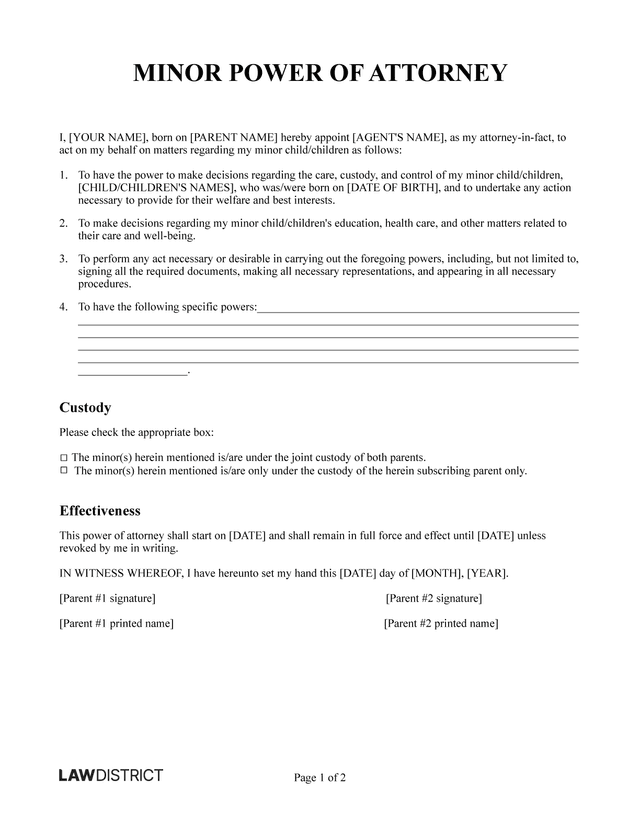
Sample of Power of Attorney for Child
To help you understand how a Power of Attorney for Child should be structured, you should review a well-written example.
Have a look at our example below to make certain that you know exactly how your form should look.
Other Child Legal Documents
There are related legal documents that may help you in a current or future situation. The following documents can also be used to ensure your child always has someone you trust to make decisions for them.
Documents dealing with all types of family and personal matters can be found on Lawdistrict’s website.
Sources
[1] USA.gov. International travel documents for children.
[2] Policy Genius. What is a power of attorney for a child?
[3] Keystone Law Group. Power of Attorney Obligations to Family Members Explained.
FAQS About Minor Power of Attorneys
When creating a Minor Power of Attorney, you may have some doubts regarding what to include or how to obtain the document.
For this reason, we have included responses to a couple of the most commonly asked questions regarding this legal form.
In most cases, parents will go to a lawyer to have them draft their Power of Attorney for a child. While an attorney can almost always provide this service, it is often expensive and can take a long time to complete.
Use our Minor Power of Attorney template to quickly draft your document and empower your legal journey.
It will also help you create a well-structured form and grant only the powers you think are necessary.
The two legal documents serve similar functions, however, they have a couple of key differences.
A Child Medical Consent form gives a caregiver the authority to make healthcare decisions only.
The Minor Power of Attorney gives not only permission to make medical decisions on the child’s behalf but also general and educational ones as well.
Try Lawdistrict Now
Instant and complete access to our entire library of legal forms
Edit, download and print in PDF from any device
Save time and money on legal document creation