
Free Temporary Guardianship Agreement
A Temporary Guardianship form is a legal document that grants an individual short-term authority to care for a minor or incapacitated adult. This document allows the guardian to make decisions regarding the ward's education, healthcare, and daily needs.

Are any children 14 or over?
Fill forms in a few steps
Save, print & download
Done in 5 minutes
What Is a Temporary Guardianship Agreement?
Parents and legal guardians use a Temporary Guardianship form, also known as a Temporary Custody Agreement, to authorize the transfer of a child’s custodial rights to another person who is not a parent.
It is ideal to use this legal document if you momentarily cannot fully care for your child or children. In some jurisdictions, this is called a “delegation of parental authority.”
It’s possible to authorize without going to court, simply with parental consent or a power of attorney in many jurisdictions.
The temporary guardian can care for the child in their home or the home of the child.
They can also solicit medical, economic, and educational services if the child needs any.
Use our Temporary Guardianship template as a reliable foundation for creating your document and a stress-free process.
How Long Does a Temporary Guardianship Last?
How long this arrangement lasts varies by jurisdiction and the specific agreement. Often, it lasts a few months.
If the guardianship needs to continue for longer than six months, you can choose to renew the Temporary Guardianship Agreement or switch to a longer-term option, like a Child Care Authorization or a Power of Attorney that grants decision-making rights for the child.
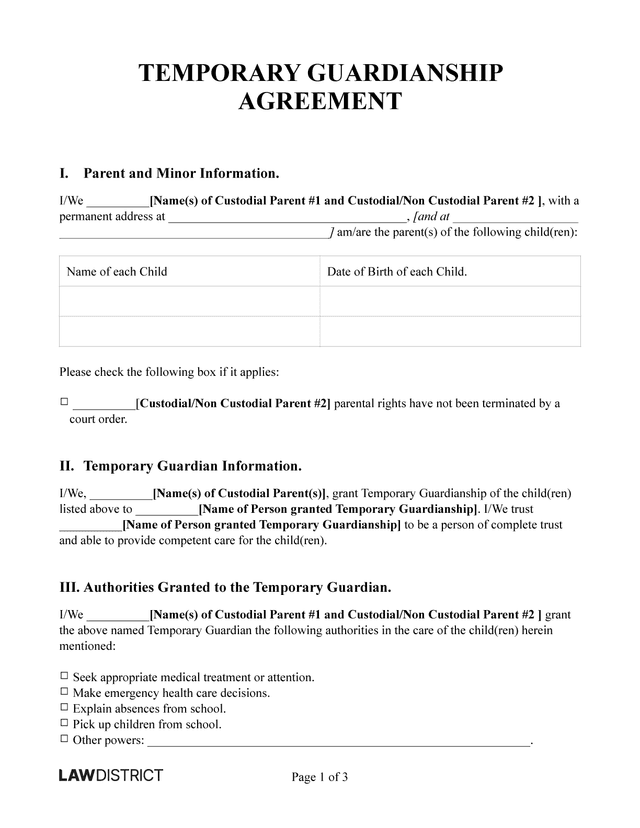
Temporary Guardianship Letter Sample
To make the writing process easier, we have included the following example.
Review this example to understand how your document should be structured.
Reasons To Have a Guardianship Letter for Minor Child
Handing over temporary custody of a child is a difficult decision, so it’s important to know when it’s actually needed. Parents often use this document in situations such as:
- Recovering from a serious illness
- Work that doesn’t allow you to be at home
- Financial problems
- Lengthy travel out of the country
- Attending treatment for mental health or chemical dependency
If you are experiencing any of these difficulties or think you will shortly, it is probably time to prepare a Temporary Guardianship Form.
Guardianship of an Adult
Guardianship is not limited to children; it can also be set up for adults who require someone else to make decisions and act on their behalf. In some states, this legal relationship is known as a “conservatorship":
Typical examples of when the court may determine guardianship of an adult are the following:
- Age-related cognitive decline due to Alzheimer’s disease or other forms of dementia
- Existing conditions such as Down syndrome, low-functioning autism, or other developmental disabilities
- Stroke or other brain injuries
- Other illnesses or medical conditions that impair an individual
States can differ on how they use the terms "guardianship" and "conservatorship". For example, in some states, the term “guardianship” refers to the care of a minor, while the term “conservatorship” refers to the care of an incapacitated adult.
Also, the steps to petition for guardianship or conservatorship can vary from state to state.
What Rights Does a Temporary Guardian Have?
A temporary guardian is granted specific rights and responsibilities while the guardianship is in effect [1].
These rights typically include the ability to make decisions regarding the child’s health, education, and general welfare. The temporary guardian can have choices over:
- Medical decisions: Consent to treatments and emergency care.
- Education: Enroll the child in school and manage their education.
- Day-to-day care: Provide for the child’s basic needs, including food, shelter, and safety.
These rights are temporary and are typically defined by the terms set in the Temporary Guardianship form.
However, the temporary guardian’s rights do not override the fundamental rights of the parents unless stated otherwise by a court or legal agreement. Usually, this granting of authority is also revocable by the parent at any time.
You can start the process yourself. Lawdistrict provides a Temporary Guardianship template that can help you write your document.
Once your document has been created, you can have it reviewed by a lawyer to make sure it complies with your state laws and circumstances [2].
How To Write a Temporary Guardianship Form
It’s important to correctly include all the necessary parts and details of a Temporary Guardianship Form.
We have included the following steps to help you draft your document.
- Write your personal information: Include your first name, last name, and address.
- Write the child or children’s information: Include the first and last names of each child, as well as their date(s) of birth.
- State who is receiving custody: Write the name of each temporary guardian. Fill in their relationship with the child or children and put in their contact information.
- Include the statement of consent: Sign this section in front of a notary public.
- Add the period of custody: Put the exact dates the custody will begin and end. If you are unsure when it will conclude, only add the start date.
- Sign the form: Both parents must sign and date the form unless there are circumstances that make it impossible for the other parent to sign.
- Have the notary public sign: A notary public should then sign and date the form.
Make sure your form reflects your specific circumstances and review your state’s laws to see if a judge must approve of the agreement.
How To Revoke a Temporary Guardianship Form
You may be wondering what happens if you want your child returned to your care before the Temporary Guardianship ends.
There is a simple way to resolve the issue of how to get your child back from temporary guardianship.
If you can resume full care of your child, simply petition the court to end the agreement. Keep in mind there are other ways to terminate temporary guardianship without going to court.
In some states, you may not need to go to court to end the agreement. Notifying the other party in writing can often be sufficient to revoke the delegation.
Difference Between Temporary Guardianship and Temporary Custody
There are slight differences between a Temporary Guardianship Agreement and a Temporary Custody Agreement.
Review the table below to understand the differences between them.
| Temporary Guardianship | Temporary Custody |
|---|---|
| Requires the consent of the parents. | Determined through a civil lawsuit by one of the parents or a third party. |
| Only for a fixed amount of time. | The court does not need the consent of
the parents. |
Temporary Child Custody FAQs
To further assist you in this legal process, we have responded to some of the most frequently asked questions regarding Temporary Guardianships.
Review the answers below to clear up any confusion regarding the agreement and making the document.
The rights of the parents are always respected in a Temporary Guardianship. Parental consent is always required.
The temporary guardian also has the same rights as the parents while the agreement is in effect.
Like most legal documents, a Temporary Guardianship should be notarized by a notary public.
Before the form is submitted to the courts, have it notarized with the signatures of the parents.
In the event, that one parent is not able to sign, the signature of the remaining parent is enough.
A Temporary Guardianship form can be obtained in several ways. You can draft your own Temporary Guardianship form PDF with the help of Lawdistrict’s free template.
Additionally, you can consult with a lawyer to draft a customized Temporary Guardianship agreement.
The main difference between guardianship and adoption is that guardianship is a temporary, revocable legal status, whereas adoption is a permanent legal status that terminates prior parental rights and assigns them to the adoptive parents.
However, a legal adoption terminates the biological parents’ rights and responsibilities for their child and transfers them to the adoptive parents.
| Legal aspect | Guardianship | Adoption |
|---|---|---|
| Parental rights | The parents retain parental rights to the child and can request contact. | The parents’ rights towards the child are permanently ended. |
| Ending the relationship | It can be ended by a court if the parents are once again able to take care of the child. | The relationship between the adoptive parents and the child is permanent. |
| Court supervision | Guardians can be supervised by a legal court. | Adoptive families are not supervised by a legal court. |
Try Lawdistrict Now
Instant and complete access to our entire library of legal forms
Edit, download and print in PDF from any device
Save time and money on legal document creation