
Free Postnuptial Agreement Template
A Postnuptial Agreement is a legal document created after marriage that details the division of assets and financial responsibilities. It outlines property ownership and debt obligations to protect both spouses’ interests in the event of legal separation or divorce.

Do you and your spouse reside in the same household?
Fill forms in a few steps
Save, print & download
Done in 5 minutes
What Is a Postnuptial Agreement?
A Postnuptial Agreement, also known as a post-marital agreement, is a legal contract between spouses that is signed after the marriage has already commenced. A Postnuptial Agreement determines how assets are separated in the event of divorce.
The agreement may also cover financial support.
The legally binding document works similarly to a Prenuptial Agreement. The main difference between the two is the moment the document is signed.
Create your document with lawdistrict’s free Postnuptial Agreement template.
When To Use a Postnuptial Agreement
A Post-Marital Agreement can be very beneficial when certain financial and personal circumstances change, such as:
- Purchasing new assets: You can use a Postnup Agreement when receiving a large inheritance or gift, and keep it as separate property.
- Starting a business: Draw up this agreement to make sure the company remains under your control if the marriage ends.
- Protecting children: This document helps establish inheritance rights for children from a previous relationship.
- Incurring debt: Use a Postnuptial Agreement to protect yourself from significant liabilities taken on by the other spouse.
- Replacing a prenup: If you didn't create a prenuptial agreement before the wedding, you can use this document to establish responsibilities and ownership.
Postnuptial Agreement Sample
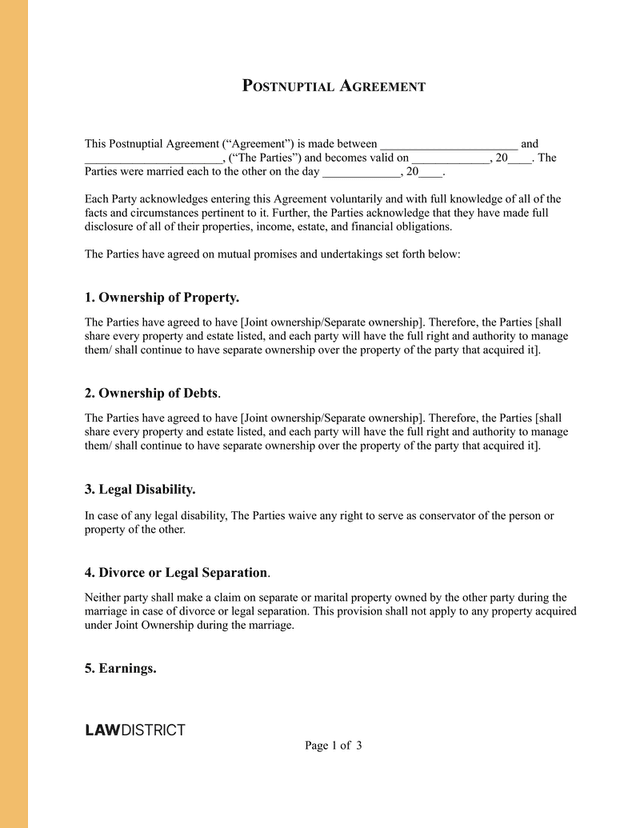
To further help guide you through the process of creating your Postnuptial Agreement, we have included an example of the document.
Review the sample Postnuptial Agreement below to understand how to structure your contract fully.
Postnuptial Agreement vs. Prenuptial Agreement
If you are planning marriage now or in the future, depending on your situation, it may be better for you to use a Postnup instead of a Prenup.
Here’s a breakdown of what each agreement can and cannot do:
| Postnuptial Agreement | Prenuptial Agreement |
|---|---|
| Can be created and signed at any time after marriage, provided divorce proceedings have not already begun. | Must be executed before the wedding. Ideally, signed weeks in advance to prevent claims of pressure or extortion. |
| Addresses changes in circumstances, such as starting a new business or settling financial disputes during the marriage. | Protects your pre-marital assets, inheritances, and sets financial ground rules before the legal union begins. |
| Courts review Post-Marital Agreements strictly for fairness because spouses owe each other a “fiduciary duty”. | These agreements are generally easier to enforce because the parties are viewed as separate individuals negotiating. |
| Provisions for future child custody arrangements or support are often not enforceable. | Cannot legally determine child custody or support, as courts always decide based on the “best interests of the child.” |
What To Include in a Postnuptial Agreement
To create a valid Postnuptial Agreement and ensure you protect your assets and more, it is essential to avoid leaving out any key information.
Typically, the agreement contains details such as how certain finances and property will be divided and the responsibilities each spouse would have in the event of separation.
In general, a Postnuptial Agreement will contain the following:
- Debts: Defines who is liable for specific financial obligations, such as loans or credit card balances.
- Alimony: Mentions the terms of spousal support, including payment amounts and duration. Or alimony establishes that no support will be paid if the marriage ends.
- Death benefits: Outlines beneficiary rights for life insurance policies and the distribution of estate assets.
- Assets: Classifies real estate, bank accounts, and personal property as either marital or separate property to confirm ownership rights.
Matters of inheritance may also be prohibited, depending on the state.
What Assets Can Be Divided in a Postnuptial Agreement?
By creating a Postnuptial Agreement, you can ensure that your separate property and assets remain yours and joint assets are split how you and your spouse agree.
Shared assets that can be divided between you and your spouse include:
- Real estate that was bought during the matrimony
- Savings for retirement
- Stocks bought during the matrimony
How To Make a Postnuptial Agreement Legally Binding
To ensure that your Postnuptial Agreement will be considered legally valid, you’ll need to follow specific requirements, which may change depending on your state.
In general, you will need to meet the following requirements to create a legally binding Postnuptial Agreement:
- Create a written document: The document should be in writing, following state laws and guidelines. Spoken agreements will not be considered binding.
- Create a fair agreement: The agreement cannot be unfair towards one spouse.
- Disclose all financial information: Each party must include all information regarding assets, income, and liabilities, such as debt. Withholding any information may void the Postnup.
- Sign willingly: Each spouse must provide their signature willingly.
- Follow state laws: Review the signing requirements and what is allowed to be included in a Postnuptial Agreement in your state.
Depending on your state’s laws, the agreement may need to be signed in front of a notary public.
How To Write a Postnuptial Agreement
By creating a well-written contract, you can avoid potential legal or financial problems in the event of a divorce.
To correctly write your Postnuptial Agreement, you will need to follow the steps below and include all essential information.
- Add the information of each spouse: Write the names of each spouse and contact information, including your address.
- List your separate and shared assets: Include separate and shared assets that were acquired before and during marriage, and who has rights to those assets, with full and complete disclosure.
- Add a section regarding legal disability: Write how each party will waive any right to serve as conservator of the person or property of the other spouse.
- Specify property in case of divorce: Mention that each party will agree not to claim any separate property that belongs to the other spouse.
- Reference earnings: Mention the earnings of each spouse that are owned separately and together.
- Mention what will happen to gifts: State that nothing in the document will constitute a waiver if one spouse makes a gift to the other.
- Add fiduciary duties: Mention that a spouse will fulfill fiduciary duties, such as an attorney-in-fact or executor trustee, if they are designated as such after the signing of the Postnuptial Agreement.
- Reference children from the marriage: Specify a child’s right to receive support from one or both parents.
- Add what happens in case of death: Write that all claims and rights by the other party will be waived at death.
- Specify the governing law: Mention the state in which the Postnuptial Agreement will be created, and whose laws will govern the document.
- Add any additional information: Include any specific details you or your spouse wishes to mention.
- Include witnesses and signatures: Add a section for the signatures of each spouse, witnesses, and a notary acknowledgment.
Certain states also allow for decisions regarding child support and inheritance to be included in the Postnuptial Agreement.
Keep in mind that before signing, you should review the signing requirements in your state and what is allowed to be included in a Postnuptial Agreement.
In many states, both sides are required to have a lawyer represent them in the process (unlike most prenuptial agreements, which usually do not require lawyer assistance, although it is highly recommended).
Additionally, in many states, if either spouse files for divorce within a period of time shortly after the signing of the Postnuptial Agreement, the agreement is deemed invalid. This period is often two years from the date of signing the Postnuptial Agreement
Easily draft your agreement and avoid the risk of making a mistake with our Postnuptial Agreement template.
Note: While we ensure quality and compliance, our service complements but does not replace the personalized counsel of a dedicated lawyer. Pay close attention to your state’s laws to determine whether you are required to have the assistance of an attorney in finalizing the postnuptial agreement.
Postnuptial Agreement Laws by State
You will be able to create and use the agreement in practically any location in the United States or a U.S. territory.
Postnuptial Agreements are legally recognized in the following locations:
- All 50 U.S. states
- Washington D.C.
- U.S. Virgin Islands
- Guam
Review your state’s laws and requirements regarding what can be included and how to formalize the agreement.
| State | State law codes |
|---|---|
| Alabama | §30-4-1 |
| Alaska | §25.15.100 |
| Arizona | §14-2207 |
| Arkansas | §9-11-503 |
| California | §721 |
| Colorado | §14-2-208 |
| Connecticut | §46b-36 |
| Delaware | §311 |
| District of Columbia | §46-601 |
| Florida | §732.702 |
| Georgia | §19-3-10 |
| Hawaii | §572-22 |
| Idaho | §32-904 |
| Illinois | Chapter 750, Act 65 |
| Indiana | §31-11-7-1 |
| Iowa | §597.1 |
| Kansas | §23-2602 |
| Kentucky | §404.020 |
| Louisiana | Title VI, Chapter 1, Art. 2325 |
| Maine | §801 |
| Maryland | §4-204 |
| Massachusetts | Chapter 209, §2 |
| Michigan | §557.23 |
| Minnesota | §519.11 |
| Mississippi | §93-3-1 |
| Missouri | §451.220 |
| Montana | §40-2-301 |
| Nebraska | §42-201 |
| Nevada | §123.010 |
| New Hampshire | §460:1 |
| New Jersey | §37:2-5 |
| New Mexico | §40-2-2 |
| New York | Chapter 14, Article 4, §50 |
| North Carolina | §52-2 |
| North Dakota | §14-07-05 |
| Oklahoma | §43-204 |
| Oregon | §108.010 |
| Pennsylvania | §3104 |
| Rhode Island | §15-4-3 |
| South Carolina | §20-5-10 |
| South Dakota | §25-2-10 |
| Tennessee | §36-3-504 |
| Texas | §3.410 |
| Utah | §30-2-2 |
| Vermont | 15 V.S.A. §61 |
| Virginia | §20-155 |
| Washington | RCW 26.16.120 |
| West Virginia | §48-29-101 |
| Wisconsin | §766.01(12) |
| Wyoming | §20-1-201 |
FAQs About Postnup Agreements
It is normal to have lingering doubts and questions regarding the Postnup Agreement creation process.
For this reason, we have added answers to the most common queries on the subject.
Review the answers below to clear up any doubts you may have regarding how to create your document, cost, and more.
There are a few common ways to get a Postnuptial Agreement. The most obvious is to go to a lawyer. However, this method may be very costly and time-consuming.
To save yourself time and money, you can use our Postnuptial Agreement template to draft the document yourself. Our documents offer a reliable foundation, empowering you to handle common legal matters with ease.
It is completely optional to create a Postnuptial Agreement when two people get married. However, certain spouses may need to create an agreement more than others.
A spouse with many separate assets, such as one who owned a business before marriage, may want to protect that asset.
A spouse with different real estate properties that were acquired before marriage may also benefit from a Postnup Agreement.
A couple’s circumstances change significantly from the time of signing a prenuptial agreement, and they wish to reflect these changes in an updated agreement.
It is possible to create your own Postnuptial Agreement without the need to hire a lawyer. It would also be beneficial to do so, that way you can avoid excessive legal fees.
By simply coming to an agreement over the division of your assets with your spouse and downloading a valid legal template, you can easily write your agreement.
Various factors play into how much a Postnuptial Agreement costs. Postnuptial Agreements can easily cost over $1,000 in lawyer fees.
Our service offers specialized advice and complements but does not replace the personalized counsel of a dedicated lawyer.
A Postnuptial Agreement is written similarly to a Divorce Agreement, however, the two documents have different functions.
Briefly review how Postnuptial Agreements and Divorce Agreements work.
| Postnuptial Agreement | Divorce Agreement |
|---|---|
| Created before any type of separation. Plans the division of assets, property, and outlines any support that will be given in the event of separation. | Created during the separation process. Splits property, assets, and liabilities. A judge will then need to approve the agreement. |
Try Lawdistrict Now
Instant and complete access to our entire library of legal forms
Edit, download and print in PDF from any device
Save time and money on legal document creation