
Free Notice To Vacate Letter Template
A Notice to Vacate Letter from a tenant to a landlord, or vice versa, stating the intent to end a rental agreement. It specifies the move-out date and provides the required notice period, allowing both parties to prepare for the end of the tenancy and settle any remaining obligations.

Fill forms in a few steps
Save, print & download
Done in 5 minutes
What Is a Notice to Vacate?
A Notice to Vacate can be used by both landlords and tenants to notify the other party that you intend to end the rental agreement.
As a landlord you can use this legal document to give the tenant time to secure new housing, while tenants can use it to give the landlord time to find a new tenant.
You can send this letter regarding the termination of a long-term agreement or a month-to-month contract.
Depending on your state of residence, you will need to give a certain amount of notice to the other party.
Sample Notice to Vacate Letter from Landlord to Tenant
To assist you with the writing process, we have included an example for landlords who need to make a Letter of Notice to Vacate for their tenants:
[Landlord’s Name]
[Phone Number]
[Email]
[Landlord’s Address]
[City, State, Zip]
[Date of Letter]
_ _ Day Notice to Vacate
Tenant Name(s): __________________________
Rental Property Address: _________________
___________________________________________
Date of Notice: _____________
To the above tenant and all others in possession of the described premises:
This letter gives you legal notice to vacate and deliver possession of the above property within _ _ days from the service of this notice.
You are being vacated from the property for the following reason(s):_______________
___________________________________________
It is understood and agreed upon in the lease signed [ _ / / _ _ _] that the tenant is responsible for all repairs and cleaning to restore the premises to move-in condition (after accounting for what is considered as normal wear and tear).
If you refuse, neglect, or otherwise fail to complete rent payments or vacate the stated premises within _ _ days from this notice, the leasing office and property management of _____________________ will take legal action according to state law to evict you (and all others) from the property.
We will return your security deposit of $___________ in full, in part, or not at all depending on the condition of the property.
Landlord Signature: ___________________
Landlord Name: _______________________
Landlord Address: _____________________
Date of Letter: ________________________
Use our Notice to Vacate Letter template in addition to the above sample to make the writing process stress-free and quick. You can quickly enter the details specific to your case to get a ready-to-send notice to vacate in just a couple of minutes.
Notice To Vacate Letter Sample
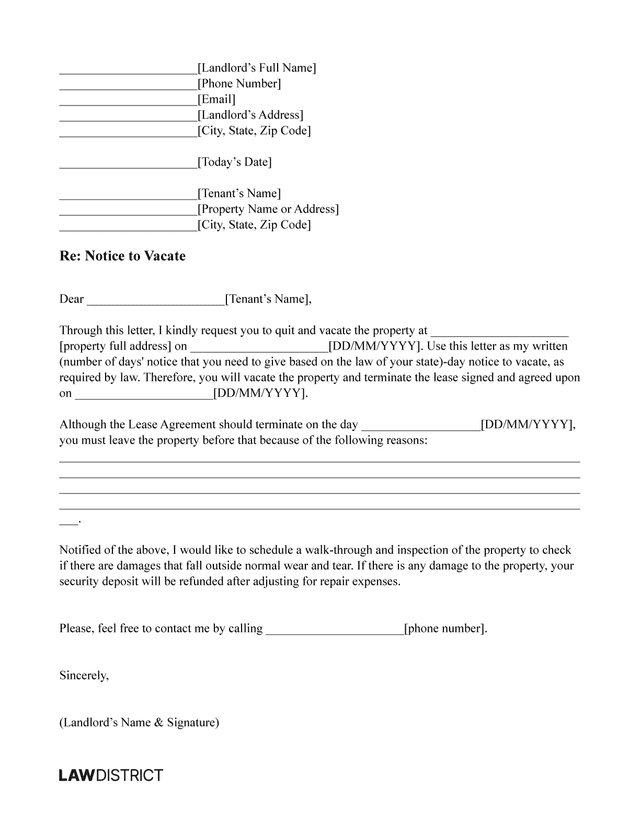
To give you a better idea of what your Notice to Vacate Letter will look like, we have included an example for you to review below.
Use this Legal Document Template and our template to easily create your letter.
Reasons To Vacate
Below are some of the different reasons you can send a Letter of Notice to Vacate:
- Breach of contract: If the tenant is violating the terms and conditions of your agreement, you can send a Notice to Vacate Letter.
- Unrentable property: If you want to sell your property, remodel it, or for any other reason your property becomes unavailable for rent you can send a letter.
- End of Month-to-month lease: As a tenant, you do not want to sign a lease agreement longer than month-to-month.
- End of lease: You do not wish to renew your lease with the tenant or vice versa.
- Causeless termination. In certain states, you may terminate the lease agreement with “no cause,” but you still must allow the tenant sufficient time to move out.
However, many states do not require any reason to be provided for a notice to vacate. Unless it's required by local or state law, it's best to not provide a reason so as to avoid potential disagreements with the notice.
Check your state’s laws regarding the amount of notice you must give your tenant or landlord before sending a Notice to Vacate Letter [1].
How To Send a Notice to Vacate
To send a Notice to Vacate Letter, you have several options. Use one of the following methods to deliver your letter:
- Send with certified mail
- Give letter in person
You’ll need to send or deliver the letter to the address to which the other party agreed to receive any communication.
To deliver the letter to a tenant, it's normally sent to the property they are renting.
Many leases state this information, and if this is the case, it's important to follow what is indicated in the lease.
The rules for serving a Notice to Vacate also vary by state. Some allow posting only under certain circumstances.
Some states also allow the notice to be provided in other written formats, such as via email or text. Make sure to look up what the rules are in your jurisdiction.
What To Include in a Notice to Vacate Letter
There are specific differences between a Notice to Vacate Letter sent by a landlord and one sent by a tenant.
However, some common details should be included in either case.
When writing a Vacate Premises Letter, it is essential to include the following information.
Date the Property Will Be Vacated
Review your lease to ensure that you are aware of the amount of notice you must give before sending your letter. Once you know how much time is needed, add the day you will vacate the property, as well as the amount of notice given.
Failure to do so can result in the contract being renewed for another period of time.
If you are the landlord, include the date the property must be vacated.
It is also critical to add the date that you send the letter. This will provide proof that you delivered the letter with sufficient notice.
It is also important to review state and local rules since, in many cases, the last day of the lease must be the last day of a rental period (usually the last day of the month). Putting an incorrect date in the middle of a rental period is a common mistake that landlords (and tenants) make in notices to vacate.
Lease Agreement Title and Date
Include the title of the original lease as well as the date of the agreement. This date is when you entered into the lease.
Remember to also include the address of the property in your letter.
Reasons the Property Is Being Vacated
You may want to include the reasons you are vacating the property, or why the tenant must leave. This is usually not required or recommended, but check your local laws first.
Explain in full, whether it be for a contract breach or simply because you have chosen not to renew the agreement.
Day of Final Walkthrough
Schedule the day when the final walkthrough of the property will take place. The purpose is for the landlord to inspect the property for damages.
It is a good idea to make this appointment when both parties are available to be present in person.
Name and Signature
Include your current address or forwarding address so that any additional communication can be sent to you.
Write your name and signature along with the date of the letter at the bottom of the document.
How To Write a Notice To Vacate to a Tenant
As a landlord, you should send a Notice to Vacate whether you are ending a short-term or long-term lease agreement.
When making your letter, remember to include the following details:
- Move-out date
- Day the final rent is due
- What fixtures must remain with the property
- Instructions regarding returning property to the pre-rental state
How To Write a Notice To Vacate to a Landlord
As a tenant, you will need to write either a 60-Day Notice to Vacate Letter or a 30-Day Notice to Vacate Letter [2].
It is essential to include:
- What day you will vacate
- Forwarding address
- Where to send the deposit
Days of Notice Required To Vacate Laws
When giving notice to your tenant, it's critical to follow your state’s laws. You must give appropriate notice, or your tenant may be able to remain on the property.
For certain states, you may need to provide a 60-Day Notice to Vacate Letter, but for other states it could be 30, 90 or less than 10 days notice to vacate.
Review the table below to find out how much notice your state requires you to give when terminating general month-to-month tenancies. Depending on your jurisdiction, this may not apply in just cause cases. Make sure to check what applies in your locality.
| State | Days of Notice Required | Law |
|---|---|---|
| Alabama | 30 days | § 35-9A-441 |
| Alaska | 30 days | § 34.03.290(b) |
| Arizona | 30 days | § 33-1375 |
| Arkansas | 30 days | § 18-17-704 |
| California | 60 days (tenancies >1 year)
30 days (tenancies <1 year) | § 1946 |
| Colorado | 90 days (tenancies >1 year)
30 days (tenancies > 6 months and <1 year) 10 days (tenancies > 1 month and < 6 months) 3 days (tenancies > 1 week and < 1 month) 1 day (tenancies < 1 week | § 13-40-107 |
| Connecticut | 3 days | § 47a-23 |
| Delaware | 60 days | § 5106 |
| Florida | 15 days | § 83.57 |
| Georgia | 60 days for the landlord, 30 days for the tenant | § 44-7-7 |
| Hawaii | 45 days for the landlord, 28 for the tenant | § 521-71 |
| Idaho | 30 days | § 55-208 |
| Illinois | 30 days | §735 ILCS 5/9-207 |
| Indiana | 30 days | § 32-31-1-1 |
| Iowa | 30 days | § 562A.34 |
| Kansas | 30 days | § 58-2570 |
| Kentucky | 30 days | § 383.695 |
| Louisiana | 10 days | § CC 2728 |
| Maine | 30 days | § 6002 |
| Maryland | 60 days | § 8-402 |
| Massachusetts | 30 days | § 186-15B |
| Michigan | 30 days | § 554.134 |
| Minnesota | 90 days or one full rental period | § 504B.135 |
| Mississippi | 30 days | § 89-8-19 |
| Missouri | 30 days | § 441.060 |
| Montana | 30 days | § 70-24-441 |
| Nebraska | 30 days | § 76-1437(2) |
| Nevada | 30 days | § NRS 40.251 |
| New Hampshire | 30 days | § 540:11(2) |
| New Jersey | 30 days if month to month, 3 months if year to year | § 2A:18-56 |
| New Mexico | 30 days | § 47-8-37 |
| New York | 30 days | § 232-b |
| North Carolina | 7 days | § 42-14 |
| North Dakota | 30 days | § 47-16-07.2 |
| Ohio | 30 days | § 5321.17 |
| Oklahoma | 30 days | § 41-111 |
| Oregon | 30 days | § 91.070 |
| Pennsylvania | 30 days (tenancies >1 year) | § 250.501 |
| Rhode Island | 30 days | § 34-18-37 |
| South Carolina | 30 days | § 27-40-770 |
| South Dakota | 30 days for landlords,
15 days for the tenant | § 43-32-13 |
| Tennessee | 30 days | § 66-28-512 |
| Texas | 30 days | § 91.001 |
| Utah | 15 days | § 78B-6-802 |
| Vermont | 60 days (tenancies 2 years or less)
90 days (tenancies > + 2 years | § 4467 |
| Virginia | 30 days | § 55.1-1253(A) |
| Washington | 20 days | § 59.18.200 |
| Washington D.C | 30 days | § 42–3505.54(a) |
| West Virginia | 30 days | § 37-6-5 |
| Wisconsin | 28 days | § 704.19 |
| Wyoming | No minimum period | No statute exists |
FAQs About Notice To Vacate Letter
To further assist you with creating your letter, we have answered some of the most frequently asked questions on the subject.
Review the answers to give yourself a better understanding of how to write a Notice to Vacate Letter.
A notice to vacate letter can be rescinded if both parties agree to extend or adjust the lease.
For example, a landlord may send a notice to vacate a letter, but rescind it if the tenant offers to pay more rent in a new lease.
It's up to both parties to extend the lease, not just one.
Eviction Notices and a Notice to Vacate have key differences.
An eviction is a court-ordered removal. A Notice to Vacate only provides a move-out date. If a tenant holds over after that date, then eviction may be required.
A Notice to Vacate simply lets the other party in a lease agreement know you do not wish to extend the lease agreement.
It will not show up as an eviction on the tenant’s record.
Lawdistrict has plenty of real estate templates, including a Notice to Vacate Letter.
Using our Tenant Notice to Vacate template, you can make your letter without paying excessive legal fees that a lawyer might charge you.
You can also create your document in a much more convenient and less time-consuming way by downloading our form from home.
Try Lawdistrict Now
Instant and complete access to our entire library of legal forms
Edit, download and print in PDF from any device
Save time and money on legal document creation