
Free Room Rental Agreement Template
Room Rental Agreements are legal contracts designed to clearly outline the rights and responsibilities of tenants and subtenants when renting out a room within a property. They help prevent disputes by clarifying rent, house rules, and maintenance responsibilities, guaranteeing mutual understanding and legal protection for both tenants and landlords.

What type of Property is being rented?
Fill forms in a few steps
Save, print & download
Done in 5 minutes
What Is a Room Rental Agreement?
A Room Rental Agreement is a legal contract that sets clear terms for subleasing a single room within a property. It specifies details such as the rental period, payment terms, and responsibilities of each party.
This document can help avoid misunderstandings when you’re renting out a room in your own home, subletting your space temporarily, or sharing an apartment [1].
Written agreements are legally binding and provide more security than verbal arrangements, guaranteeing all parties understand their obligations and that parties may be able to better enforce these agreements in the event of any disputes.
By having your tenant sign a Room Rental Agreement, you can minimize disputes and protect the rights of both tenants and landlords [2].
If you are a principal tenant who wishes to sublease your entire rental unit, use our Sublease Agreement form instead.
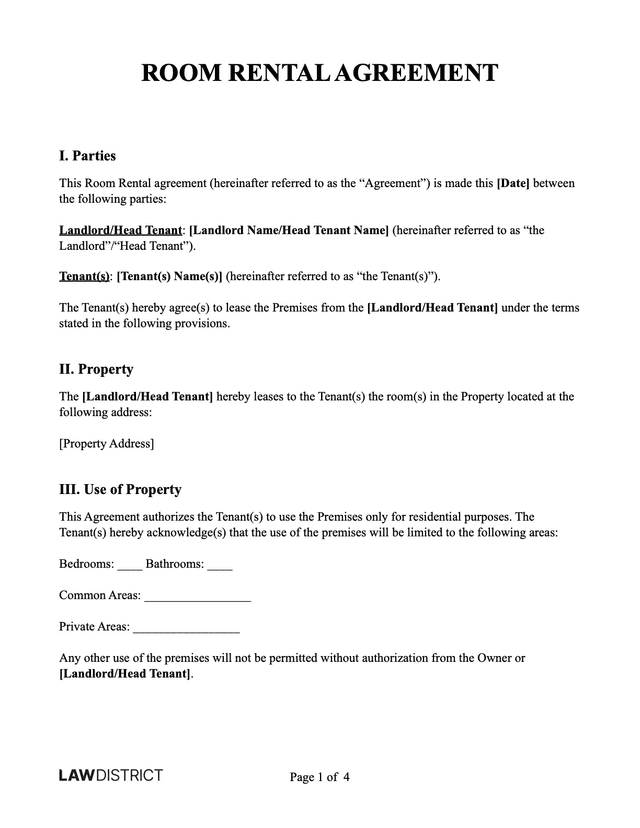
Room Rental Agreement Sample
We have included the following Room Rental Agreement sample for your reference. Use this example along with the Room Rental Agreement template to write your own document.
When To Use a Room Rental Agreement
Room Rental Agreements are mainly used when tenants want to sublease a room in the living unit they are renting. However, this form of agreement is also recommended for property owners and real estate managers seeking to lease a single room of a home to a tenant.
Generally, Room Rental Agreements are more flexible in terms of structure and less extensive than other real estate agreements.
They are also much less complex than a Residential Lease Agreement, where you need to take state laws into account to ensure legal validity. It is still important to consider relevant state and local laws about renting, but in many jurisdictions, those rules are not as strict when applied to leasing a single room.
Although Sublease Agreements should contain standard terms like the rent amount, their scope lies much more in defining expectations, rules, and responsibilities.
The agreement’s goal is to maintain a good tenant-subtenant relationship.
The following is a list of situations where you might find it useful to sign an agreement:
- Cleaning duties. Famous for being one of the main reasons for disagreement, this legal form helps define this type of responsibility upfront.
- Managing visitors. If one of the tenants has a rich social life or a close partner, this can rapidly become a touchy subject.
- Household chores. Watering plants, taking out the trash, and washing dishes are just a few examples of the tasks you can list in a Room Rental Agreement.
- Extra costs. Clarify in advance how unexpected repairs and fees will be divided.
- Sleeping hours. Another friction point that can lead to a serious conflict. Add it to your agreement and elude unpleasant conversations.
What To Include in a Room Rental Agreement
There’s no limit as to how specific you can be when drafting this type of document. However, a simple Room Rental Agreement form should contain the following basic elements:
- Parties: Names of the landlord/head tenant and tenant(s).
- Property details: Address and description of the rental property.
- Use of property: Authorized areas for private and shared use (e.g., bedrooms, common areas).
- Lease term: Start and end dates of the rental period, along with options for extension or termination.
- Specific rooms: Designation of rooms the tenant will occupy.
- Rent and payment terms: Rent amount, payment frequency (monthly or weekly), and acceptable payment methods.
- Late fees: Amount charged for late payments and applicable deadlines.
- Security deposit: Amount required, terms for deductions, and timeline for return after the agreement ends.
- Additional provisions: Any extra provisions specific to your situation.
- Utilities: Allocation of payment responsibilities for utilities and services.
- Furnishings: List of furniture and other items included in the lease.
- Governing law: Applicable state laws governing the agreement.
- Signatures and signing date: Signatures of all parties, with the agreement’s signing date.
Remember to declare the income from subleasing a room in your tax return.
You will be able to deduct any repairs you have to undertake in the room and common areas defined in the agreement.
How To Write a Room Rental Agreement
You’ll need to gather the necessary details to create a clear and legally binding Room Rental Agreement document.
Key elements to include in your Agreement are:
- Property address and room details
- Landlord and tenant(s) names
- Rental period, rent amount, and payment terms
- Use of private and shared areas
- Utilities and services allocation
- Furnishings provided
- Governing law
Conclude the agreement with signature lines for all parties and dates. Provide the tenant with a copy of the original lease, if applicable, and include required disclosures, such as lead-paint information for older properties.
Create your document using our free online customizable Room Rental Agreement template to guarantee you don’t leave out any significant details.
Difference Between Room Rental and Roommate Agreement
The main difference between a Roommate Agreement and a Room Rental Agreement is that the landlord does not need to be involved in the former. A Room Rental Agreement is also usually more formal and is easier to enforce if disputes arise.
However, there are more distinctions you should examine to stay away from trouble:
| Roommate Agreement | Room Rental Agreement |
|---|---|
| Landlord does not need to be informed | Permission from Landlord required |
| Includes no reference to original Rental Agreement | Incorporates elements of original Rental Agreement |
| Used for sharing a rental unit | Used for subleasing a room in a rental unit |
FAQs About Room Rental Agreements
It is essential that you fully understand Room Rental Agreements before you start drafting your own document.
We have prepared a list of answers to the most frequently asked questions to help you clarify any doubts you may have.
Sublease Agreements may cover more than one tenant. List every tenant separately and specify details like their names and agreement periods.
Depending on the size of the room and the amenities in it, tenants may be required to pay different amounts for utilities. Make sure you include this in your agreement, too. If different rooms in a home vary greatly, or if different terms apply to each tenant, it may be wise to use separate Room Rental Agreements for each applicable tenant.
It’s highly advisable to have a Room Rental Agreement whenever you rent out a room or sublease to another tenant, even though it may not be legally required. Having this agreement protects both parties by clearly outlining their rights and responsibilities.
For example, if a subtenant misses paying the rent or damages the premises, a Room Rental Agreement provides protection to the main tenant.
Or suppose that you are the subtenant and the tenant tries to charge you unexpected fees. A contract can help prevent such situations.
Without a Room Rental Agreement, misunderstandings or disputes can arise due to the lack of clearly defined terms. For example, a tenant may refuse to pay rent on time, or disagreements over maintenance and shared responsibilities could escalate.
In such cases, it becomes difficult to enforce any verbal agreements or protect your rights. A written agreement guarantees that both parties have a clear understanding of what’s expected of them. This reduces the risk of legal or financial conflicts.
Try Lawdistrict Now
Instant and complete access to our entire library of legal forms
Edit, download and print in PDF from any device
Save time and money on legal document creation