
Free Durable Power of Attorney Form
A Durable Power of Attorney (DPOA) form allows you to authorize someone to manage your financial, legal, or medical affairs, even if you become incapacitated. The designated person retains authority to act on your behalf as outlined in the document. Unlike a standard Power of Attorney, a DPOA remains in effect if you are unable to make decisions for yourself.

Which Power of Attorney would you like to create?
Fill forms in a few steps
Save, print & download
Done in 5 minutes
What Is a Durable Power of Attorney?
A Durable Power of Attorney form (DPOA) is a legal instrument that enables an individual to designate a trusted person to manage their financial affairs should they become incapable of doing so themselves.
This authority may be enacted under the following circumstances:
- Should you become physically disabled or incapacitated, inhibiting your ability to personally manage your assets.
- If you are legally declared incompetent, a situation that disqualifies you from managing your financial affairs.
- If you desire to appoint an agent to take the reins of your financial management, particularly in case you are incapacitated or deemed legally incompetent [1].
Entrusting someone with a Durable Power of Attorney form ensures peace of mind, knowing that your financial interests will be safeguarded and competently managed during unforeseen circumstances.
Other Names for a Durable Power of Attorney
Durable Power of Attorney, often shortened to DPOA, is also known as an Enduring Power of Attorney in some regions, or more descriptively, Power of Attorney with durable provisions.
Despite the variations in naming, the essential purpose and function of this legal document—providing lasting appointed authority—remains consistent.
Who Are the Key Parties Involved in this Agreement?
The Principal: The individual who is seeking to appoint a power of attorney [2].
The Agent: An Agent, also known as the Attorney in Fact, takes control of the Principal’s financial affairs. Additional Co-Agents can be appointed by the Principal in a DPOA.
When to Use a Durable POA
A Durable Power of Attorney form (DPOA) serves as a safety net, providing a legal solution to a range of situations where you may be unable to manage your financial affairs. It is particularly advisable to use a DPOA in the following scenarios:
- Planning for potential incapacitation: If you have any health conditions that might potentially render you unable to manage your finances or if you want to proactively prepare for unforeseen circumstances.
- Legal incompetence: In cases where there's a risk you could be legally declared incompetent due to mental health concerns or cognitive decline.
- Age-related considerations: As you age, it becomes increasingly crucial to have arrangements in place to handle your finances, especially if cognitive decline becomes a concern.
- Frequent or risky travel: If you travel frequently or engage in risky activities that could lead to incapacitation, a DPOA can ensure your finances are managed.
- Complex financial management: If your financial affairs require expert handling, such as managing large investments or running a business, appointing a trusted individual with a Durable Power of Attorney for finance can be a prudent step.
In essence, a Durable POA is an essential instrument in any comprehensive financial planning or estate planning strategy. It provides a means to ensure your financial matters will be aptly handled, regardless of the circumstances that might arise.
Durable Power of Attorney for Financial Matter
Creating a Durable Power of Attorney for finances can give Agents different powers related to your financial affairs. These include the handling of:
- Real estate
- Personal property
- Banking
- Taxes
- Government benefits
- Retirement transactions
- Buying and selling stocks and bonds
There are additionally many other financial management provisions that are permitted within a DPOA form. You can choose which of these will apply when you create and put this kind of legal instrument into effect.
When building a POA document, you can also set limits on what the Agent can and cannot do [3].
For example, you can limit the actions an appointed Agent can take regarding changes to your will, selling property and personal assets. It can also stipulate the revocation of Power of Attorney if the agent breaches the agreements of the DPOA or if they can no longer perform their duties.
On a related note, the Uniform Power of Attorney Act (UPOAA) is a standardized approach to laws on power of attorney intended to simplify these complex legal documents.
As of now, the UPOAA has been adopted in 31 states, offering a statutory form to streamline the process and make it more consistent across these jurisdictions.
This approach can provide additional clarity and uniformity when establishing a Durable Power of Attorney for finances.
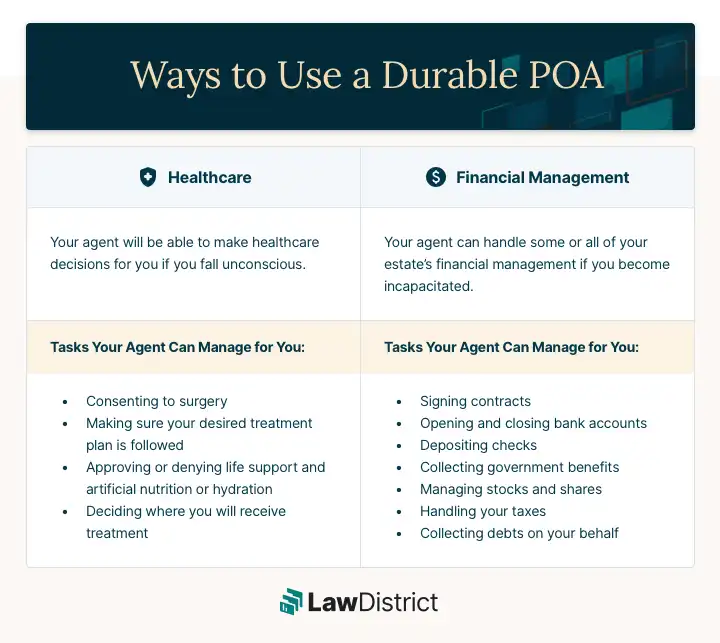
Specific Financial Powers an Agent Can Be Granted
You can authorize your Agent to handle specific financial management tasks on your behalf, such as:
- Managing bank and investment accounts
- Paying bills and other expenses
- Buying, selling, or managing real estate
- Filing and paying taxes
- Managing retirement accounts and benefits
- Collecting debts or income owed to you
- Handling insurance and government benefits
- Buying or selling stocks, bonds, and other investments
- Managing business or personal property
- Signing financial documents on your behalf
The exact powers your agent will have depend on the terms of your DPOA and the specific laws of your state.
DPOA Statute Laws by State
This section provides a comprehensive overview of the varying statute laws concerning Durable Power of Attorney across different states in the U.S.:
Durable Power of Attorney Sample
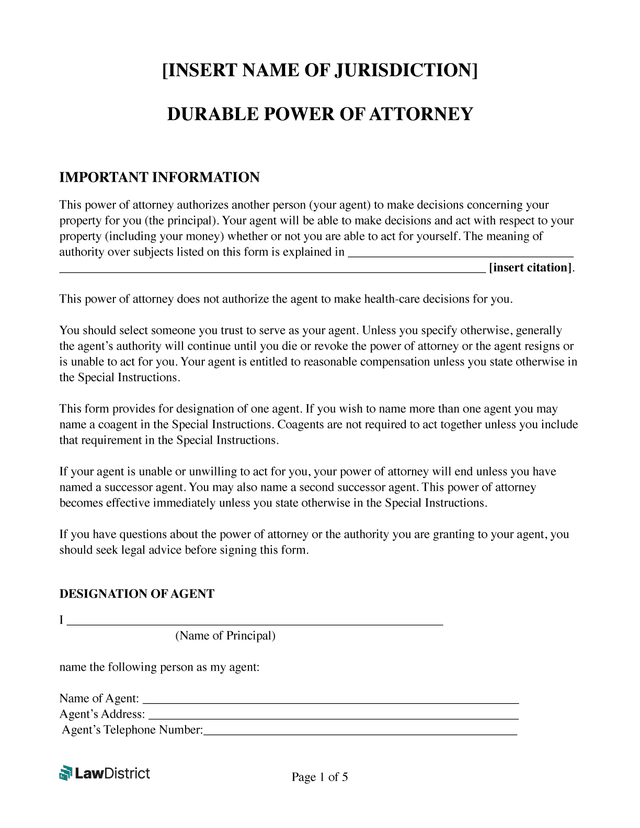
Before setting out to draft any legal material, it's beneficial to inspect a model document. This approach ensures you have a grasp of the appropriate structure of a Durable Power f Attorney, effectively preventing critical errors that could result in legal disputes.
How To Write a Durable Power of Attorney Form
There are a few considerations that you should keep in mind before appointing a Power of Attorney.
Before starting a Durable POA document, individuals are advised to read and understand the following steps:
Important Information Regarding Your Jurisdiction’s Laws or Regulations
This section outlines the function of the document and responsibilities of the agent. Read this thoroughly to understand the implications of the document.
Fill in the required citation (referencing your jurisdiction's laws or regulations) to clarify the scope of the agent's authority.
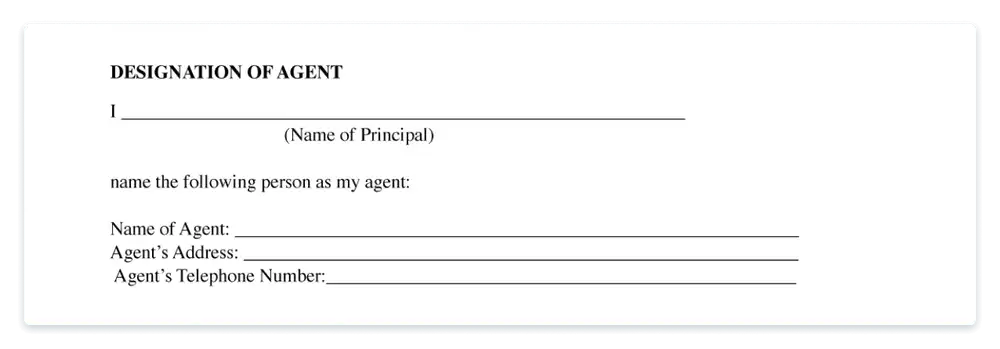
Designation of Agent
After inputting your name, you need to identify who will hold the authority to make decisions on your behalf. This person should be dependable and capable of making decisions aligned with your best interests. Remember, the person you select will have considerable power and control over your affairs[4].
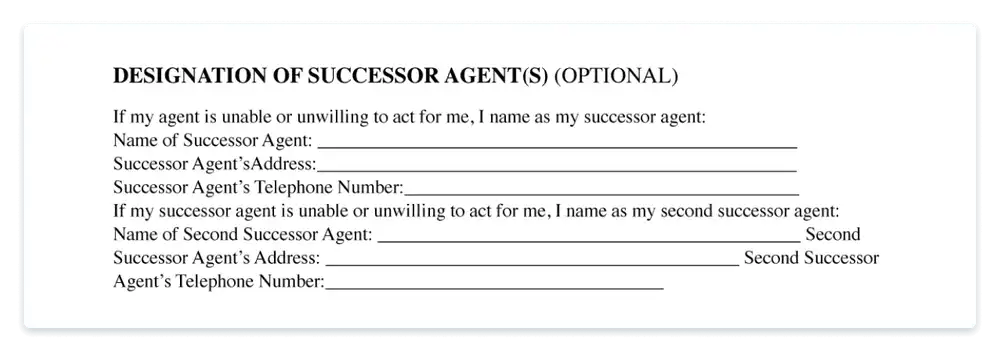
Designation of Successor Agent (optional)
Designating a successor is an optional contingency plan in case your initial agent cannot fulfill their duties.
This role, like the initial agent, requires a responsible individual. Choosing more than one alternate agent can provide additional assurance that someone will be available to act on your behalf.
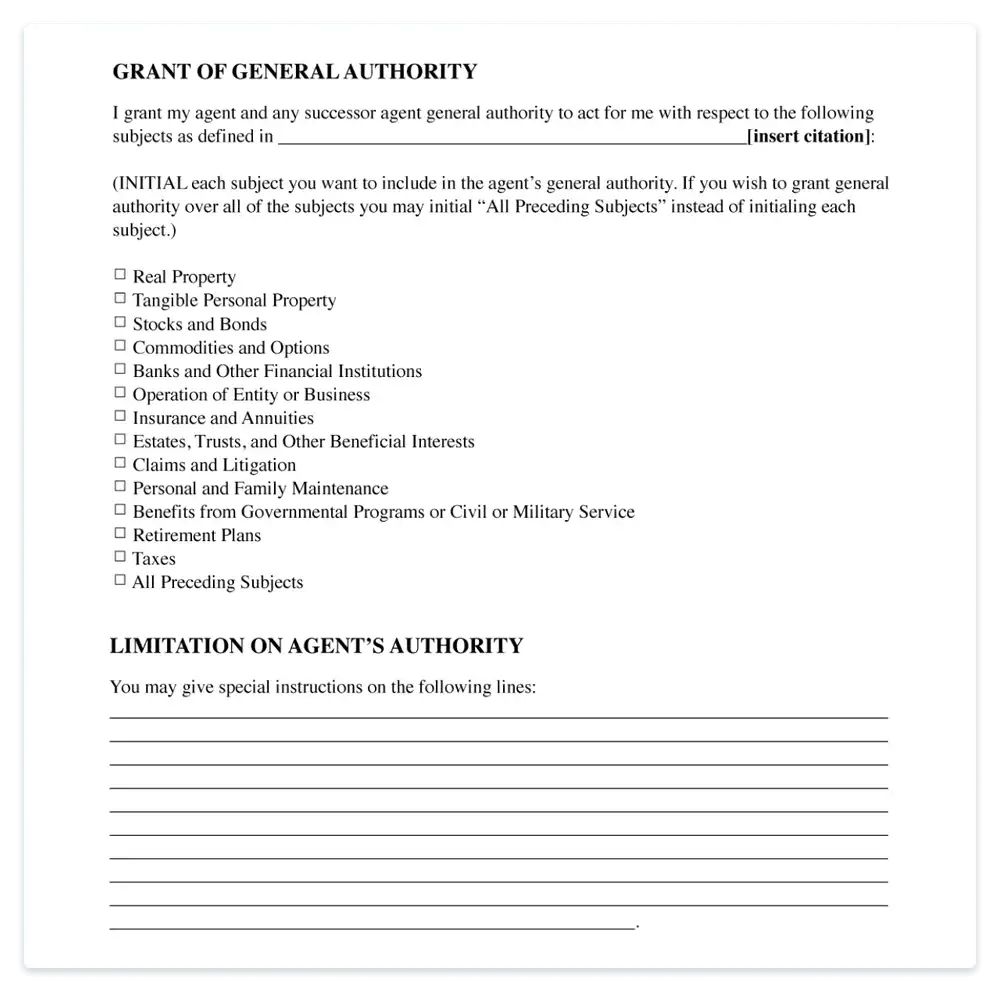
Grant of General Authority
In this section, you're customizing the scope of the agent's powers. By initialing the different categories, you determine which areas your agent can act within.
Be cautious and conscious of what each category implies, to avoid granting unwanted authority.
Grant of Specific Authority
If you choose to grant specific authority, your agent will be able to perform certain actions that can significantly impact your estate.
Each item in this section is a significant action that can affect your property or its disposition upon your death. Only grant these powers if you fully trust your agent's judgment.
To point out the relevance of this section, be aware that these specific authorities may include:
- Create or change rights of survivorship
- Create or change a beneficiary designation
- Authorize another person to exercise the authority granted under this power of attorney
- Exercise fiduciary powers that the principal has authority to delegate
- Access the content of electronic communications
Limitation on Agent's Authority
This section provides a chance to further refine your agent's powers.
You might think of it as a space for customization or clarifications, enabling you to add any nuanced details regarding the agent's role that were not covered in previous sections.
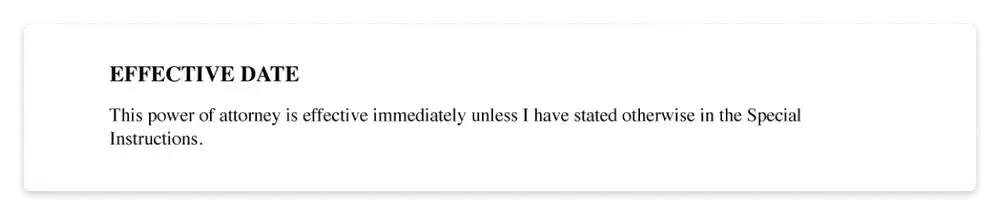
Effective Date
Unless you stipulate otherwise, the power of attorney will come into effect as soon as it's signed and notarized.
However, you have the option to specify conditions for its activation, such as a medical determination of incapacity.
Reliance on This Power of Attorney
This reassures third parties (banks, financial institutions, etc.) that they can rely on the decisions made by your agent.
If you become incapacitated, the document remains valid, providing necessary continuity.
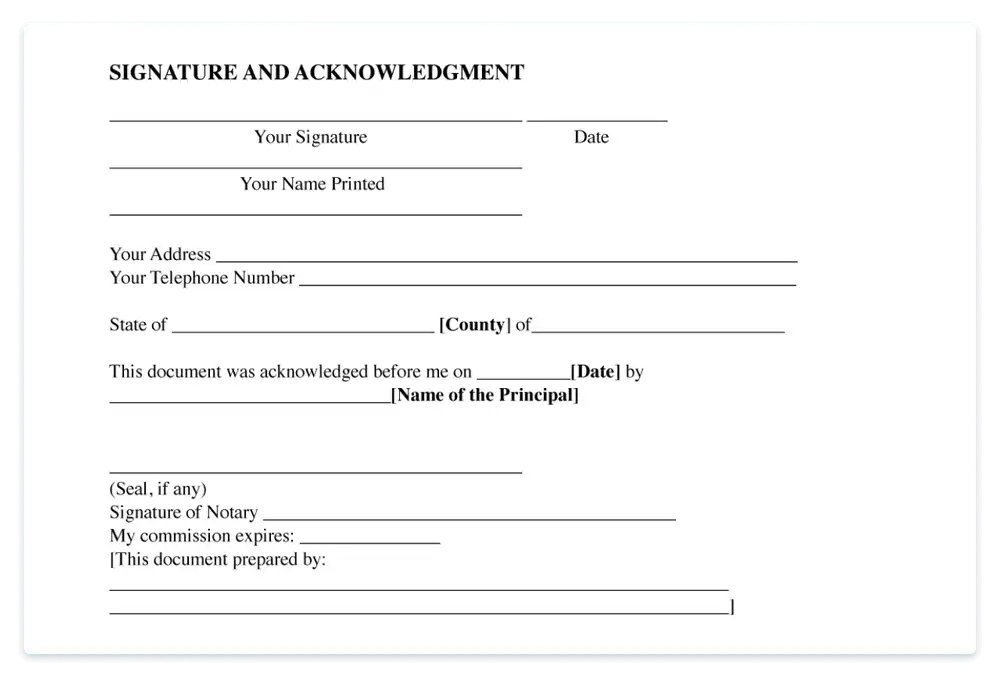
Signature and Acknowledgment
Here, you officially sign the document, indicating your approval of all the details within.
A notary's presence is often required to authenticate the document, providing an additional level of security and validity.
Important Information for Agent
This final part of the document details the responsibilities and legal obligations of the agent.
It's not only for your agent to read but also for you to understand what expectations and responsibilities your agent is bound by law to meet.
DPOA Signing Requirements
For a Durable Power of Attorney to be legally binding, the Principal's signature must be carried out in compliance with the specific regulations stipulated by state law.
| State | Signing Requirements & Laws |
|---|---|
| Alabama | Notary Public ( § 26-1A-105 ) |
| Alaska | Notary Public ( § 13.26.600 ) |
| Arizona | 1 Witness and Notary Public ( § 14-5501 ) |
| Arkansas | Notary Public ( § 28-68-105 ) |
| California | 2 Witnesses or Notary Public ( § 4402(c) ) |
| Colorado | Notary Public ( § 15-14-705 ) |
| Connecticut | 2 Witnesses and Notary Public ( § 1-350d ) |
| Delaware | 1 Witness and Notary Public ( § 49A-105 ) |
| Florida | 2 Witnesses and Notary Public ( § 709.2105 ) |
| Georgia | 1 Witness and Notary Public ( § 10-6B-5 ) |
| Hawaii | Notary Public ( § 551E-3 ) |
| Idaho | Notary Public ( § 15-12-105 ) |
| Illinois | 1 Witness and Notary Public ( § 755 ILCS 45/3-3 ) |
| Indiana | 2 Witnesses or Notary Public ( IC 30-5-4-1 ) |
| Iowa | Notary Public ( § 633B.105 ) |
| Kansas | Notary Public ( § 58-652(3) ) |
| Kentucky | Notary Public ( § 457.050 ) |
| Louisiana | No Statute |
| Maine | Notary Public ( § 5-905(1) ) |
| Maryland | 2 Witnesses and Notary Public ( § 17–110 ) |
| Massachusetts | 2 Witnesses ( § 5-103 ) |
| Michigan | 2 Witnesses or Notary Public ( § 700-5501(2) ) |
| Minnesota | Notary Public ( § 523.01 ) |
| Mississippi | Notary Public ( § 87-3-105 ) |
| Missouri | Notary Public ( § 404.705(3) ) |
| Montana | Notary Public ( § 72-31-305 ) |
| Nebraska | Notary Public ( § 30-4005 ) |
| Nevada | Notary Public ( § 162A.220(1) ) |
| New Hampshire | Notary Public ( § 564-E:105 ) |
| New Jersey | Notary Public ( § 46:2B-8.9 ) |
| New Mexico | Notary Public ( § 45-5B-105 ) |
| New York | 2 Witnesses and Notary Public ( § 5-1501B ) |
| North Carolina | Notary Public ( § 32C-1-105 ) |
| North Dakota | No Statute |
| Ohio | Notary Public ( § 1337.25 ) |
| Oklahoma | Notary Public ( § 3005 ) |
| Oregon | No Statute |
| Pennsylvania | 2 Witnesses and Notary Public ( § 5601(b)(3) ) |
| Rhode Island | Notary Public ( § 18-16-2 ) |
| South Carolina | 2 Witnesses and Notary Public ( § 62-8-105 ) |
| South Dakota | Notary Public ( § 59-12-4 ) |
| Tennessee | No Statute |
| Texas | Notary Public ( § 751.0021 ) |
| Utah | Notary Public ( § 75-9-105 ) |
| Vermont | 1 Witness and Notary Public ( § 3503 ) |
| Virginia | Notary Public ( § 64.2-1603 ) |
| Washington | 2 Witnesses or Notary Public ( § 11.125.050 ) |
| West Virginia | Notary Public ( § 39B-1-105 ) |
| Wisconsin | Notary Public ( § 244.05 ) |
| Wyoming | Notary Public ( § 3-9-105 ) |
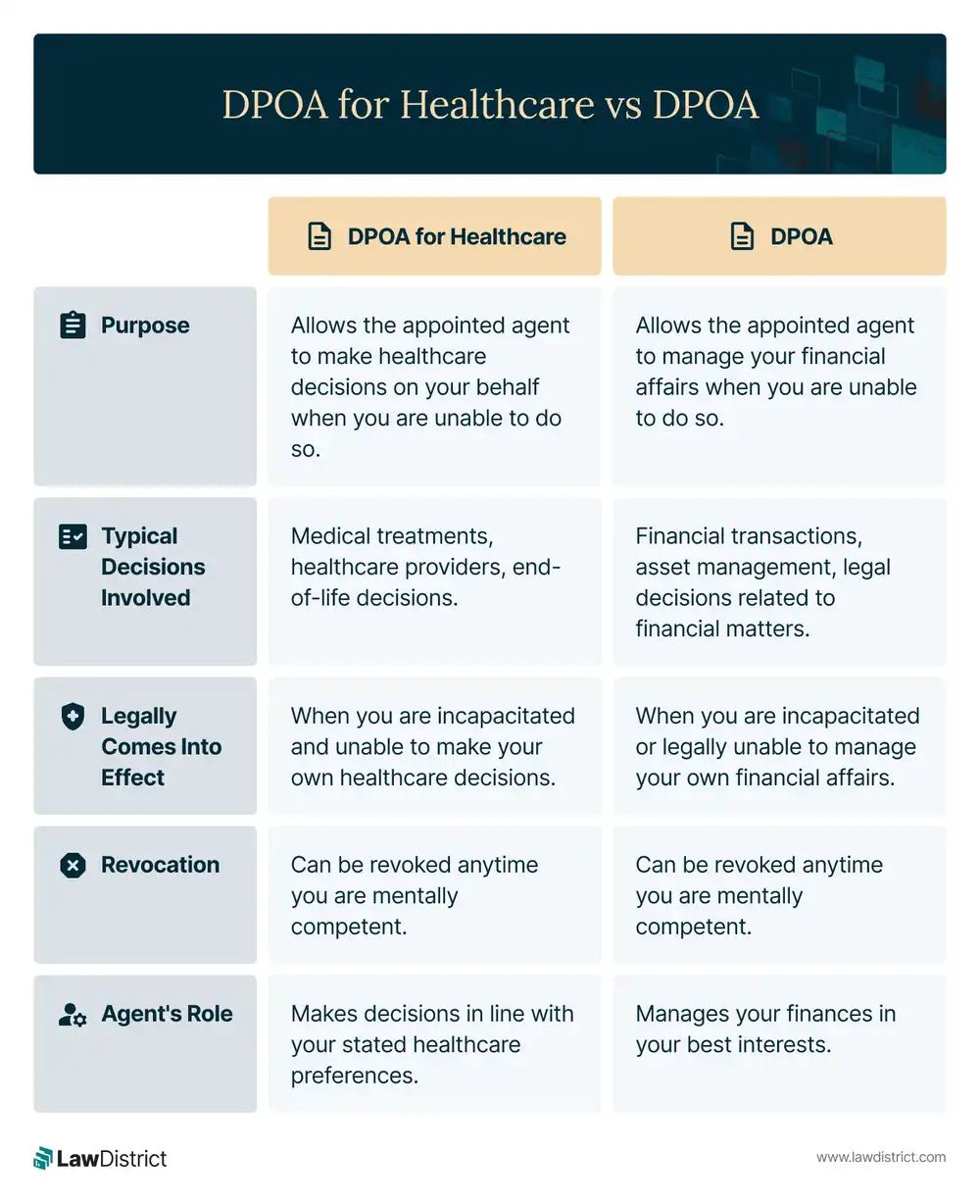
DPOA for Healthcare vs DPOA
A Durable Power of Attorney for Healthcare is an alternative POA document that gives the Agent instructions on how to attend to the Principal’s healthcare needs.
This is different from a regular Durable POA, which only grants powers to manage the financial affairs of the individual appointing an Attorney-in-Fact.
A Durable POA for Healthcare has some similarities to and works in conjunction with an Advance Directive or Living Will, as it gives details regarding your desires for medical treatment if you are unconscious or incapacitated.
However, the key difference with a DPOA for Healthcare is that it empowers the Agent to make medical decisions for you. It allows the Agent(s) or Attorney-in-Fact to act for you if you are incapacitated due to injury, disability, declining health, advanced age, or mental health reasons.
For a better understanding, examine the following simplified comparison table illustrating the differences between a Durable Power of Attorney (DPOA) for Healthcare and a general DPOA:
Durable Power of Attorney FAQs
If you’re still unsure if a Durable Power of Attorney is right for your situation, read below for answers to the most asked questions about this type of legal form.
A Durable Power of Attorney means that an individual (the Principal) has legally appointed one or more persons (or Agents) to manage some or all their financial affairs.
This grants the appointee the authority to act on the Principal's behalf before and/or at any time they become physically or mentally incapacitated, including decisions about their well-being, personal finances, and asset management.
These powers can be specially tailored to an individual’s necessities, depending on their circumstances.
Simply follow these steps to complete a Durable Power of Attorney document:
- Select Create Document at the top of this page
- Enter your name and the name of the person you have chosen as your Agent
- Specify when the POA will come into effect
- Choose the powers you wish to grant the Agent
- Download and print off your completed forms
- Sign and date the documents (you may require a notary and witnesses)
The key difference between a General Power of Attorney and a Durable Power of Attorney is that a General POA ends as soon as you become incapacitated or die.
However, a Durable POA continues to be valid even if you become incapacitated. It remains in force until its revocation, the appointment of a different Attorney-in-Fact, or your death.
Unless you have specified otherwise, a Durable Power of Attorney can last until your death.
While, your appointed Agent may manage your funeral plans and financial affairs before you have died, they cannot take on these responsibilities after your death.
However, as the Principal of this kind of legal instrument, you can revoke the POA at any time and/or specify an end date to your Agent’s authority within your document.
Preview of your Durable Power of Attorney
Notice to Person Executing Durable Power of Attorney
Your agent (attorney-in-fact) has no duty to act unless you and your agent agree otherwise in writing. This document gives your agent the powers to manage, dispose of, sell, and convey your real and personal property, and to use your property as security if your agent borrows money on your behalf. This document does not give your agent the power to accept or receive any of your property, in trust or otherwise, as a gift, unless you specifically authorize the agent to accept or receive a gift.
Your agent will have the right to receive reasonable payment for services provided under this durable power of attorney unless you provide otherwise in this power of attorney.
The powers you give your agent will continue to exist for your entire lifetime, unless you state that the durable power of attorney will last for a shorter period of time or unless you otherwise terminate the durable power of attorney. The powers you give your agent in this durable power of attorney will continue to exist even if you can no longer make your own decisions respecting the management of your property.
You can amend or change this durable power of attorney only by executing a new durable power of attorney or by executing an amendment through the same formalities as an original. You have the right to revoke or terminate this durable power of attorney at any time, so long as you are competent.
This durable power of attorney must be dated and must be acknowledged before a notary public or attested to by 2 witnesses. A durable power of attorney that may affect real property should be acknowledged before a notary public so that it may easily be recorded.
You should read this durable power of attorney carefully. When effective, this durable power of attorney will give your agent the right to deal with property that you now have or might acquire in the future. The durable power of attorney is important to you. If you do not understand the durable power of attorney, or any provision of it, then you should obtain the assistance of an attorney or other qualified person.
NOTICE: THE POWERS GRANTED BY THIS DOCUMENT ARE BROAD AND SWEEPING. THEY ARE EXPLAINED IN THE UNIFORM STATUTORY FORM POWER OF ATTORNEY ACT (CALIFORNIA PROBATE CODE SECTIONS 4400-4465). IF YOU HAVE ANY QUESTIONS ABOUT THESE POWERS, OBTAIN COMPETENT LEGAL ADVICE. THIS DOCUMENT DOES NOT AUTHORIZE ANYONE TO MAKE MEDICAL AND OTHER HEALTHCARE DECISIONS FOR YOU. YOU MAY REVOKE THIS POWER OF ATTORNEY IF YOU LATER WISH TO DO SO.
All acts done by the Agent pursuant to a durable power of attorney during the principal´s incapacity have the same effect, power, authority and inure to the benefit of and bind the principal and the principal´s successors in interest as if the principal had capacity. This power shall authorize my Agent to manage my affairs and to exercise all of my legal rights, including rights and powers acquired in the future. My Agent's authorized, but not limited to, exercise the power to:
- Tangible personal property
- Stocks and bonds
- Commodity and options
- Bank and other financial institutions
- Operation of entity or business
- Estates, trusts, and other beneficial interests
- Insurance and annuity transactions
- Claims and litigation
- Personal and family maintenance
- Benefits from governmental programs or civil or military service
- Retirement plans
- Taxes
Any power or authority granted to my Agent under this document shall be limited to the extent necessary to prevent this Power of Attorney from causing, (i) my income to be taxable to my Agent, (ii) my assets to be subject to a general power of appointment by my Agent, or (iii) my Agent to have any incidents of ownership with respect to any life insurance policies that I may own on the life of my Agent.
This Power of Attorney shall be governed by the laws of the state of California. Moreover, I intend to have this Power of Attorney universally recognized and be admissible to recordation. In case that I become a resident of another jurisdiction, or obtain any form of property interest in another jurisdiction, it remains my intention that the laws of California shall continue to govern over this Power of Attorney to the extent that might be legally possible.
__________________________________
_________
Witness Signature: ___________________________________
Name: _________
City: _________
State: _________
Witness Signature: ___________________________________
Name: _________
City: _________
State: _________
A notary public or other officer completing this certificate verifies only the identity of the individual(s) who signed the document to which this certificate is attached, and not the truthfulness, accuracy, or validity of that document.
STATE OF _________,
COUNTY OF _________, ss:
On ________________ before me, _________________________________, personally appeared _________, who proved to me on the basis of satisfactory evidence to be the person(s) whose name(s) is/are subscribed to the within instrument and acknowledged to me that he/she/they executed the same in his/her/their authorized capacity(ies), and that by his/her/their signature(s) on the instrument the person(s), or the entity upon behalf of which the person(s) acted, executed the instrument.
I certify under PENALTY OF PERJURY under the laws of the State of California that the foregoing paragraph is true and correct.
WITNESS my hand and official seal.
| ________________________________ | (Notary Seal) |
| Signature of Notary Public |
By acting or agreeing to act as the agent (attorney-in-fact) under this power of attorney you assume the fiduciary and other legal responsibilities of an agent. These responsibilities include:
1. The legal duty to act solely in the interest of the principal and to avoid conflicts of interest.
2. The legal duty to keep the principal's property separate and distinct from any other property owned or controlled by you.
You may not transfer the principals property to yourself without full and adequate consideration or accept a gift of the principals property unless this power of attorney specifically authorizes you to transfer property to yourself or accept a gift of the principal's property. If you transfer the principals property to yourself without specific authorization in the power of attorney, you may be prosecuted for fraud and/or embezzlement. If the principal is 65 years of age or older at the time that the property is transferred to you without authority, you may also be prosecuted for elder abuse under Penal Code Section 368. In addition to criminal prosecution, you may also be sued in civil court.
I have read the foregoing notice and I understand the legal and fiduciary duties that I assume by acting or agreeing to act as the agent (attorney-in-fact) under the terms of this power of attorney.
Date:
Signed:
_________________________________
_________
Try Lawdistrict Now
Instant and complete access to our entire library of legal forms
Edit, download and print in PDF from any device
Save time and money on legal document creation