
Free Demand Letter Template
Draft your own Demand Letter effortlessly with our user-friendly examples and printable templates. Our sample document streamlines the process for you.

Select the reason for writing this letter:
Fill forms in a few steps
Save, print & download
Done in 5 minutes
What Is a Demand Letter?
A Demand Letter is a legal form that serves as a final notice for resolving a matter, typically a dA Demand Letter is a formal written communication sent to notify a party of a dispute or claim and to request specific action or remedy.
It outlines the grounds for the claim and the sender's demands for resolution, including timing. While often used as a final notice before legal action or initiating formal arbitration proceedings, it may also serve as an initial formal communication in dispute resolution to be settled directly among the parties.
Sending a Demand Letter highlights the seriousness of the situation by setting a deadline for response or action and may notify the recipient of potential legal consequences if the matter is not resolved in a timely manner.
Other names for a Demand Letter include:
- Debt collection letter
- Letter of demand (LOD)
- Payment demand letter
- Final Demand For Payment
When to Use a Demand Letter
A Demand Letter is a formal tool typically used to pursue payment or action when someone owes you money or to demand performance of a contractual obligation that is unsatisfied.
However, it is essential to consider each situation's unique circumstances and approach them accordingly, including consulting with legal counsel to ensure compliance with applicable laws and regulations.
A legal Demand Letter will typically be recommended when:
- Payment, service or delivery has not been received within the agreed-upon time frame.
- You have contacted the company about the situation, and they have indicated they will remedy it, but haven't done so in a reasonable amount of time or in the time they have promised.
- You have been charged for a service or product that was not provided or delivered or that was not to your reasonable satisfaction.
- A company has refused to credit your account, and you believe credit is warranted.ebt, before the sender takes legal action against the recipient. It outlines the grounds for the debt and debt recovery strategies.
Sending a Demand Letter highlights the seriousness of the situation by imposing a strict deadline and notifying the recipient of the sender's intent to sue.
Other names for a Demand Letter include:
- Debt collection letter
- Letter of demand (LOD)
- Payment demand letter
- Final Demand For Payment
When to Use a Demand Letter
A Demand Letter is a tool typically used to pursue payment when someone owes you money. However, it is essential to consider each situation's unique circumstances and approach them accordingly.
A legal Demand Letter will typically be recommended when:
- payment has not been received within the agreed-upon time frame
- You have contacted the company about the situation, and they have indicated they will remedy it but haven't done so in a reasonable amount of time
- You have been charged for a service or product that was not provided or delivered
- A company has refused to credit your account, and you believe credit is warranted
How To Write a Demand Letter
To be effective, a Demand Letter should be carefully drafted with specific factual allegations and a clear statement of the relief sought.
If litigation ensues, the demand letter may be admissible as evidence (subject to applicable rules of evidence and any settlement negotiation privileges) to demonstrate good faith efforts to resolve the dispute, establish the basis for claims, or prove damages.
However, statements made in settlement negotiations may be protected from admission under applicable rules of evidence. Consult with an attorney regarding the evidentiary implications of your demand letter.
Complete these steps to draft an effective Demand Letter:
- Begin with an introduction. Clearly state the reason for writing the letter, whether it's to demand payment, action, or an insurance claim.
- Present the issue in detail. Describe the situation by providing as much information as possible, such as the amount owed, date the amount was owed, a description of the action required to rectify the matter, damages, etc.
- Attach supporting evidence. Attach relevant documentation that supports your demand, such as contracts, receipts, or photographs.
- State the terms of your settlement (optional). For example, if you're collecting a debt, you may accept a settlement for less than the full amount or settle for installment payments.
- Provide contact information. Include the names and contact information of both the sender and recipient in the letter.
- Preserve all rights and claims. Add a statement that you reserve the right to make additional future claims if this is not rectified. Here is an example of language that you should have reviewed by your lawyer:
Remember to keep the tone polite and professional, as the letter may be used in legal proceedings or arbitration meetings.
Also, remember to be as factual as possible, avoiding statements of how it has made you feel or emotional characterizations that could undermine the credibility of your claim.
The more factual and concise your demand letter, the more effective it is, especially if the matter escalates to legal proceedings.
Use Lawdistrict’s Demand Letter template to assist in the drafting process. However, please note that this template is for informational purposes only and does not constitute legal advice.
Demand Letter for Payment Example
Demand Letters for payment are one of the most common types of demand forms. They are typically the last notice sent to a debtor regarding an outstanding payment, asking them to make amends by paying the due balance.
Examine the following example to create yours:
From: [Your Name]
Address: [Your Address]
To: [Recipient’s Name]
Address:[Recipient’s Address]
[Date]
Dear [Name],
Through this letter, I hereby demand that you pay the amount of $[Debt amount] for the Debts related to:
[Cause of debt] before the [Due Date].
If you ignore this notice, I inform you that we will initiate all the legal procedures in accordance with state and
federal law to collect the amount owed.
Please be advised that this letter constitutes official notice of demand and may be used as evidence in court proceedings if you fail to pay. If this
happens, you will also be responsible for any court costs and fees.
I hope we can solve this problem in the simplest possible way for both of us.
Sincerely,
[Signature]
[Your name]
How To Send a Demand Letter
While Demand Letters can be delivered by various methods, including personally or by mail, sending one via email or text message may not provide adequate proof of delivery or receipt, which could be important if litigation follows.
The formality and delivery method should be appropriate to the nature and amount of the claim.
These are the most legally secure methods to deliver a Demand Letter:
- Hiring a lawyer to deliver it on your behalf.
- Sending it by registered mail.
- Delivering it in person and obtaining an Affidavit of Service.
Please note that in some jurisdictions and for certain types of claims, sending a demand letter before filing a lawsuit may be required by statute, court rule, or contract. For example, some states require pre-suit notice for construction defect claims, medical malpractice claims, or claims against governmental entities.
Additionally, many contracts contain notice and cure provisions requiring written notice before filing suit. Failure to comply with applicable notice requirements may result in dismissal of your lawsuit or waiver of certain claims. Always consult with an attorney licensed in the applicable jurisdiction to determine the specific requirements for your situation.
Why Send a Demand Letter
There are some benefits that come from sending a Demand Letter before filing a lawsuit, such as:
- Indicating your good faith in trying to resolve the issue.
- Demonstrating you are serious about solving the issue.
- Saving you time and money by facilitating a speedy resolution.
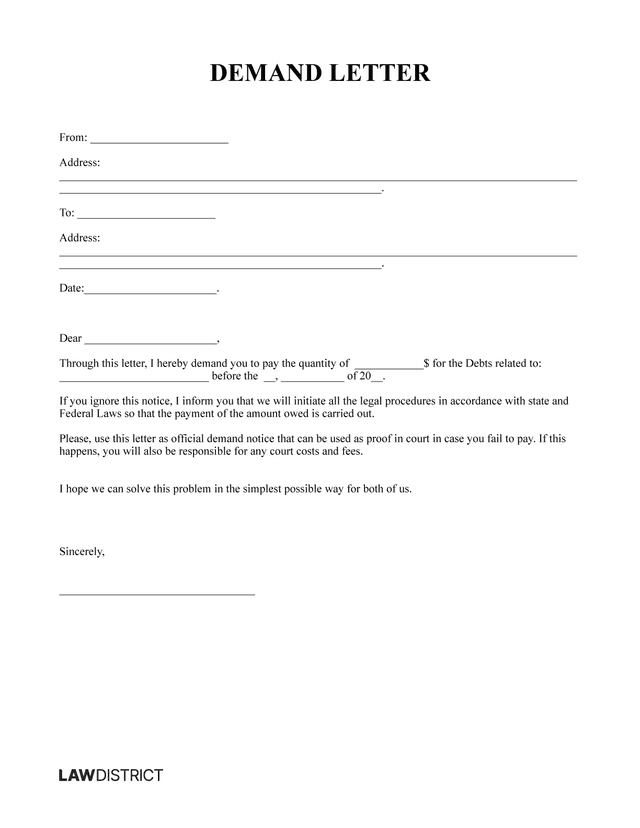
Sample Demand Letter
Before drafting your own Demand Letter, it's advisable to examine a sample as a reference.
Take a look at this Demand Letter example below before starting your own:
FAQs About Letter of Demand
It is essential to have a comprehensive understanding of Demand Letters before beginning to draft your own document.
To assist you in clearing up any doubts you may have, we have compiled a list of frequently asked questions with the corresponding answers.
Sending a demand letter through an attorney can prove to be a useful method for settling various disputes.
However, the cost will depend on the complexity of your case, the attorney's experience and hourly rate, and the amount of work required.
For example, in New York, attorney fees for drafting a demand letter typically range from $500 to $2,000 or more. Our Demand Letter template can be used as a starting point, but should be reviewed and customized by an attorney to ensure it is appropriate for your specific circumstances.
A Demand Letter specifies a reasonable deadline by which the recipient must respond. If the deadline passes and the recipient fails to respond or refuses to accept the conditions outlined in your letter, you may consider taking legal action by filing a lawsuit.
However, you should consult with an attorney before proceeding to evaluate the strength of your case and explore alternative dispute resolution options.
Ensure you include a copy of the original letter to substantiate your claim.
There are multiple options to create a Demand Letter online.
We recommend you use Lawdistrict's free Demand Letter template as a starting point for drafting your demand letter.
However, it is strongly recommended that you have it reviewed by a qualified attorney licensed to practice in the applicable jurisdictions to ensure it meets all legal requirements, is appropriate for your specific circumstances, and complies with applicable laws and court rules.
Try Lawdistrict Now
Instant and complete access to our entire library of legal forms
Edit, download and print in PDF from any device
Save time and money on legal document creation