
Free Catering Contract Template

A Catering Contract is a formal agreement between a caterer and a client that clearly defines the terms of catering services. It covers details such as the menu, payment terms, staffing, liabilities, and cancellation policies. This document is important for preventing misunderstandings and making sure your event is successful.

Trusted by 2,587 users.

update icon

Last Update February 6th, 2026

Fill forms in a few steps

Fill forms in a few steps

Save, print & download

Save, print & download

Done in 5 minutes

Done in 5 minutes

What Is a Catering Contract?

Catering contracts are used by caterers and their clients to document their agreements and engagements. This document includes all the terms and conditions of the catering services that will be provided.

It is a legal agreement that specifies the types of food and refreshments that will be provided by a caterer for a specific date or period of time.

When drafted correctly, a Catering Contract is crucial in ensuring that an event runs smoothly and that there are no disagreements or misunderstandings between the two parties.

Types of Catering Services

Not all catering is the same. Depending on the type of event being organized by the client, they will need to hire different types of catering services. Some of the most common types are outlined below:

  • Corporate catering: Food and beverage service for business events like luncheons, dinners, conferences, and product launches.
  • Wedding catering: Catering for weddings often involves helping with decor, food presentation, and table arrangements, as well as taking into account the wedding themes—in addition to serving food and drinks.
  • Social event gathering: Provision of food and drinks for more events such as parties, hors d’oeuvres, buffets, outdoor BBQs, and brunches.
  • Concession catering: Catering for major occasions, such as sporting competitions, live concerts, and large conferences.
  • Food truck catering: Mobile catering offering diverse cuisine at events, festivals, and private gatherings.
  • In-house catering: Catering provided by a venue, such as a hotel, as part of an event rental package.
  • Social event gathering: Provision of food and drinks for more events such as parties, hors d’oeuvres, buffets, outdoor BBQs, and brunches.
  • Concession catering: Catering for major occasions, such as sporting competitions, live concerts, and large conferences.

Catering Contract Sample

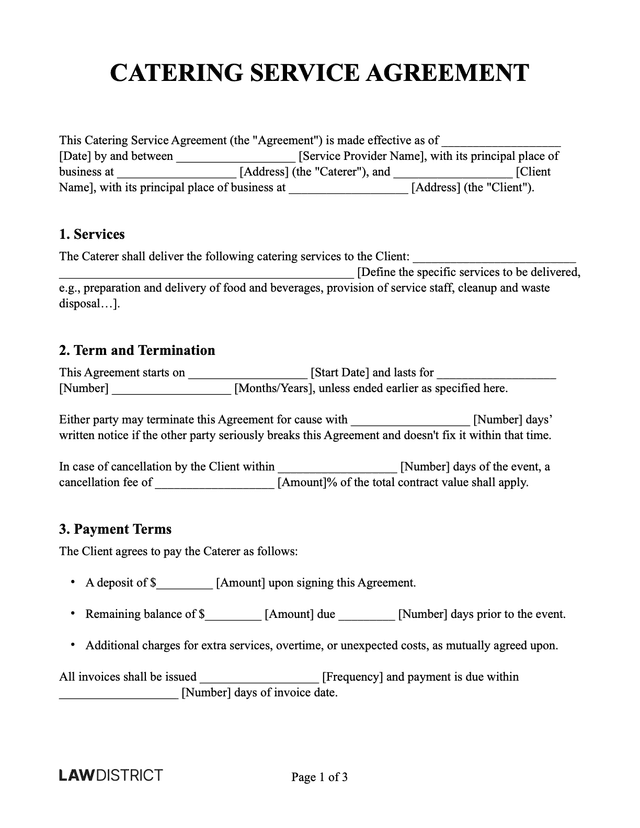
We recommend looking at a 100% verified sample catering contract before starting your own.

Use our example below to get a feel for the points to cover and details to include in your own customized agreement.
view preview icon
Catering Contract Template

What To Include in a Catering Contract

Looking to hire a caterer for an event? Then you need to make sure you have a rock-solid Catering Contract so that your event runs successfully.

Your contract should include all the necessary details so that both parties are clear on their responsibilities and everything works out smoothly.

After including the name and contact information of both parties, you should define the food and drink services that will be provided at the event:

  • Menu and food to be served
  • Food substitutions and alternates
  • Type of food service provided
  • Leftover food and beverages
  • Any additional items and services that need to be supplied

In addition to discussing the food and drink, your Catering Contract should also include the following elements:

  • Fees and payment schedule
  • Staffing requirements
  • Insurance and liabilities
  • Health and safety requirements
  • Cancellation policy
  • Breach of contract terms

How To Write a Catering Contract

Creating a contract is an essential part of any successful catering project.

However, a Catering Contract needs various key details in order to be legally binding and to make sure it holds up in court. Having all the necessary information also helps avoid future misunderstandings and conflicts.

Below is a list of what is typically included:

  1. Identify the parties – Clearly state the names and contact information of the caterer and the client.
  2. Define the event details – Include the event date, time, location, and expected guest count.
  3. Outline the menu and services – Specify the food and beverages to be served, service style (buffet, plated, etc.), and any additional services like table settings or decor.
  4. Set pricing and payment terms – Detail the total cost, deposit requirements, installment payments (if any), and final payment deadline.
  5. Specify staffing requirements – Indicate the number of servers, bartenders, or other staff needed and who is responsible for hiring them.
  6. Include liability and insurance information – Define who is liable for damages, injuries, or food-related health issues, and whether insurance coverage is required.
  7. Establish health and safety protocols – Make sure you comply with local health regulations, food handling standards, and venue policies.
  8. Add a cancellation policy – Clearly state the terms for cancellations, refunds, and any penalties for last-minute changes.
  9. Address leftover food and waste disposal – Specify whether leftovers will be packaged for the client or disposed of by the caterer.
  10. Include a breach of contract clause – Outline the consequences if either party fails to meet their obligations, including legal remedies or penalties.

Once drafted, both parties should review and sign the contract to formalize the agreement. Consider having a legal professional revise the document to make sure it’s valid in your jurisdiction.

Other Business Documents

A catering contract is one of the few legal documents you’ll need to receive or provide catering services.

However, our expert legal document making tools can help you put together other helpful agreements such as the following:

Catering Contracts: Frequent Questions

A caterer contract needs to be prepared carefully to avoid misunderstandings and disagreements between the two parties. To find out more about how these agreements work and must be prepared, check our FAQs below.

Who Should Use a Catering Contract?

A Catering Contract can be used by a client to hire a caterer to provide food for an event. It is commonly used by companies that want to organize staff events; for fundraisers; by wedding planners; and in general by any individual or organization that wants to plan an event of any kind that will require food.

How Do I Get a Catering Contract Template?

By using our Catering Contract template, you can quickly drag and drop your information without having to design or structure the document yourself.

With our reliable foundation, you can make the writing process simpler. Once you create your document, you can have the information confirmed by a legal professional. This extra step can guarantee that your document is valid in your jurisdiction.

How Does a Catering Payment Schedule Work?

A Catering Contract should clearly define payment terms. Clients typically pay a deposit upon signing, an installment before the event, and a final payment afterward, covering any extra services.

Caterers may charge a fixed fee, hourly, or based on guest count, food items, or staff. The contract should also outline rates for staff, additional guests, extra food, and potential overtime fees.

view preview icon
Catering Contract Template

You are only a few steps away from your own Catering Service Agreement!


Download our professional examples

Preview of your Catering Service Agreement

SERVICE AGREEMENT
This Service Agreement (hereinafter, the "Agreement"), is dated as of _________ (hereinafter, the "Effective Date"), and is entered into by and between the following parties:

_________ of _________, _________ and _________ (hereinafter, the "Client"),

and

_________ of _________, _________ and _________ (hereinafter, the "Contractor").
1. SERVICES

During the term of the Agreement, _________ shall perform the following services for _________ (hereinafter, the "Services"):


2. PAYMENT AMOUNT AND METHOD

During the Term of the Agreement, the Client agrees to pay the Contractor as follows:

Regular payments of $
hourly.
_________ agrees to pay, in addition to the principal and interest due hereon, all reasonable attorney fees, plus all other costs and expenses of collection and enforcement.

In addition to any other right or remedy provided by law, the failure of _________ to pay for the Services when due shall be considered a material breach of this contract, and _________ may terminate this Agreement and/or seek legal remedies.
3. TERM

This Agreement will commence on the Effective Date and shall continue until completion of the Services by the Contractor, unless earlier terminated as provided herein, or unless extended by mutual agreement expressed in writing signed by both parties prior to the completion of the Services by the Contractor.
4. OWNERSHIP OF WORK

The Contractor acknowledges and agrees that all intellectual property and related material, including but not limited to any copyrightable works, ideas, discoveries, inventions, patents, products or other information (hereinafter, the "Work Product"), performed under this Agreement shall be considered "Work Made for Hire" as defined in the U.S. Copyright laws and, therefore, shall be owned by and be for the express benefit of the Client.

If requested by the Client, the Contractor will provide and execute all necessary documentation to confirm or perfect the ownership of the Client to the Work Product.
5. INDEPENDENT CONTRACTOR

The Contractor certifies that, in providing the Services under this Agreement, he is acting as an independent contractor and not as an employee or an agent. Nothing contained in this Agreement shall be deemed to constitute an employment, agency, joint venture or partnership relationship between the parties.
6. NON-EXCLUSIVE CLAUSE

The Parties hereby acknowledge that this Agreement is non-exclusive, and nothing herein shall prevent either Party from entering into similar or same agreements with third parties.
7. EVENTS OF DEFAULT

The occurrence of any of the following events shall constitute and is hereinafter referred to as an "Event of Default":

a. If either party fails to make a required payment when due.

b. If either party becomes unable to perform its duties and fails to make available or deliver the Services in the time and manner provided for in this Contract.

c. If either party becomes or is declared insolvent or bankrupt.

d. If either party's property becomes subject to any levy, seizure, general assignment for the benefit of creditors, application or sale for or by any creditor or government agency.
8. REMEDIES

In the event that either party (hereinafter, the "Defaulting Party") fails to perform any of its material obligations under this contract, or if any one of the hereinabove described Events of Default occurs which causes damage to the other Party (hereinafter, the "Non-defaulting Party"), it shall be considered a material breach of this Agreement.

In such an event, the Non-defaulting Party may notify the Defaulting Party in writing and request it to rectify and correct such breach of contract within _________ working day(s) from the effective date of such notice. If the Defaulting Party fails to cure the default(s) within such period of time, this agreement will be automatically terminated.

The defaulting Party shall be liable for any such breach pursuant to the applicable laws.
9. FORCE MAJEURE

Neither party shall in no event be held liable or responsible to the other party nor be deemed to have defaulted under or breached this Agreement for any delay or failure in fulfilling or performing any obligation under this agreement when such delay or failure is resulting from circumstances beyond its reasonable control (hereinafter, "Force Majeure causes").

The term Force Majeure shall include, without limitation, acts of God, acts of civil or military authorities, insurrections, vandalism, riots, wars, lock-outs, embargoes, acts of nature, fire, natural disasters, epidemics, work stoppages or other labor disputes, or supplier failures.

A Party claiming the benefit of this provision shall, as soon as reasonably practicable after the occurrence of any such event:
(a) provide written notice to the other Party of the nature and extent of any such Force Majeure cause; and
(b) use reasonable efforts to remove any such causes and resume performance under this Agreement, as soon as reasonably practicable.
10. DISPUTE RESOLUTION

In the event a claim, dispute or controversy arises out of or in connection with this Agreement, the parties agree to attempt to resolve the claim, dispute or controversy by conducting good faith negotiations.

If the parties are unable to settle the matter between themselves within 30 days, the dispute shall thereafter be resolved by binding arbitration under the then current Commercial Arbitration Rules of the American Arbitration Association.
11. ENTIRE AGREEMENT

This document constitutes the entire agreement and understanding between the parties, and supersedes all prior agreements and understandings, whether oral or written, with respect to the subject matter of this Agreement.
12. SEVERABILITY

This Agreement will be enforced to the fullest extent permitted by applicable law.

If for any reason any term or provision of this Agreement is held to be invalid or unenforceable, such invalidity or unenforceability will not affect any other term or provision of this Agreement. However, the parties shall cease performing such invalid or unenforceable provisions and negotiate in good faith to replace such invalid or unenforceable provisions with a valid, legal, and enforceable provision consistent with the original intent.
13. AMENDMENTS

This Agreement may be amended or modified as needed. However, any modification, variation or amendment of this Agreement shall only be valid if made in writing form and duly signed by the parties obligated under the amendment.
14. GOVERNING LAW

This Agreement shall be governed, construed and interpreted in accordance with the Laws of the State of .
15. NOTICES

Any and all notices, requests, demands or other communications to be given under this Agreement must be (i) given in writing and (ii) personally delivered or mailed by certified or registered mail, return receipt requested, or transmitted by electronic mail transmission to the party to whom such notice or communication is directed, to the mailing address or electronic mail address of such party as set forth in the opening paragraph of this Agreement, or to such other address or email address as any party may from time to time notify the other.
16. WAIVER

The waiver by either party of a breach, default, delay or omission of any of the provisions of this Agreement by the other party will not be construed as a waiver of any subsequent breach of the same or other provisions.
17. ATTORNEY'S FEES

In the event that any action is instituted to enforce or interpret the validity of this Agreement or any of its provisions, the prevailing party in such action shall be entitled to reasonable attorney's fees, costs and necessary disbursements in addition to any other available remedies.
18. ASSIGNMENT

This Agreement and all rights and obligations hereunder may not be assigned by either party without prior written consent of the other party.

IN WITNESS WHEREOF, the parties hereto have executed this Agreement as of the date first above written.

Service Provider: 
 
  
By: _______________________Date: ________


Service Recipient: 
  
By: _______________________Date: ________


Try Lawdistrict Now

Instant and complete access to our entire library of legal forms

Edit, download and print in PDF from any device

Save time and money on legal document creation