
Free Quitclaim Deed Form
A Quitclaim Deed is a legal document used to transfer ownership of property without guaranteeing a clear title. It's often used to transfer property between family members, in divorce settlements or to correct title issues. By using a Quitclaim Deed, the grantor relinquishes any claim to the property. A Quitclaim Deed template simplifies the process for easy filing.

Are you the Buyer or the Seller?
Fill forms in a few steps
Save, print & download
Done in 5 minutes
What Is a Quitclaim Deed?
A Quitclaim Deed (also written as quit claim deed) is an essential legal document that can be used to transfer or amend a title on a real estate property. These forms are sometimes known as non-warranty deeds as they provide no guarantees that the current owner (also known as a grantor) possesses full rights to the property when it is transferred to its new owner (or the grantee).
Because property laws vary in each state, every jurisdiction has its own legislation on how these deeds may be used. It is therefore crucial that your document meets your local statutory rules in order to be effective [1].
What Is the Purpose of a Quitclaim Deed?
Despite offering no guarantees on ownership rights, Quitclaim Deeds are practical for a number of purposes. They can reduce the time and paperwork necessary if you need to release ownership of a property to someone you trust or to make corrections to the title of the real estate.
Quitclaim Deed By States
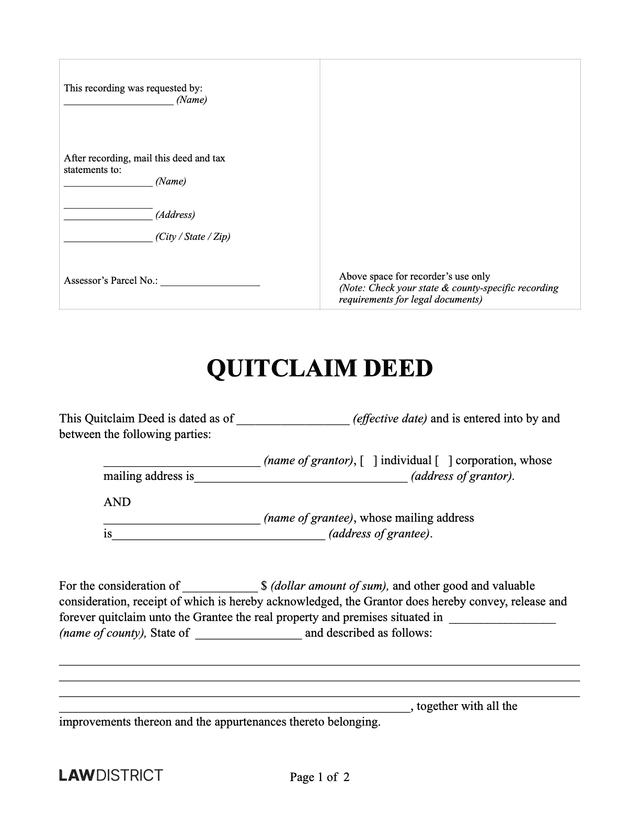
Quitclaim Deed Sample
Before starting your own quitclaim deed it is wise to first look over an example template to get a better idea of what is required. Use our deed sample below to get a much clearer view of what you will need to include in your final form.
When To Use a Do-it-Yourself Quitclaim Deed
There are many situations where a Quitclaim Deed can prove useful for real estate owners looking to make changes to their property’s title [2].
Below we’ve detailed some of the most important reasons you should consider using a Quitclaim Deed.
- Transfer property between family members: Easily transfer ownership rights to children, siblings, or other close family members.
- Add or remove a spouse from the title: Update property ownership after marriage or divorce, especially when spousal consent is required.
- Correct a title defect: Fix errors on the title without costly legal procedures.
- Change the owner's name on a title: Update the title if the owner’s name changes due to personal reasons or if transferring the property to a business or LLC.
- Transfer ownership to a trust: Property is often transferred to a trust for estate planning or tax purposes.
How To Fill Out a Quitclaim Deed
It is easy to fill out a Do-it-yourself Quitclaim Deed online from home. Using our online contract builder, all you need to do is enter your information as instructed for your state and it will be entered into the appropriate template. This can then be downloaded and printed, making it now ready for signing. ready for signing.
How To File a Quitclaim Deed
Once a Quitclaim Deed has been completed and signed, it must be filed so the property title can be officially updated and changed. To do this, you will need to visit your local recording office or county clerk.
Local recording offices are usually based in each county in each state. Each locality often has its own local rules and procedures for the recording process, and the time and process can vary as a result.
Regardless of the state, when you visit the office you must bring the Quitclaim Deed and a blank check to pay the filing fee. Once this process is complete the grantee(s) named in the deed will become the new official owner of the property.
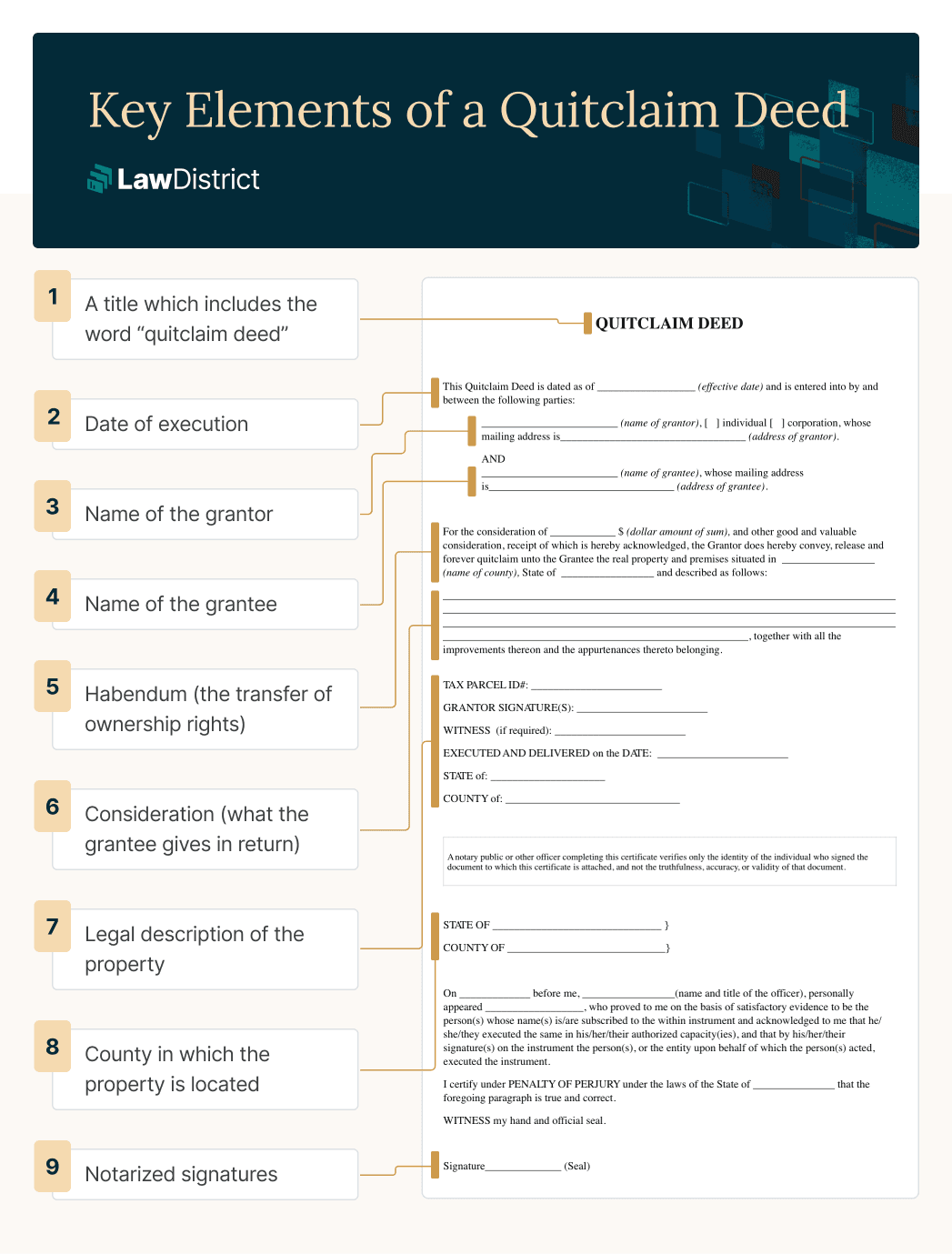
How To Write a Quitclaim Deed
Follow these steps to write a DIY Quitclaim Deed. You can download the necessary document template and use it to easily create your own deed.
- Insert requestor information: At the top of the document, fill in the name of the person requesting the recording and where the deed and tax statements should be mailed after recording.
- Provide property details: Enter the Assessor’s Parcel Number (APN) and Tax Parcel ID. These numbers help identify the property involved in the transfer.
- Identify the grantor(s): Include the full legal name(s) of the grantor(s).
- Add witness information: If required by your state or county, include a witness to the deed and have them sign in the designated section.
- Execution date and location: Provide the date of execution and the state and county where the deed is being signed.
- Notary section: Ensure that a notary public fills out their section, confirming the identity of the grantor(s) and their authority to sign the deed.
- Sign and seal the deed: The grantor(s) must sign the deed, and the notary will apply their signature and official seal.
Check your local county requirements for any additional conditions before filing the deed.
Quitclaim Deed vs. Warranty Deed
The main difference between Quitclaim Deeds and warranty deeds is that Do-it-Yourself Quitclaim Deeds offer no guarantee that the grantor holds the title. Warranty deeds do provide this guarantee, and are preferred in standard real estate sales for fraud protection.
Other deed types, like grant, bargain and lady bird deeds, may also lack title guarantees.
| Quitclaim Deed | General Warranty Deed | |
|---|---|---|
| Warranties Provided | None | Against all title defects |
| Used For | Exchanging a property for little to no money or adjusting the title. | When a property is sold for its market value. |
| Coverage Period | N/A | The property’s entire history. |
Other Title Transfers: Reconveyance of Deed
Review and compare how other title transfers work, particularly when it comes to conveyance and reconveyance.
How Reconveyance Works After a Mortgage
A deed of reconveyance is only used once the mortgage or trust deed has been completely paid off by the borrower.
When that happens, a search of the title will demonstrate that the lien has been paid. That will ensure the lien is still not held against it, and it can be sold.
Then the deed of reconveyance can be issued, and the title passed to the previous homeowner.
As the final part of the process of selling the property, a deed of reconveyance is necessary. Without it, the homeowner can have problems in the future claiming proper ownership.
Conveyance vs. Reconveyance
It’s essential to note the difference between conveyance and reconveyance.
Conveyance is the act of transferring ownership of property from one individual or entity to a new owner.
In this case, the new owner was never the owner of the property. Reconveyance covers the same act of transferring a title.
The key difference is that the person who receives the title was the previous owner of the property.
Deeds of Trust vs. Mortgages
While both agreements facilitate property loans, mortgages and deeds of trust differ significantly in their structure and parties involved.
| Feature | Mortgage | Deed of Trust |
|---|---|---|
| Number of parties | Two parties: The borrower and the lender | Three parties: The borrower, the lender, and a neutral trustee |
| Title holder | The borrower typically holds the title, while the lender holds a lien on the property | The neutral third party (trustee) holds the legal title until the loan is paid off |
| Complexity | Generally straightforward | More complex due to the addition of the trustee |
| Release of title | The lender releases the lien directly when paid off | The trustee transfers the title to the owner via a deed of reconveyance upon payoff |
| Regional usage | Common nationwide, but preferred in certain states | Required or preferred in specific states to secure property loans |
Quitclaim Deed FAQs
It is vital to understand the information and requirements of Quitclaim Deeds before creating one yourself and putting it into action. Read through our FAQs below to learn more about how these deeds work.
It is essential to be sure that you wish to complete your property transfer before filling in and signing a Quitclaim Deed. This is because there is no way to nullify the agreement unilaterally once it is signed.
To regain your rights to the property, you will need to talk to the grantee and use a new quitclaim deed. The transfer must be done subject to agreement with the grantee, as the new document will need to be notarized and (if your state requires it) witnessed.
No, it is not necessary to call upon a lawyer to complete a Quitclaim Deed. The process of drafting and completing this form can be done totally online using our contract maker or using a standard template.
It is possible to find Quitclaim Feed forms online or at your local county recording office. Once you have the relevant template document, you can easily fill in the necessary information at home.
Yes, it is vital to use a notary when signing your Quitclaim Deed. Most states have strict rules on how property transfers must be carried out to avoid fraud and to ensure all parties understand the agreement they are signing.
Therefore, you will need to visit a notary public and (depending on your state) may need to have the signing witnessed by disinterested parties too.
Try Lawdistrict Now
Instant and complete access to our entire library of legal forms
Edit, download and print in PDF from any device
Save time and money on legal document creation