
Free Character Reference Letter for Court
A Character Reference Letter for Court can provide an individual with a testimony from someone, such as an employer, teacher, or long-time friend, to defend their character if they are in a complex legal situation.

Fill forms in a few steps
Save, print & download
Done in 5 minutes
What Is a Character Reference Letter for Court?
A Character Reference Letter for Court is a legal form that can be used as a type of recommendation letter during a trial.
The purpose of writing this letter is to provide a positive testimony of someone’s character. It is often used when it is beneficial for a court to learn about this person’s reputation and personality, to help them argue their case.
When To Use a Character Reference Letter for Court
There are certain legal circumstances in which a Court Reference would be the ideal form of testimony.
The types of cases Character Reference Letters should be used for include:
- Driving under the influence (DUI)
- Child custody
- For convictions
Character Recommendation Letters are the perfect way to defend someone’s reputation in a court of law.
Who to Select
If you are going to write a Character Reference Letter or have one written for you, there are a number of people you can select.
The person you write the letter for or write a statement for you could be your:
- Friend
- Family member
- Co-worker
Use our Character Reference Letter for Court template to create a well-written document.
Once you have your written statement, you can have a legal professional review to make sure everything is in order.
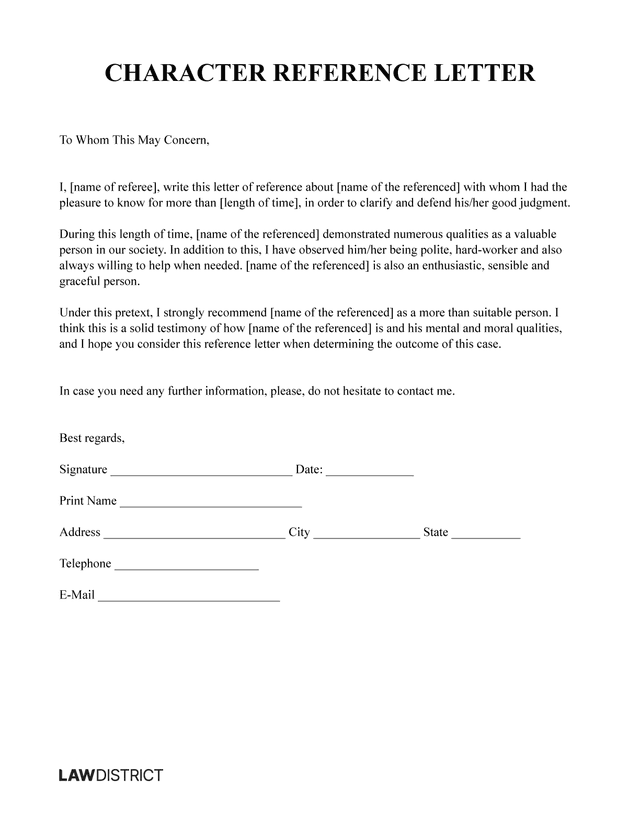
Sample Character Reference Letter for Court
Whenever preparing a legal document, it is helpful to review written examples.
Take a look at the sample Character Recommendation Letter below, to better understand how to create your document.
How To Write a Character Reference Letter for Court
It is not very difficult to create this type of recommendation letter. However, there are some things you must keep in mind.
When writing a Character Reference Letter for Court, it’s essential to add the important examples and details in the correct sections.
Take a look at what you should include in your reference letter.
The Heading
In the heading, make sure you add your full name and address. Once you’ve done that, you should add the date the letter is being sent.
It’s also a good idea to include the case number. It will make it even easier to connect the letter to your friend or family member.
The Introduction
When you begin writing your letter, ensure you properly greet the judge presiding over your friend or family member’s case.
Afterward, give your name, your occupation, how you know the person in the legal situation, and for how long.
The Body
The body paragraph, or paragraphs, will provide the reasons that the person you are discussing in the letter has a good reputation and is a good person.
The best way to do that is to provide concrete examples, such as:
- How this person has helped you
- How this person has volunteered in any way
- If they have donated money
By adding examples like these, it will show how this person just made a one time mistake or can be trusted, based on what they are in court for.
Ending
How you end your letter is also essential. Make sure you briefly summarize what you have spoken about, and ask the court to consider your letter.
Remember to sign the letter as well. Often, it is important to state that the facts in the letter are true and that the letter is affirmed under penalty of perjury. In many instances, an affirmation of the veracity of the letter is required for a judge to consider the letter.
Try our Character Reference Letter template to help you avoid missing any important details.
Tips for Writing Your Character Reference Letter
Throughout your letter, there are a number of characteristics that you can focus on to have a greater impact.
According to a study by Tera D. Letzring, called “The Good Judge of Personality: Characteristics, Behaviors, and Observer Accuracy,” judgmental accuracy is related to characteristics such as:
- Independence
- Trustfulness
- Sympathy
- Courage
- Sense of humor
- social skills
- maturity
Try to mention these characteristics throughout your letter to provide a more compelling testimony, by doing the following:
- Being specific: Give concrete examples of the individual's character rather than giving generic or bland comments about them.
- Staying positive: Focus on the person's positive qualities and stay away from including their negative traits.
- Being respectful: Keep a formal and sincere tone throughout the letter.
- Avoiding speculation: Try not to suggest what penalty you think is appropriate, as the judge will make that decision.
Example of a Good Character Reference Letter
Whether you are planning to write for a family member or friend, Character Reference Letters for Court must be clear and concise.
Look over the following outline, to give yourself a better idea of how to structure your recommendation letter.
[Your name]
[Your address]
[Date]
To The Honorable Judge [Name],
My name is [your name], and I am a [your profession]. I have known [person’s name] for [amount of time]. [Person’s name] has always been a loving and caring [friend/family member/co-worker] since we first met.
That is why I am writing this letter to defend [person’s name], because [he/she] has always been a respected person in the community, and a genuine person to everyone [he/she] has come across.
To give you a personal example, [Person’s name] dropped me at my job, and my children at school when my car was stolen 5 years ago. [Person’s name] came through for us when we needed it.
Apart from that, [he/she] has often participated in community events and fundraisers.
It is unfortunate that [he/she] is in this situation. However, it is obvious to me that [person’s name] will do all that [he/she] can to resolve this situation without further problems, and is sorry for any damage or inconvenience [he/she] has caused.
I hope that this testimony will be taken into consideration.
Yours truly,
[Your signature]
[Your name]
Dos and Don’ts of a Character Reference Letter
As with any legal form, contract, or document, it is critical to know what to include as well as what not to include.
There are also ways to ensure your letter is written in a positive way that will not do more harm than good.
Take a look at the table below to understand the dos and don’ts of Character Reference Letters writing.
| Dos | Don’ts |
|---|---|
| Be Clear and Concise. | Avoid making the letter too legal, it should be personal. |
| Mention several examples of the subject’s good moral character. | Do not suggest any sentences or punishments. |
| Chat with the person’s lawyer first to ensure the information included is useful and non-damaging. | Avoid stating if the subject of the letter is guilty or innocent. |
Avoid explicitly stating that you are trying to convince the Court of something. It is more important to focus on establishing the specific character of the individual that you are supporting, and share that you personally believe that they have such good character.
Character Reference Letter for Court FAQs
Some common questions are usually asked by anyone who needs to write a Character Reference Letter for Court.
For that reason, we have included the answers to some of the most frequently asked questions to help you write your document.
If you would like someone to write a Character Reference Letter for Court on your behalf, then you should consider someone you have a close relationship with.
The person writing the letter should be able to provide good examples of your character. That means ideally it should be someone who you have known for many years and trust to do a good job.
There is no set limit for the number of Character letters that can be provided to a judge on your behalf. However, that doesn’t mean that you should make too many.
It is a good idea to only have between 2 and 4 letters sent on your behalf.
If you have too many letters sent, it may appear suspicious, and the Court may lend less weight to each individual letter.
The Character References will usually be collected and read by the judge. So it is a good idea to make your letter out to the judge presiding over your loved one’s case.
It is a personal letter, however, so make it formal as it is going to be part of a legal case or dispute.
A judge looks for honesty, specific examples, and credibility regarding the person mentioned in a character letter.
The letter should highlight the individual's positive traits, contributions to their community, and any other actions that show their commitment to the people around them or personal growth.
It’s important to be honest and avoid exaggerating, as judges want to see genuine, well-written letters that give insight into the person's character and circumstances.
Try Lawdistrict Now
Instant and complete access to our entire library of legal forms
Edit, download and print in PDF from any device
Save time and money on legal document creation