
Free Cohabitation Agreement
If you are planning to move in with your special other, a Cohabitation Agreement can be used to set the terms of the relationship.

Are you living with your partner?
Fill forms in a few steps
Save, print & download
Done in 5 minutes
What Is a Cohabitation Agreement?
A Cohabitation Agreement serves as a legally binding document between 2 individuals choosing to share a life as unwed partners.
Unlike marriage, where legal entitlements to property division and spousal support are automatically provided, couples living together lack these privileges in the absence of a formalized agreement.
A Cohabitation Agreement is purposefully crafted to cater to the needs of romantically involved couples who intend to share a home.
This type of legal form enables non-married couples to clearly articulate their agreed-upon management of property and finances both throughout their relationship and in the event of a separation.
Assuming your Cohabitation Agreement satisfies your state's legal requirements, you can seek the court's assistance in compelling your former partner to honor their contractual obligations, should they choose not to comply.
Other common names used for this type of agreement are:
- Relationship Agreement
- Consensual Relationship Agreement
Cohabitation Agreement Legal Requirements
While the specific legal requirements for a Cohabitation Agreement can vary depending on the jurisdiction, several general principles tend to apply universally.
These include:
- Written agreement: The agreement must be in writing. Oral agreements are typically harder to enforce and may not be recognized in all jurisdictions.
- Clear terms: The terms of the agreement should be clear, unambiguous, and comprehensive, covering all aspects of the couple's relationship that the agreement is meant to regulate.
- Full disclosure: Both parties should fully disclose their respective assets and liabilities. This allows each party to make an informed decision about the agreement.
- Voluntary and without coercion: Both parties must voluntarily agree without any undue influence, duress, or coercion.
- Consideration: Like any contract, a Cohabitation Agreement must have consideration, meaning something of value must be exchanged between the parties. This can be mutual promises or the actual cohabitation itself.
- Signatures: Both parties must sign the agreement, and the signatures should ideally be witnessed.
Cohabitation Agreements are still not legally recognized in some states. Courts in Georgia (Ga. Code § 13-8-1 (2023) and Louisiana may deem them invalid due to moral judgments, while Illinois allows limited enforcement if unrelated to a marriage-like relationship.
Parties to such an agreement should remember that it is a binding contract, and can usually be legally enforced just as any other contract.
What To Include in a Cohabitation Agreement
Crafting a Cohabitation Agreement offers couples the flexibility to tailor its scope to their specific needs, whether it encompasses the entirety of their relationship or focuses on specific transactions, such as purchasing a property.
The agreement should explicitly outline their preferences regarding property and financial sharing and should include the sections listed below.
Cohabitation
This section should state that both parties have consented to reside together in a committed relationship, sharing a common household at the specified residence throughout their cohabitation.
The parameters of the relationship should be expressed in the agreement. The nature of the relationship in many cases is romantic, but it can be wise to acknowledge the exact relationship involved, as a cohabitation between romantic partners will likely be very different than one between two platonic roommates.
Joint Expenses
In this part of the form, it is defined how both parties will divide and contribute to shared expenses, such as rent/mortgage, utilities, groceries, and other household-related costs in an equitable manner.
It is important to note that despite sharing expenses, the parties often maintain separate bank accounts.
Separation
In the event the parties choose to separate, this section establishes a mutually agreed process for handling the distribution of assets, debts, and property acquired during the cohabitation period.
The parties are committed to ensuring a fair and equitable division and are dedicated to resolving any disagreements through peaceful negotiation or mediation, avoiding the need for litigation.
Fair and equitable is usually a standard applied to a marriage in a divorce. Division of assets or property between cohabiting partners can often result in a disparity, so it is important that the parties understand what they come into the contract with, and what they will leave it with as well.
Custody and Support
If the parties have a child together during their cohabitation, they are dedicated to jointly making decisions regarding custody, visitation, and support.
Their decisions will always prioritize the best interests of the child, and they will comply with relevant laws and court orders governing custody and support arrangements.
In most jurisdictions, agreements regarding custody and support can be difficult to enforce and may not be enforceable at all unless they are approved by a judge through a relevant court process.
Termination
The agreement shall cease to be in effect automatically if either party enters into marriage with another person or if both parties mutually consent in writing to terminate it.
Furthermore, the agreement shall be terminated in the event of the death of one of the parties.
Governing Law
This section states that the agreement will be regulated and interpreted based on the laws of the specified state, without considering any conflicting legal provisions.
Binding Effect
Through the parties' signatures included in this section, the agreement becomes legally enforceable.
It highlights the significance of the agreement and its applicability to all parties mentioned, ensuring that the terms and obligations stated within it carry legal weight and can be upheld by the appropriate authorities.
Including these issues within a Cohabitation Agreement ensures clarity and transparency, enabling couples to proactively manage their financial and property matters.
How To Write a Cohabitation Agreement
Drafting a Cohabitation Agreement allows unmarried couples to establish clear guidelines and address important aspects of their shared life.
Follow the steps below to write an effective Cohabitation Agreement:
Parties and effective date: Identify the parties involved by including their full names, current addresses, and the effective date of the agreement.

Recitals: Describe the committed, unmarried relationship of the parties, their intention to live together, and their desire to establish rights, responsibilities, and provisions for children born or adopted during cohabitation.

Cohabitation: Specify the agreement for living together in a committed relationship and sharing a household at the designated address.
Living costs: List the expenses the parties will share and how the expenses will be shared.

Separation: Address the division of assets, debts, and property in case of terminating the relationship.

Custody and support: Establish joint decision-making for custody, visitation, and support arrangements based on the child's best interest, as well as what process the parties will use to make a decision if there is a disagreement.

Termination: Clearly define events that lead to automatic termination.

Compliance: Specify the state whose laws will govern and interpret the agreement.

Validity: State that the agreement is binding upon the parties involved.

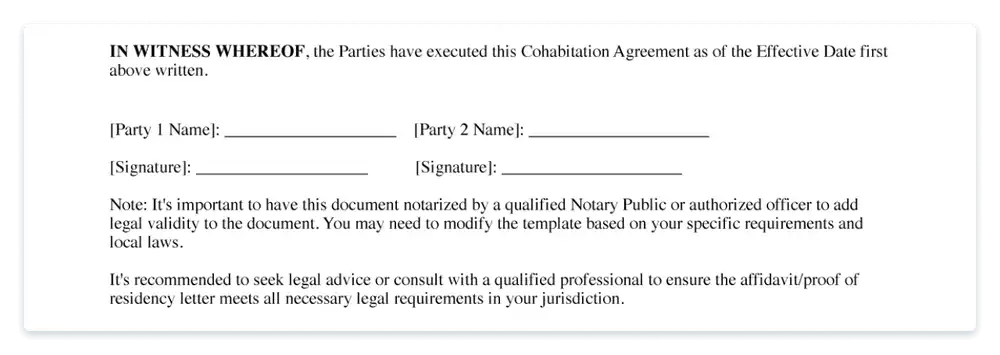
Execution: Include a signature block where both parties can sign and date the agreement.
Remember, each cohabitation relationship is unique, so customize the agreement to reflect your specific circumstances.
Use our step-by-step form builder to write your document and avoid critical mistakes that could make it unenforceable.
Rights of Cohabitation Couples
The rights of unwed couples living together can vary depending on the state or jurisdiction, as there is no uniform federal law governing cohabitation relationships.
Often, unwed couples have limited or no rights to the financial assets of the other, although they almost always have automatic rights to the establishment of custody and child support involving children.
However, the following are some general considerations you should take into account when writing your document:
Property rights
Cohabiting couples generally do not enjoy the same automatic property rights as married couples. Each partner usually retains ownership of the assets they individually acquire unless they explicitly agree otherwise. This can often be most troublesome when it involves real property such as a home.
Financial obligations
While cohabiting couples are generally not subject to the same financial obligations as married couples, such as spousal support or alimony, they do have responsibilities on shared financial matters that they have mutually agreed upon.
Healthcare and insurance
Partners who live together often do not have the same rights to each other's healthcare or insurance benefits as married couples. Certain states may acknowledge domestic partnerships or establish alternative legal avenues to grant specific rights and benefits.
Parental rights
In cases where cohabiting couples have children together, both partners may have parental rights and responsibilities. However, these rights can still vary depending on state laws and may require additional legal steps to establish or protect these rights.
End-of-Relationship matters
Unlike divorce, there is typically no legal framework specifically designed for the dissolution of a cohabitation relationship. Therefore, unwed couples living together need to rely on contractual agreements to address property division, custody, and support matters in case of separation.
To ensure the protection of their interests, unmarried couples living together should be aware that legal rights and obligations differ from those of married couples, and there is a need for well-defined agreements to address these matters effectively.
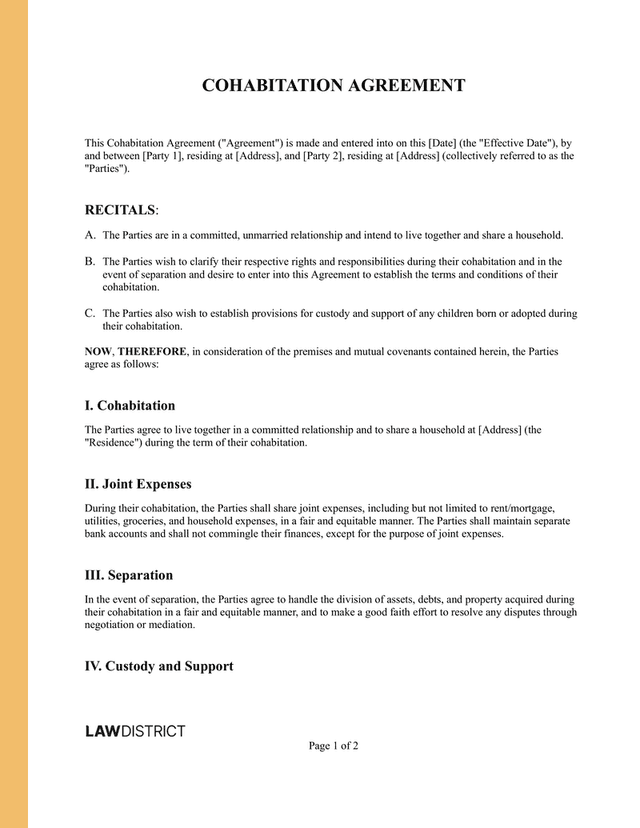
Cohabitation Agreement Sample
Completing a Cohabitation Agreement template can prove tricky without a reliable reference point.
Review our Cohabitation Agreement sample below before you begin to make the process of writing your own document simpler.
Other Personal and Family Documents
A Cohabitation Agreement is an essential legal document that outlines the terms of your partnership and provides a contingency plan in the event of a breakup.
In addition to this, our expert legal document-making tools can help you create other helpful forms, such as the following:
FAQs About Cohabitation Agreement
For a better insight into the workings of a Cohabitation Agreement, we've prepared a comprehensive FAQ section.
Browse through to address any uncertainties about defining terms with your partner and measures to take should the relationship end.
Yes, a Cohabitation Agreement can be legally binding, provided it is executed correctly. This means it should be in writing, signed by both parties and ideally witnessed by an attorney.
It's important to note that the enforceability of such agreements can vary based on jurisdiction. Use a relationship agreement template like ours to create a solid basis for your legal journey.
You can get a Cohabitation Agreement template from a local attorney, although this alternative may prove to be quite costly.
We recommend that you use our free Cohabitation Agreement template to ensure it complies with all required legal stipulations. Our forms can be customized to address your unique circumstances and preferences.
Try Lawdistrict Now
Instant and complete access to our entire library of legal forms
Edit, download and print in PDF from any device
Save time and money on legal document creation