
Free Lead-Based Paint Disclosure Form
Take advantage of our Lead-Based Paint Disclosure form in PDF to let a tenant or buyer know of any lead-based paint on the property. Our template allows you to create your legal document with ease.

Select the property type:
Fill forms in a few steps
Save, print & download
Done in 5 minutes
What Is a Lead-Based Paint Disclosure?
A Lead-Based Disclosure form is a legal document that alerts a buyer or renter of a home if lead-based paint is found on that property.
The EPA and the federal government require Lead-Based Paint Disclosure forms to be issued to renters and buyers when selling or renting a house built before 1978.
The EPA fact sheet explains why you need to give buyers and renters this form, as well as what information is required on it.
Lead-based paint is a special kind of paint that was used before 1978. It contains lead, which can cause serious health problems if it gets into your body.
For this purpose, landlords must provide all known information regarding lead-based paint to their tenants before they sign a lease agreement.
Use our free Lead-Based Paint Disclosure form to effortlessly provide any critical information to your tenant.
Lead Disclosure Rule
Lead-based paint has not been allowed since 1992 after the U.S. Consumer Product Safety Commission banned it in 1992 in the Residential Lead-Based Paint Act.
The Department of Housing and Urban Development and the EPA listed requirements for landlords and anyone selling their homes because of this act [1].
As a landlord or home seller, you are required to do the following:
- Provide the EPA-issued lead-based paint pamphlet
- Provide information regarding any known lead-based paint on the property
- Disclose records of lead-based paint reports
- Submit the Lead-Based Paint Disclosure form to the lease
- Keep all the signed records for at least three years
You must comply with these requirements based on section 1018 of the Residential Lead-Based Paint Act.
EPA Pamphlet
The Lead-Based Paint Disclosure Rule requires sellers and lessors (landlords) of target housing to provide purchasers and tenants with an EPA-approved lead hazard information pamphlet and a federally approved lead hazard information statement.
The EPA pamphlet helps buyers identify homes that have lead-based paint hazards [2].
Using the pamphlet, you can know what to avoid and your rights as a renter or buyer when you plan to live in a property built before 1978.
How To Fill Out a Lead-Based Paint Disclosure Form
When creating a Lead-Based Disclosure form, it is essential to include all information regarding lead-based paint. The other party must also acknowledge or disclose all relevant information before signing.
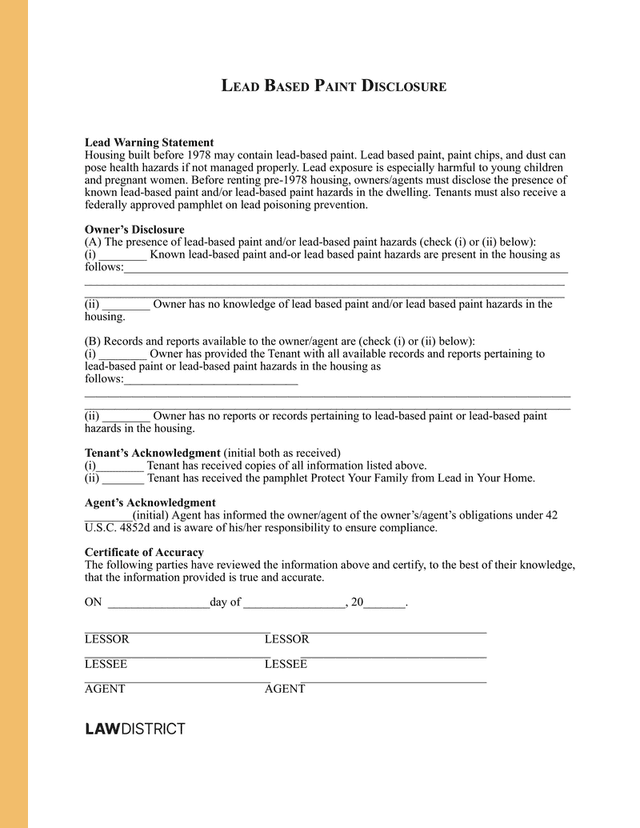
To create a valid disclosure of information on the Lead-Based Paint form, you must include the following:
- Seller or Landlord’s disclosure: The landlord must acknowledge that there are or are not known lead-based paint or lead-based paint hazards in the residence.
- Buyer’s or Renter’s acknowledgment: As the buyer or renter, you can mark that you have received the information regarding lead-based paint and the EPA pamphlet.
- Agent’s acknowledgment: If there is a real estate agent involved, they must certify they let the landlord know what their responsibilities are under § 42 U.S. Code 4852d.
- Signatures and date: Once all steps are completed, all parties must sign and date the form.
Lead-Based Paint Inspection
When viewing a property, potential tenants or buyers can observe the home for signs of old paint protruding through newer paint. This visual inspection should be recommended first, and if there is a high concern about lead paint use in the home, an official inspection can be ordered.
All landlords or sellers should have an inspection carried out on the property before leasing or completing a transaction.
The inspection should be completed by using the EPA’s Inspection, Risk Assessment, and Abatement Firms Locator.
This will tell you if the home has lead-based paint and where it is located within the property.
An inspector will use methods such as:
- Portable X-ray fluorescence machine
- Lab tests of paint samples
Using an inspector will let you know how much lead-based paint is present.
Lead-Based Paint Hazard Act exemptions
If you are interested in leasing or selling your property, you do not necessarily need to disclose any information regarding lead-based paint.
You do not have to supply a Lead-Based Paint Disclosure form if any of the following applies to your property:
- The property was built after January 1, 1978
- Homes that do not include a bedroom (studios, lofts, etc.)
- Rental contracts that conclude within 100 days
- Property that has been examined by a state-certified inspector
- Residences for the disabled where no children under the age of six reside
Some of these exemptions are not valid in every state, so always make sure to check your state’s specific exemption requirements.
Lead-Based Paint Disclosure Sample
To further help you understand what is needed when creating a Lead-Based Disclosure form we have included an example of the document below.
Review the sample below to understand how to structure your document.
Other Real Estate Documents
Other legal documents can help you in this situation or similar circumstances.
Knowing certain documents related to a Lead-Based Disclosure form can help you avoid unnecessary legal fees and save you time during this process.
Here are some similar real estate documents that can help both landlords and tenants.
It is essential to use the correct documents when buying, renting, or selling real estate.
Resources [1] eCFR. 16 CFR 1303.
FAQs About Lead-Based Paint Disclosures
To clear up any doubts that you still have regarding Lead-Based Paint Disclosure forms, we have answered the most common questions on the matter.
Look over the following answers to remove any doubts you may still have.
The most typical way to get a Lead-Based Paint Disclosure form is by going to a lawyer.
However, this typically means paying excessive legal fees and can lead to long waiting times.
Avoid this by using our Lead-Based Paint Disclosure template available in PDF format to make the entire process much simpler.
With LawDistrict’s template, you can create a solid basis for your legal journey.
Yes, landlords are required to disclose information regarding lead-based paint to their tenants if they are renovating a property that is currently being occupied.
If the renovation interacts with painted surfaces, the tenants must receive information regarding lead-based paint and hazards.
They must receive this information within 60 days of the renovation start date.
Use our Lead-Based Paint Disclosure template to create your document and correctly notify your tenants.
Try Lawdistrict Now
Instant and complete access to our entire library of legal forms
Edit, download and print in PDF from any device
Save time and money on legal document creation