
Free Partnership Dissolution Agreement Template
Take advantage of our Dissolution of Partnership Agreement template to create a form that acts as a foundation that will help you navigate through the process of ending a legal business relationship.

Excellent 4.5 out of 5
Fill forms in a few steps
Save, print & download
Done in 5 minutes
What Is a Partnership Dissolution Agreement?
A Partnership Dissolution Agreement is a formal legal document that partners use to mutually agree to terminate their business relationship.
It outlines the procedures and terms for ending the partnership, including:
- Division of assets (e.g., hard assets, cash, intellectual property rights)
- Settlement of outstanding liabilities between the partners (e.g., debt)
- How to handle outstanding liabilities owed to third parties (e.g., service contracts)
- Ending future rights and obligations between the partners
- Any other necessary arrangements to effectuate ending the partnership
Dissolution of Partnership forms help guarantee that the end-of-partnership process is handled in a transparently negotiated manner, reducing the likelihood you and any partners will have future disputes due to a misunderstanding of terms. Dissolution may have different tax results for the parties.
Dissolution may have significantly different tax consequences for each partner depending on the partnership's assets, liabilities, capital accounts, distributions, built-in gains, debt allocations, and prior tax elections.
The partnership's CPA should assist with the entity's final tax filings; however, each partner should also consider consulting independent tax counsel or a qualified CPA regarding their individual tax consequences before executing the dissolution agreement.
Depending on the context and the specific terms outlined in your agreement, the form may also be referred to as a:
- Business Partnership Termination Agreement
- Partnership Termination Contract
- Partnership Separation Agreement
- Civil Partnership Dissolution
With these variations in mind, our Partnership Dissolution Agreement template gives you a reliable foundation for ending a business relationship with a partner.
⚠️ A Partnership Dissolution Agreement helps document the partners' agreement regarding the termination of their business relationship. However, signing a dissolution agreement alone may not eliminate existing obligations to lenders, landlords, vendors, customers, employees, governmental agencies, or other third parties.
Additional filings, notices, consents, releases, or contractual amendments may be required depending on the partnership's business activities, governing agreements, and applicable law.
When to use a Dissolution of a Partnership
A dissolution of a partnership can be brought about by a number of different reasons, from disputes to a mutual understanding. In any event, a full review of any written partnership agreement must be undertaken in order to ensure compliance with the terms.
If the agreement reveals an impediment to dissolution or could lead to an unwanted outcome, the parties would need to amend it before dissolving the partnership. This would help ensure the intended objectives are achieved.
Before pursuing a dissolution, partners should carefully review the partnership agreement and any related governing documents. Existing provisions may establish specific procedures for dissolution, buyouts, valuation methods, voting requirements, notice periods, restrictions on transfers, dispute resolution requirements, or continuing obligations that remain effective after dissolution.
Take a look at when you may need a Dissolution of Partnership Agreement:
- Voluntary termination: When partners mutually agree to end the partnership, either after achieving their business goals or to pursue other opportunities.
- One partner leaves the partnership: If a partner wishes to leave while others wish to continue the business, this document outlines the terms for their exit.
- Disputes: Helps resolve situations where partners cannot agree on business operations or future directions.
- Unforeseen Circumstances: If a partner dies, becomes incapacitated, or declares bankruptcy, a legal dissolution will likely be necessary.
- Predetermined Conclusion: Some partnerships are established with a specific duration or goal. This agreement can formalize the end of the partnership once those conditions are met.
- Legal Requirements: This applies when legal or regulatory changes make the business model untenable.
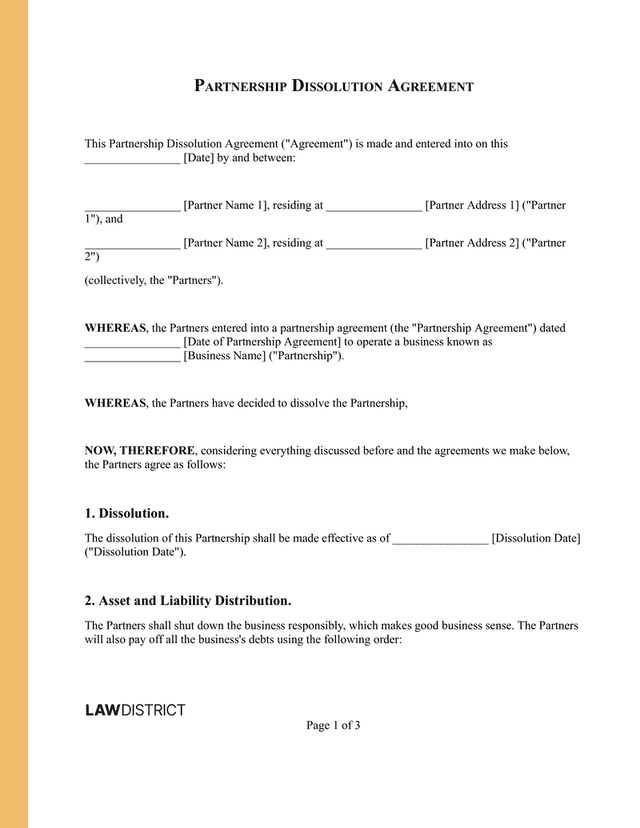
Partnership Dissolution Agreement Sample
You can review our Dissolution of Partnership example below to help you create your document and understand the structure and terms of the legal form.
Partnership Dissolution Agreement Requirements and Conditions
Dissolving a partnership involves a series of steps that follow both state and federal laws.
Below is a simplified table summarizing the primary state and federal requirements to legally end a partnership. These vary by state, so always consult legal counsel to be sure.
| State Requirements | Federal Requirements |
|---|---|
| Present a statement of dissolution (articles of dissolution or certificate of cancellation). | File Form 1065, U.S. Return of Partnership Income, and mark "final return". |
| Include the necessary state paperwork and pay termination fees. | Make sure to submit your partnership's final state tax return and cover any remaining taxes. |
| Potentially file additional forms, such as a transfer of property report. | Report all final income and distributions on your personal tax return, given that partnerships function as pass-through entities for tax purposes. |
Here are some other requirements you should consider, and may need to meet depending on your circumstances:
- Mutual consent or other authorized approval: Depending on the partnership agreement and applicable state law, dissolution may require unanimous consent, a specified voting threshold, a triggering event or another authorized approval mechanism. This consensus is crucial for the validity of the agreement.
- Public notice: Depending on state law, you may need to publish a notice of the partnership's dissolution in a local newspaper to inform the public and potential creditors.
- Private creditor and third party notifications: Partnerships should identify and notify private lenders, landlords, vendors, customers, insurers, licensing authorities, and other parties with contractual relationships. Certain agreements may require consent before assignment, termination, transfer of assets, or release of a partner from liability.
- Employees and benefits obligations: If the partnership has employees, partners should address final payroll obligations, accrued benefits, employee notices, retirement plans, workers' compensation obligations, and employment law compliance matters.
Our Partnership Dissolution Agreement template can help you outline the division of assets, allocation of liabilities, and any obligations for ongoing or unfinished business.
By fulfilling these requirements and creating the correct Dissolution of Partnership forms, you and your partner can set the basis for a smooth and legally sound dissolution.
Terms to Include in a Partnership Dissolution Agreement
Creating a comprehensive Partnership Dissolution Agreement is crucial to ensure a smooth and clear dissolution process. To do so, you will need to include the key terms.
Below are terms to include in your document, which may change depending on your circumstances:
- Partners' details: Names, contact details, and roles of all partners involved.
- Date of termination: The date on which the partnership officially ends.
- Rights and obligations: The ending of any and all rights and obligations amongst the partners.
- Asset distribution: Allocation method for assets and liabilities among partners.
- Intellectual property and business name rights: Ownership of trademarks, service marks, logos, websites, domain names, software, trade secrets, customer lists, social media accounts, and other intellectual property should be clearly assigned to one or more partners.
- Escrow: The partners may establish an escrow account or reserve fund to address unknown liabilities, tax adjustments, pending litigation, customer claims, indemnification obligations, or unresolved business expenses that arise after dissolution.
- Winding-up process: Steps for closing the partnership's operations.
- Conflict resolution: Mechanism for resolving any disagreements during dissolution.
- Mutual release of claims: The partners may agree to release and discharge one another from known and unknown claims arising out of the partnership relationship, except for obligations expressly preserved in the dissolution agreement.
- Indemnification: One partner may need to cover potential future liabilities that may be imposed on other partners for a period of time.
- Taxes: How the company's final Federal, state and local tax filings will be addressed.
- Books and records: The agreement should identify who will retain partnership records after dissolution and establish reasonable rights of access for former partners, auditors, tax professionals, and governmental authorities.
- Fees and expenses: How the payment to professionals (e.g., CPA, law firm) and other transaction closing costs (e.g., filing fees) will be paid amongst the partners.
- Confidentiality: Requirements for maintaining the privacy of business information.
- Non-disparagement: The partners may agree not to make statements that could reasonably be expected to harm the reputation, goodwill, or business interests of a former partner or any continuing business.
- Governing law: The legal jurisdiction overseeing the agreement.
What are the rights of partners after a Dissolution of Partnership?
After a partnership is terminated, such as in a Business Partnership Dissolution, you and your former partner have specific rights and obligations that include:
- Settlement of debts: Each party is responsible for paying off all joint debts to wrap up the partnership's financial affairs.
- Profit sharing: Any profits arising from the dissolution process must be divided among the partners as per the terms of the dissolution agreement.
- Distribution of remaining assets: After debts are cleared, the remaining assets are distributed among you and your former partner.
- Future business endeavors: You and any remaining partners can choose to start a new business partnership or completely cease operations.
- Right to an accounting: Partners may have rights under applicable law or their governing agreement to receive information regarding the partnership's assets, liabilities, distributions, and winding-up activities.
- Winding-up authority: Certain partners may retain authority to complete unfinished business, collect receivables, satisfy obligations, liquidate assets, and undertake actions necessary to conclude the partnership's affairs.
These points help to ensure a structured and fair conclusion to the partnership, addressing both financial responsibilities and opportunities for future ventures.
Other Business Documents
There are related business documents that you can use when working with a partner or even for setting up a company.
Take a look at some forms that can be used to enhance your operations and help you avoid legal issues:
FAQs About Partnership Dissolution Agreement
To help you better understand how to create your legal document and the dissolution process, we have answered some of the most typical questions on the topic.
Review the answers below to better empower your legal journey.
Dissolution is the legal change in the partners' relationship when one or more decide to stop being involved, changing the firm's status.
Liquidation is the actual process of selling off the business assets, paying off creditors, and distributing any leftover money.
Dissolution happens first, and liquidation is the step that follows to finish the business
Yes, ideally all partners must consent and sign to make the winding-up process smooth and legally binding. If one partner refuses to sign, the remaining partners may need to seek mediation, arbitration, or a court order to force a judicial dissolution.
Existing debts and liabilities must be paid using partnership assets before any cash is given to the partners. If company funds are not enough to cover debts, the partners may remain personally liable depending on whether it is a general or limited partnership.
Yes, remaining partners can buy out the departing partner’s share and form a new business. This requires a clear buyout clause in the original contract or a new partnership agreement moving forward.
Yes, you must notify third parties and creditors so they know the partners no longer have the authority to sign new deals or incur debts under the old name. You also need to file final tax returns and cancel business permits or registration licenses with local authorities.
Try Lawdistrict Now
Instant and complete access to our entire library of legal forms
Edit, download and print in PDF from any device
Save time and money on legal document creation