
Free Letter of Agreement Template
A Letter of Agreement (LOA) outlines the terms of an arrangement between two parties in a clear, concise format. LOAs are commonly used in freelance work, business collaborations, and service agreements.

How was the Agreement reached?
Fill forms in a few steps
Save, print & download
Done in 5 minutes
What Is a Letter of Agreement (LOA)?
A Letter of Agreement (LOA) is a legal document that outlines the terms and conditions of a partnership or agreement between two parties.
It serves as a less formal alternative to a traditional contract but holds the same legal weight when it contains all the necessary elements of a binding agreement.
This agreement letter between two parties specifies specifies the services to be provided, the responsibilities of each party, the payment structure, and the timeline for the work to be completed.
Unlike more detailed contracts, a Letter of Agreement is often simpler and more straightforward, making it ideal for less complex transactions or partnerships.
It is particularly useful in situations where a full contract is not necessary or when parties wish to document their agreement quickly without the need for extensive legal formalities.
Letter of Agreement Sample
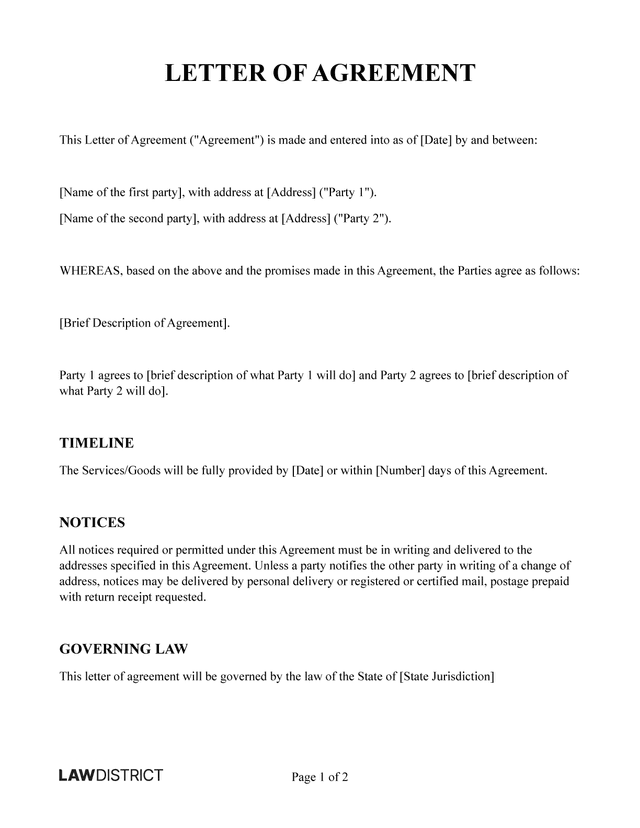
Before you begin drafting your own Letter of Agreement, reviewing a sample for guidance is beneficial.
Consider examining the sample Letter of Agreement between two parties provided below as a starting point for your document:
When To Use a Letter of Agreement
A Letter of Agreement can be used in various scenarios where a formal but less complex agreement is needed.
Here are some common instances when a LOA might be the appropriate choice:
- Freelance and consulting services: Freelancers or consultants offering services to businesses or individuals often use LOAs to specify the scope of work, payment terms, and deadlines.
- Business collaborations: When companies engage in short-term partnerships, joint ventures, or collaborative projects, a LOA can serve as a straightforward agreement that outlines each party's contributions and responsibilities.
- Service agreements: For services that do not require a detailed contract, a LOA can define the specifics of the service provision, including scope, duration, and compensation.
- Event planning and management: Organizers and vendors for events might use LOAs to agree on the services to be provided, payment schedules, and logistical arrangements.
- Simple sales transactions: For the sale of goods or services that are straightforward and do not involve complex terms, a LOA can document the agreement effectively, providing a record of the sale and terms.
- Project-based work: Projects with a clear set of objectives, timelines, and payment terms can be governed by a LOA, making it suitable for industries like construction, web design, and marketing campaigns.
The key advantage of using a Letter of Agreement is its flexibility and simplicity, allowing parties to create a binding agreement that is easier to understand and implement.
However, it's important to make sure that the LOA includes all necessary elements that are relevant to your circumstances.
What To Include in a Letter of Agreement
To guarantee clarity, prevent misunderstandings, and provide legal protection, certain key elements should be included.
However, elements of your LOA may vary depending on your jurisdiction and the specific circumstances of your case, but some necessary details may include:
- Introduction of parties: Identify the names and contact information of all parties involved in the agreement. This section establishes who is agreeing to what.
- Description of services or goods: Provide a detailed description of the services to be performed or the goods to be provided. This should include the scope of work, deliverables, and any specific expectations or standards to be met.
- Duration of agreement: Specify the start date and end date of the agreement. If the project is ongoing or does not have a definite end date, explain how the agreement can be terminated by either party.
- Payment terms: Outline the compensation structure, including the total amount to be paid, payment schedule (e.g., upon completion, in installments), and any conditions related to payment.
- Dispute resolution: Describe the process for resolving disputes should they arise. This could include mediation, arbitration, or legal action, specifying the jurisdiction under which disputes will be settled.
- Termination conditions: Outline the conditions under which the agreement can be terminated by either party. This includes breach of contract, failure to meet deadlines, or other scenarios that would warrant ending the agreement.
- Signatures: The document should end with a space for both parties to sign and date the agreement. Signatures legally bind the parties to the terms of the LOA.
- Miscellaneous provisions: Depending on the nature of the agreement, you might also include clauses related to indemnification, liability, or amendments to the agreement.
How To Write a Letter of Agreement
Writing a Letter of Agreement involves a clear, structured approach to ensure all essential aspects of the agreement are covered and understood by all parties.
Here’s a step-by-step guide to crafting an effective LOA:
1. Begin With the Basics
Start by listing the date, the names, and contact information of all parties involved. This foundational step sets the stage for a formal agreement.
2. Define the Scope
Clearly articulate the services or goods being exchanged. This includes a detailed description of the work to be done, the expected deliverables, and any specific standards or conditions that must be met.
3. Set the Timeline
Include both the commencement and completion dates of the agreement. If the agreement is open-ended, specify how and under what conditions it can be terminated.
4. Outline Payment Details
Clearly state the compensation terms, including amounts, payment schedules, and methods. Be sure to address any provisions for late payments or penalties.
5. Incorporate Legal Clauses
Depending on the nature of the agreement, you may need to include confidentiality clauses, non-compete agreements, or intellectual property rights. These clauses protect both parties and the integrity of the agreement.
6. Detail Dispute Resolution
Specify how disputes will be handled, should they arise. This could range from mediation to arbitration, providing a clear path to resolution without immediate litigation.
7. Termination Conditions
Clearly outline how the agreement can be terminated, detailing the process and any notice requirements.
8. Close With Signatures
Conclude the document with a section for signatures from all parties. Include the date next to each signature for reference. Consider having a legal professional review your finished document to guarantee that it’s legally binding in your jurisdiction. The mentioned steps will help you create a Letter of Agreement that is clear and comprehensive.
Is a Letter of Agreement Legally Binding?
While a LOA is generally considered less formal than a traditional contract, it does not diminish its potential to be legally binding. The key is making sure ensuring that the document is comprehensive and includes specific details about the agreement.
For a LOA to hold legal weight, it must clearly outline the responsibilities, rights, and obligations of each party involved in the agreement.
How To Improve the Enforceability of Your Agreement Letter
Enforceability depends on the content of the LOA and how well it adheres to the legal standards of contract law in the jurisdiction where it is applied.
The LOA must be drafted with clarity, leaving no room for ambiguity about the agreement's terms and conditions. This clarity helps prevent disputes and makes it easier to resolve them if they arise.
While a LOA is generally considered less formal than a traditional contract, it does not diminish its potential to be legally binding. The key is ensuring that the document is comprehensive and includes specific details about the agreement.
Double-check that you’ve included the agreement’s scope, duration, payment terms, and any other critical aspects relevant to the arrangement.
In practice, whether for freelance services, business collaborations, or other agreements, making sure that your Letter of Agreement meets these criteria can provide both parties with a sense of security and legal protection.
Letter of Agreement FAQs
Understanding Letters of Agreement thoroughly is crucial before you start drafting your own.
To help clarify any uncertainties you might have, we've put together a list of commonly asked questions along with their answers.
Simply using a sample from the internet and modifying it for your situation could lead to significant mistakes, potentially undermining your ability to defend your case in court.
We advise using our Letter of Agreement template, which can then be reviewed by a licensed attorney to make sure it adheres to all applicable laws.
A Letter of Agreement serves a similar purpose to a contract, as both outline the terms of an arrangement between parties.
However, a Letter of Agreement is typically less formal and may not include all the standard legal provisions found in a more detailed contract. It's often used for straightforward agreements or services.
Despite these differences, both are legally binding if they contain essential elements like offer, acceptance, and consideration.
Try Lawdistrict Now
Instant and complete access to our entire library of legal forms
Edit, download and print in PDF from any device
Save time and money on legal document creation