
Free Minnesota Power of Attorney (POA) Form
A Minnesota Power of Attorney is a simple way to give legal authority to another person, known as your Attorney. They can then make important decisions for you when needed. This form helps you stay prepared and protects your interests in different situations.

Which Power of Attorney would you like to create?
Fill forms in a few steps
Save, print & download
Done in 5 minutes
Types of Power of Attorney in Minnesota
Before starting a Minnesota Power of Attorney, it is critical to know what type of POA to create. There are many different varieties of these legal instruments, and each grants different kinds of powers from a Principal to an Agent or Attorney-in-Fact.
The most common kinds of POA available in Minnesota include the following examples:
- Durable: Durable Power of Attorney documents are invaluable tools for individuals planning how their estate will be managed in their old age, or in the event of sudden illness or disability. They allow the Agent to act for the Principal even if they become incapacitated.
- Limited: A Limited Power of Attorney lets a Principal grant time-limited powers to an Agent. This is usually to allow the Agent to complete a one-off task such as signing a contract.
- Medical: Medical Power of Attorney is a durable form of POA that allows a Principal to appoint a person to make medical decisions for them if they become incapacitated
- Real Estate: Real Estate POAs are specially tailored documents that let Principals grant powers to an Agent for the purposes of managing real estate.
- Vehicle (DMV): A Vehicle Power of Attorney (or DMV POA) gives an Agent the authority to transfer ownership of a car or motorbike belonging to the Principal and to manage other issues related to cars and other motor vehicles.
- Springing: A springing Power of Attorney is a legal instrument that allows you to appoint and give authority to an Agent when certain criteria are met and specific events occur. These will normally become active when the Principal becomes incapacitated and unable to act for themselves.
- Minor (Child) Power of Attorney: This variety of Power of Attorney allows a Principal to appoint an Agent to take on their legal parental rights for a limited period of time. This could be for work reasons, deployment in the military, or due to an illness.
- Tax: A Tax Power of Attorney form enables you to grant authority to an agent to represent you before Minnesota’s Department of Revenue.
How to Get a Power of Attorney in Minnesota
A Minnesota Power of Attorney can be filled in fully online with our step-by-step form completion survey. All you need to do is answer the questions and add in your own information to create a fully complete POA tailored to your necessities.
Alternatively, the task of creating a POA can be left to a lawyer. However, this is usually a more time-consuming and costly process.
Also, some pre-prepared forms for Vehicle or Tax POAs can be obtained directly from a Minnesota Driver and Vehicle Service or Department of Revenue site. However, it is recommended to seek the help of an attorney in order to fill the document properly.
Minnesota Power of Attorney Requirements
To comply with MN law you’ll need to complete your Power of Attorney form and ensure that it is correctly signed. There are a number of rules that control how this should be done.
Firstly, the people signing the POA must all be legally able to sign a contract. This means they should be able to demonstrate that:
- They are over 18 years old
- They are sound of mind
- They understand the agreement being signed
If the Agent is a financial institution, they must have trust powers and a registered place of business within Minnesota.
The document itself must also be signed in a way that’s legally compliant with Minnesota state statutes. For your POA to be effective in Minnesota, this must be done in the following way:
- Both the Principal and the Agent must sign.
- A notary public must also be present at the signing to notarize the document, and must sign it too.
Be aware, that once the POA document is completed and signed, there are still some steps you’ll need to take if you plan to manage real estate in Minnesota. You’ll need to register the document with the local County Recorder where the property is located after signing.
Minnesota Power of Attorney Sample
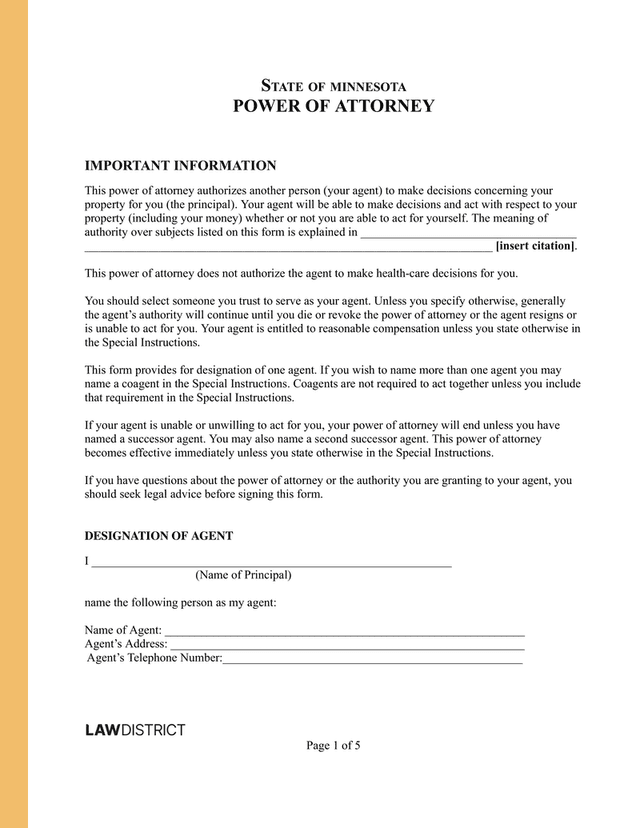
Looking over a completed Minnesota POA sample is a good place to start when you’re planning to create your own document. Use our template example below to understand the information that goes into this form and to learn more about what your document can do.
FAQs About Minnesota Power of Attorney Forms
It is important to have a good understanding of what Minnesota Power of Attorney forms can do before filling in your own. Read through our FAQs below to get a better idea of the key information needed as well as any other special considerations.
It is possible to create your own Minnesota Power of Attorney easily online with our easy contract maker. Alternatively, you can find templates for certain types of POA at your local DVS or Department of Revenue office or can pay to have a legal expert draft and complete your document.
A Minnesota Power of Attorney is an important legal document that allows you to appoint a trusted individual to act on behalf of you to carry out important activities. Once signed, these legal forms can be used for a number of different purposes depending on their type and listed powers.
These responsibilities include:
- Managing your financial affairs
- Making medical decisions for you if you are incapacitated
- Handling activities for you such as buying or selling property
A Statutory Durable Power of Attorney contains the wording that represents the legal standard of these legal instruments in Minnesota. Once completed and signed, this document allows an Agent to manage a Principal's financial affairs after any period of incapacity
Try Lawdistrict Now
Instant and complete access to our entire library of legal forms
Edit, download and print in PDF from any device
Save time and money on legal document creation