
Free Michigan Rental Application Form
The Michigan Rental Application Form is a formal document used to screen applicants before a lease is signed. It covers everything from employment history to income verification. Using this form allows you to vet candidates thoroughly while staying within the bounds of federal housing laws.

Fill forms in a few steps
Save, print & download
Done in 5 minutes
What Is a Michigan Residential Rental Application?
A Michigan rental application is a legal document used by landlords and property managers to assess and choose an appropriate tenant for a rental property. They are sometimes known by other common names such as:
- Tenant applications
- Rental lease applications
- Lease applications
- Application for a rental property
Having a rental application can prove highly important to make sure you get the right tenant into your property. The process of screening prospective residents in this way allows you to discover any issues such as their inability to pay rent or the likelihood to cause a nuisance before signing a contract.
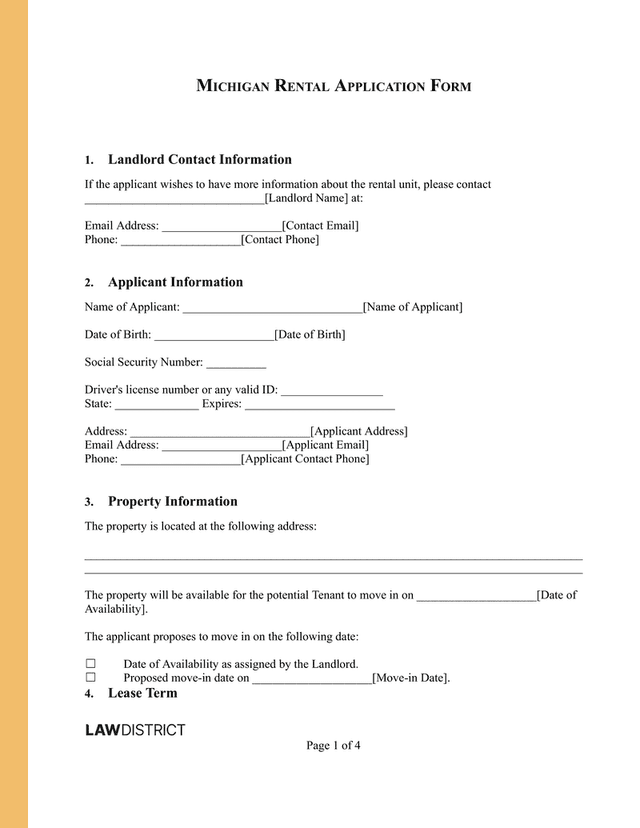
Michigan Rental Application Sample
Looking over a readily prepared template of a rental application can make it much easier to create your own. Review our document sample below to get more familiar with what your application form will look like when it’s completed.
What To Include in a Michigan Rental Application Form?
When you fill in a simple rental application form for Michigan you’ll need to ask for some crucial data from the tenant to make the vetting process as effective as possible.
When you create your own application for a rental property you should request the following information:
- Personal data
- Rental history
- Employment details
- Income information
- Credit history
- Personal references
- Permission for background checks
Furthermore, landlords must make a number of important disclosures on a standard rental application form. This information might include:
- The property’s condition
- Potential hazards to the tenant
- Shared utility arrangements
- Rent control rules
- Smoking policy
- The security deposit
- Associated fees
Michigan Rental Application Laws
Michigan state has various laws regarding the use of rental applications. If your document is not compliant with Michigan law, you may get sued by the applicant and face legal consequences.
Application Fee
In Michigan, there is generally no limit on the amount a landlord can charge for a rental application fee, and these fees are typically non-refundable. However, as of 2026, the Michigan legislature has seen introduced measures (such as House Bill 4770) aiming to cap these fees at $50 and require they be refunded if an application is denied. You should ensure your fee is reasonable and covers only the actual cost of background screening.
Security Deposit
Landlords cannot charge more than one and a half months' rent for a security deposit, regardless of whether the unit is furnished or unfurnished (Michigan Compiled Laws, Chapter 554, Section 554.602). Contrary to common misconceptions, Michigan law does not provide a higher 3-month limit for furnished properties.
Housing Discrimination Law
Michigan has robust state-level protections under the Elliott-Larsen Civil Rights Act (ELCRA) and the Persons With Disabilities Civil Rights Act. These laws are broader than the federal Fair Housing Act (FHA). It is illegal to discriminate based on:
- Race and Color
- National Origin
- Religion
- Sex, Sexual Orientation, and Gender Identity or Expression
- Familial Status
- Disability
- Age
- Marital Status
- Height or Weight
As a consequence, you are not allowed to use these details as a basis for rejection on a Lawdistrict Michigan Rental Application form nor to include them in the decision-making process.
Notice of Eligibility
Potential tenants must be informed about the screening criteria and reasons for denial or approval. To prove that these facts were shared, a signature of acknowledgment must be provided within the application or alongside it.
Consent Credit Check
Within Michigan, federal law is in effect that requires potential renters to provide written consent for a credit history check during the application process. This is known as the Federal Credit Reporting Act (FCRA).
FAQs About Michigan Rental Application Form
Having a good idea of what you can and cannot use a Michigan rental application for is important. In our FAQs below, we explain what is and isn’t allowed when you create your own form.
A credit reference is a document that provides information on the credit history of an applicant for a rental property. This may be requested on MI rental applications so that landlords can properly assess whether a potential tenant will be able to meet the rental payment schedule.
It's a simple process to search for eviction records in the state of Michigan. They are available to the public through the court's search system.
You can find any eviction that has been registered by the courts.
Go to the Michigan Courts Case Search and search by name. Then find the court case of the applicant if any exist.
This is a good way to see if an applicant has any past issues with landlords.
You cannot ask tenants a number of questions when you are vetting them with a Michigan rental application document. You must not request any of the following information from the applicant during this process:
- Race or ethnicity
- Religion
- Sexuality
- Immigration or citizenship status
- Arrest records
- Marital or familial status
- Whether they have children or not
Try Lawdistrict Now
Instant and complete access to our entire library of legal forms
Edit, download and print in PDF from any device
Save time and money on legal document creation