
Free Massachusetts Residential Lease Agreement Form
A Massachusetts Residential Lease Agreement is a formal rental contract between a property owner and tenant. It documents the main terms of the tenancy. This usually includes the rent amount, payment dates, lease length and deposit terms. It also outlines and the rights and obligations that apply during the rental period.

What type of property will you rent?
Fill forms in a few steps
Save, print & download
Done in 5 minutes
What is a Massachusetts Residential Lease Agreement ?
A lease agreement is a legally binding contract between a landlord and a tenant. This is written to conform to state laws where the property is located. In Massachusetts these allow both parties to comply with a series of set terms for a specified number of months or years.
Rental contracts and lease agreements have a lot of similarities as they both set out payment plans and the terms of use for a house or apartment. However, the big difference is the duration that they cover. Rental agreements usually only cover short-term tenancies of a few months at a time or month-to-month contracts.
A lease agreement should contain the following details:
- How long the tenant may legally reside in the property
- How much rent should be paid
- Information about the security deposits necessary
- When rental installments are due
- Any additional costs that must be serviced by the tenant
- The rules regarding the proper use of the property
- Situations that constitute lease violation eviction procedures
Massachusetts Residential Lease Agreement Sample
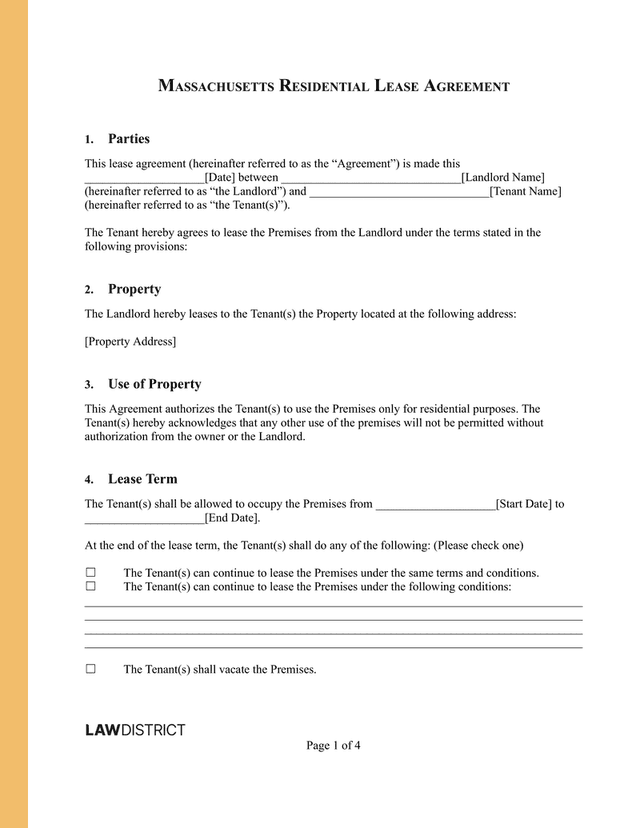
Before beginning the process of creating a residential lease agreement in Massachusetts it is sensible to review an example document first. Use our MA lease agreement sample below to find out more about the structure and contents of a fully-fledged rental contract.
Types of Massachusetts Lease Agreements
There are many types of MA lease agreement forms that can be used to manage and legally bind many different types of rental situations. They allow landlords to rent out various types of property they might have and for tenants to find the best kind of tenancy for their needs.
The most common types of lease agreements in Massachusetts include:
- Standard residential lease agreements: Under an Arizona standard lease agreement both the landlord and tenant commit to a fixed set of terms that last for a series of months or years.
- Lease with option to purchase: Lease agreements with rent-to-own options are designed for tenants in Arizona that wish to buy the property they are renting. This requires them to pay a sum of money each month, in addition to rent, to cover the costs of the principal.
- Month-to-month rental agreements: Month-to-month Arizona lease agreements will often have similar basic terms to standard residential lease contracts. However, they differ as they can be renewed or ended on a month-by-month basis. Their terms may also be flexibly altered each month.
- Commercial lease agreements: Commercial leases are provided by Arizona landlords of retail property to tenants that intend to use the real estate to run a business.
- Room rental (roommate) agreements: In Arizona rental properties with shared living areas a room rental agreement can be used to rent a singular bedroom.
- Sublease Agreement: An Arizona sublease agreement allows tenants to reassign or "sublease" the property to another individual. This requires the property landlord’s permission and must be specifically allowed in the original lease.
Massachusetts Lease Addendums and Disclosures
Massachusetts lease agreements must contain a few disclosures and addendums when they are completed and signed. This is to properly inform the tenant of any health risks or potential issues with the property or details about how the property is managed that they must be aware of.
These essential addendums include the following:
- Inventory checklist: At the time of receiving a security deposit or within 10 days of the tenancy beginning (whichever is later), the landlord must issue a Statement of Condition that enables the tenant to write down any damages or repairs that need to be performed on the property (MGL, Chapter 186, § 15B).
- Lead paint disclosure: If the rental unit is in a building constructed before 1978, the landlord or their agent must disclose whether lead paint can be found on the property and must provide safety information for any located on the premises (MGL, Chapter 111, § 197A).
- Security deposit holding disclosure: A section must be added advising the tenant on how the security deposit will be collected and stored, as well as informing the resident of key rules that apply in Massachusetts regarding the deposit (MGL, Chapter 186, § 15B).
- Security deposit receipt: Once the security deposit has been accepted by the landlord, a receipt must be issued immediately. Additionally, within 30 days of receiving the deposit, the landlord must provide a second receipt indicating the name and location of the bank where the funds are held (MGL, Chapter 186, § 15B).
- Fire insurance: Tenants must be informed of the terms and conditions of any fire insurance that is on the property upon written request (MGL, Chapter 186, § 21).
Massachusetts Lease Agreement Laws
A Massachusetts lease agreement must be written and signed within the laws of Massachusetts state, otherwise, it will be legally contestable and can be declared invalid and block either party from recourse if a violation is committed. These will police how you start and end the contract and control what procedures you can reasonably ask a tenant to follow.
The most important laws to consider when you are renting a property in Massachusetts include:
- Security deposits: Massachusetts landlords may charge no more than one month’s rent. This must be returned to the tenant within 30 days of vacating the property and returning the keys. Landlords must also give advance notice of any deductions (General Laws Annotated chapter 186, §15B).
- Landlord’s right to enter: Under the State Sanitary Code (105 C.M.R. 410.000), landlords must provide at least 48 hours' notice for non-emergency repairs. For other entries allowed by the lease (inspections or showings), a reasonable notice period is required, which is widely accepted as 24 hours. Entry always requires tenant permission unless there is a court order or an emergency.
- Move-in checklist: If a security deposit is collected, the landlord is legally required to provide a rental inspection checklist (Statement of Condition) within 10 days of the tenancy beginning.
For more specific information on Massachusetts lease agreement laws, check the MA government legislature.
FAQs About Massachusetts Lease Agreement
For additional information, take a look at this guide on landlord and tenant rights within Massachusetts.
If either the landlord or tenant for any reason needs to terminate an MA lease agreement early, they must provide the correct amount of notice in a written Massachusetts lease termination letter.
This letter needs to contain the following information:
- The name of the landlord and the tenant
- The date the letter has been written and signed
- The name and address of the property in question
- Information explaining why the tenancy needs to be terminated early
- The reason the lease is being broken
- The date that the resident will vacate the property
- Acknowledgment of any penalties that will be incurred
- Signature of the signing party
It’s important to have a written Massachusetts lease agreement in operation whether you are a landlord or a tenant. There are many advantages to having a formal contract for a rental property such as the right to recourse if the terms are violated and the protection of important legal rights for rental property owners and residents.
It is not necessary to notarize an MA residential lease agreement. However, whilst this might not be a legal requirement in Massachusetts state, signees are still advised to consider this step to provide further legal enforceability.
Try Lawdistrict Now
Instant and complete access to our entire library of legal forms
Edit, download and print in PDF from any device
Save time and money on legal document creation