


Key Takeaways
- Evictions are governed by state laws, and the process typically involves serving a notice, filing a lawsuit, attending court, and enforcing a judgment.
- Reasons for eviction include non-payment of rent, lease violations, property damage, criminal activity, or health code breaches.
- Landlords must follow legal procedures, as self-help evictions (e.g., changing locks or shutting off utilities) are prohibited in many states and can result in penalties.
- The timeline for eviction varies widely by state, ranging from a few weeks to several months, depending on local laws and court processes.
Eviction is a legal process a property owner can use to regain control from a tenant. In the United States , eviction is governed by state law, so the process and legal requirements vary widely between states.
In some places, removal can be accomplished in mere days, while in other states, it may take multiple court trips over many months.
If you’re planning to evict a tenant, make sure you check your state’s eviction laws before taking any action.
What is the Eviction Process?
Typically, the process begins with a notice of violation, continues in court, and ends with a tenant’s forced removal. State laws establish the process that eviction proceedings must follow.
In most jurisdictions, the eviction process is intended to prevent tenants from losing their homes before the court can sort out if there was a breach in the lease between landlord and tenant.
Reasons for Eviction
- Non-payment of rent
- Violations of the lease agreement
- Holdover tenancy, when a tenant maintains possession after the end of a lease
- Damage to the property caused by the tenant
- Criminal activity
- Health code violations
To understand how these reasons are legally defined and restricted, especially in jurisdictions with additional tenant protections, consider learning more about good cause eviction.
How Does an Eviction Process Work?
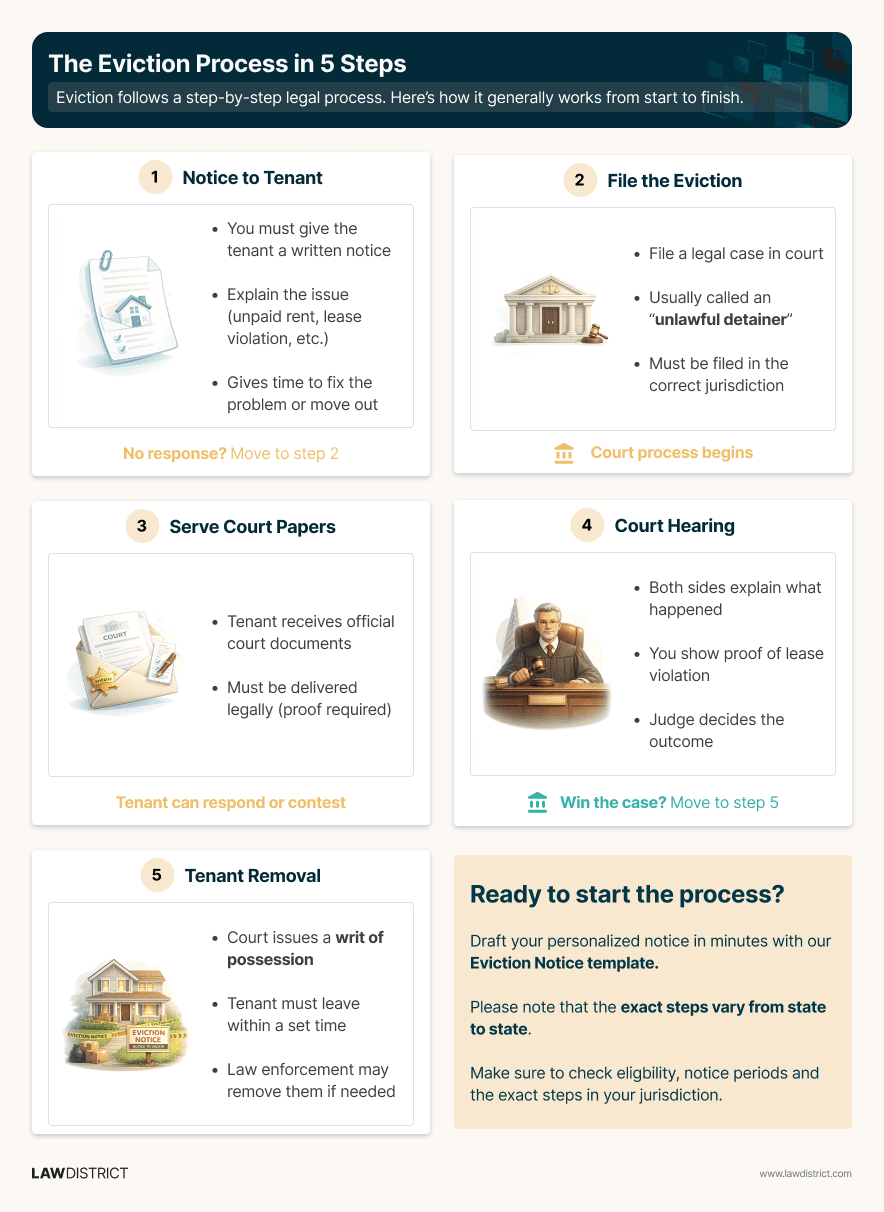
Once a landlord has determined that the lease was breached, they can begin the eviction process to retake possession of their property. Generally, the process follows the following five steps:
Step 1: Give the Eviction Notice to the Tenant
Before initiating legal action, landlords must serve the tenant with a written eviction notice.
This document must comply with local laws and specify the reason for eviction, the time allowed to resolve the issue, or the deadline to vacate.
Common notices include:
- Pay or quit notice: Allows tenants to stay if overdue rent is paid within a set timeframe (e.g., 3–5 days).
- Comply or quit notice: Gives tenants time to fix lease violations, such as unauthorized pets.
- Unconditional notice to quit: Requires tenants to leave without an option to remedy, typically used for severe or repeated lease violations like property damage or illegal activity.
If the tenant does not comply within the notice period, the landlord must proceed to court.
Step 2: Fill Out the Eviction Form
Landlords must file a formal complaint called "unlawful detainer" or "forcible entry and detainer" in the appropriate court.
Ensure all paperwork is accurate and filed in the property's jurisdiction. If the property is owned by a business entity, such as a corporation or an LLC, it must be listed as the plaintiff.
Create your Eviction Notice Now
Step 3: Serve Papers to the Tenant
The tenant must be officially notified of the lawsuit with proper notice by being served with court papers. This step requires proof of service to be submitted to the court.
Step 4: Eviction Trial
If the tenant contests the eviction, both parties will present their case in court. Landlords must provide evidence of lease violations and proper notice.
If successful, landlords may receive a judgment for possession and, in some cases, compensation for damages or attorney’s fees.
Step 5: After the Judgment
If the court rules in favor of the landlord, a writ of possession is issued. This allows local law enforcement to remove the tenant if they do not leave voluntarily within a specified timeframe.
Landlords should follow local laws regarding any belongings left behind by tenants, which may require storing items for a certain period.
For example, some states require the property to be stored for a certain amount of time to allow the tenant to recover their personal possessions.
Rules for Landlords in Evictions
Certain parts of the eviction workflow are best left to the courts and law enforcement.
Even where self-help eviction is legal, confrontations with tenants can quickly escalate. Damage to the property or violence is not uncommon in these situations.
These are some landlord don’ts:
- Attempting to remove the tenant from the property by force
- Removing the belongings of your tenants from the property until after a writ of possession is issued
- Changing the locks while the tenant still occupies the dwelling
- Utility shut-offs, such as water, gas, or electricity
- Harassing the tenants beyond serving legal notices
Eviction Notice Requirements by State
Review the table below to know exactly how much notice you must provide and for what type of contract breach.
Understand how much notice must be given to pay or vacate or cure or vacate in your state.
| State | Accepted Delivery Method | Days to Pay or Vacate | Days to Cure or Vacate | Laws |
|---|---|---|---|---|
| Alabama | - Hand delivery - Posting the notice on the property | 7 days | 14 days | § 35-9A-421(b), § 35-9A-421(a) |
| Alaska | - Hand delivery - Registered/certified mail | 7 days | 7 days | AS 34.03.220(b), AS 34.03.160 |
| Arizona | - Hand delivery - Registered/certified mail - Posting the notice on the property | 5 days | 10 days (week-to-week tenancy) 30 days (month-to-month) | § 33-1368(2b), § 33-1368(A) |
| Arkansas | - Hand delivery - Registered/certified mail | 3 days | 14 days | § 18-60-304(3), § 18-17-901 |
| California | - Hand delivery - Registered/certified mail | 3 days | 3 days | CCP § 1161(2), CCP §1161(3) |
| Colorado | - Hand delivery - Posting the notice on the property | 3 days | 3 days | § 13-40-104 |
| Connecticut | - Hand delivery - Posting the notice on the property | 3 days (non-curable, served 9 days after missed payment) | 3 days (non-curable, served 9 days after missed payment) | § 47a-23 |
| Delaware | - Hand delivery - Registered/certified mail - Posting the notice on the property | 5 days | 7 days | Title 25 § 5502, 25 § 5513 |
| District of Columbia | - Hand delivery - Posting the notice on the property AND mailing a copy by registered/certified mail | 30 days | 30 days | DC Law 22-245 |
| Florida | - Hand delivery - Registered/certified mail - Delivery as specified in the tenant's lease | 3 days | 7 days | § 83.56(3), § 83.56(1) |
| Georgia | - Hand delivery - Posting the notice on the property AND mailing a copy by registered/certified mail | 7 days (after receiving a Dispossessory procedure summons) | No specified period | § 44-7-50 |
| Hawaii | - Hand delivery - Posting the notice on the property | 5 days | 10 days | § 521-68, § 521-72 |
| Idaho | - Hand delivery - Posting the notice in the local newspaper AND mailing a copy by registered/certified mail | 3 days | 3 days | § 6-303(2), § 6-303(3) |
| Illinois | - Hand delivery - Registered/certified mail - Posting the notice on the property | 5 days | 10 days | 735 ILCS 5/9-209, 735 ILCS 5/9-210 |
| Indiana | - Hand delivery - Registered/certified mail - Leaving the notice on the property | 10 days | A reasonable period to cure the breach | IC 32-31-1-6 |
| Iowa | - Hand delivery - Posting the notice on the property AND mailing a copy by registered/certified mail | 3 days | 7 days | § 562a.27(2), § 562A.27(1) |
| Kansas | - Hand delivery - Registered/certified mail - Posting the notice on the property AND mailing a copy by registered/certified mail | 10 days | 14 days | *§ 58-2507, *§ 58-2564(1) |
| Kentucky | - Hand delivery - Posting the notice on the property AND mailing a copy by registered/certified mail | 7 days | 14 days | By county |
| Louisiana | - Hand delivery - Posting the notice on the property - Registered/certified mail (New Orleans East Bank only) | 5 days | 5 days | CCP 4701 |
| Maine | - Hand delivery - Posting the notice on the property AND mailing a copy by registered/certified mail | 7 days (served 7 days after non-payment) | 7 days | Title 14 § 6002, § 6025 & § 6002 |
| Maryland | - Hand delivery - Posting the notice on the property AND mailing a copy by registered/certified mail | Not necessary | 30 days (non-curable) 14 days if there is a risk of immediate danger to health | § 8-401, § 8–402.1 |
| Massachusetts | - Hand delivery - Registered/certified mail - Leaving the notice on the property | 14 days | No specified period | Chapter 186, Section 11 |
| Michigan | - Hand delivery - Posting the notice on the property | 7 days | No specified period | § 554.134(2), § 600.5714 and § 554.134(4) |
| Minnesota | - Hand delivery | 14 days | No specified period | § 504B.135(b) |
| Mississippi | - Hand delivery - Posting the notice on the property (nonpayment of rent only) - Posting the notice in the local newspaper (if other methods fail) | 3 days | 30 days | § 89-7-27, § 89-8-13(3)(b) |
| Missouri | - Hand delivery - Registered/certified mail - Leaving the notice on the property | Renter may cure non-payment up to 1 day before Unlawful Detainer trial date | 10 days | § 535.060, § 441.040 |
| Montana | - Hand delivery - Registered/certified mail | 3 days | 14 days 3 days in the case of unauthorized pets or occupants | § 70-24-422 |
| Nebraska | - Hand delivery - Delivery by process server - Posting the notice on the property AND mailing a copy by registered/certified mail | 3 days | 14 days | § 76-1431(2), § 76-1431(1) |
| Nevada | - Hand delivery | 5 days | 5 days to quit with 3 days to cure | NRS 40.2512 |
| New Hampshire | - Hand delivery | 7 days | 30 days | § 540:3 |
| New Jersey | - Hand delivery - Registered/certified mail - Posting the notice on the property | Not necessary or 30 days if landlord has accepted late rent previously | 30 days | § 2A:18-61.2(b) |
| New Mexico | - Hand delivery - Registered/certified mail - Leaving the notice on the property - Leaving a copy with the tenants employer AND mailing copies to the tenant's last known address AND workplace | 3 days | 7 days 3 days for an unauthorized occupant | § 47-8-33, § 47-8-33(b) |
| New York | - Hand delivery - Posting the notice on the property | 14 days | 30 days None if illegal activity has been committed on the property | § 711(2), § 753(4) |
| North Carolina | - Hand delivery - Registered/certified mail - Posting the notice on the property | 10 days | None or 10 days if substantial damage has been done to the property | § 42-3, § 42-26 |
| North Dakota | - Hand delivery - Registered/certified mail to the last known address of the tenant - Posting the notice on the property (if all other methods fail) | 3 days | 3 days | § 47-32 |
| Ohio | - Hand delivery - Registered/certified mail - Posting the notice on the property | 3 days | 3 days | § 1923.02 and § 1923.04, § 1923.04 |
| Oklahoma | - Hand delivery - Registered/certified mail - Posting the notice on the property | 5 days | 10 days | Title 41 § 131, § 41-132 |
| Oregon | - Hand delivery - Registered/certified mail - Posting the notice on the property | 3 days (served 7 days after non-payment) | 14 days | ORS § 90.394, § 90.392 |
| Pennsylvania | - Hand delivery - Registered/certified mail - Posting the notice on the property | 10 days | 15 days (for leases of less than 1 year) 30 days (for leases of over 1 year) | § 250.501(b) |
| Rhode Island | - Hand delivery - Registered/certified mail - Posting the notice on the property (if other methods fail) | 5 days (served after 15 days of non-payment) | 20 days | § 34-18-35, § 34-18-36 |
| South Carolina | - Hand delivery - Registered/certified mail - Delivery by process server | 5 days | 14 days | § 27-40-710(B), § 27-40-710 |
| South Dakota | - Hand delivery (1st attempt) - Posting the notice in the local newspaper (1st attempt, optional) - Posting the notice on the property AND mailing a copy by registered/certified mail (2nd attempt) | 3 days | A reasonable period to cure the breach | § 21-16-2(4), § 43-32-18 |
| Tennessee | - Hand delivery - Registered/certified mail - Posting the notice on the property AND mailing a copy | 14 days | 30 days | § 66-28-505, § 66-7-109 |
| Texas | - Hand delivery - Registered/certified mail - Posting the notice on the property | 3 days | 3 days | § 24.005 |
| Utah | - Hand delivery - Registered/certified mail - Leaving the notice on the property | 3 days | 3 days | § 78B-6-802 |
| Vermont | - Hand delivery - Posting the notice on the property | 14 days | 30 days 14 days if illegal activity has been committed by the tenant | § 4467 |
| Virginia | - Hand delivery - Posting the notice on the property AND mailing a copy | 5 days | 30 days | § 55.1-1415, § 55.1-1245 |
| Washington | - Hand delivery - Registered/certified mail (and leaving a copy with another resident of the property) | 14 days | 10 days | SB-5600, RCW 59.12.030 |
| West Virginia | - Hand delivery - Registered/certified mail | No specified period | No specified period | § 55-3A-1 |
| Wisconsin | - Hand delivery - Registered/certified mail - Posting the notice on the property AND mailing a copy | 5 days for 1st violation 14 days for 2nd violation | 5 days for 1st violation 14 days for 2nd violation | § 704.17(2) |
| Wyoming | - Hand delivery - Leaving a copy of the notice on the property with a fellow resident above the age of 14 | 3 days | 3 days | § 1-21-1003 |
If you do not deliver your notice legally or with the correct amount of notice, the eviction could be dismissed.
How Long Does the Eviction Process Take?
Eviction timelines vary significantly from state to state. The quickest states may go from posting of notice to a sheriff forcibly removing a tenant within two weeks. States with a slower process can take three or more months to have the eviction workflow make its way through the court system.
Even though most states or municipalities have a fast-tracked docket for evictions, the pace can slow if a judge determines they want to review additional evidence. All the while, the tenant can maintain possession of the property, though they will continue to owe rent during this time.
Helpful Resources
Key Takeaways
- Evictions are governed by state laws, and the process typically involves serving a notice, filing a lawsuit, attending court, and enforcing a judgment.
- Reasons for eviction include non-payment of rent, lease violations, property damage, criminal activity, or health code breaches.
- Landlords must follow legal procedures, as self-help evictions (e.g., changing locks or shutting off utilities) are prohibited in many states and can result in penalties.
- The timeline for eviction varies widely by state, ranging from a few weeks to several months, depending on local laws and court processes.
Eviction is a legal process a property owner can use to regain control from a tenant. In the United States , eviction is governed by state law, so the process and legal requirements vary widely between states.
In some places, removal can be accomplished in mere days, while in other states, it may take multiple court trips over many months.
If you’re planning to evict a tenant, make sure you check your state’s eviction laws before taking any action.
What is the Eviction Process?
Typically, the process begins with a notice of violation, continues in court, and ends with a tenant’s forced removal. State laws establish the process that eviction proceedings must follow.
In most jurisdictions, the eviction process is intended to prevent tenants from losing their homes before the court can sort out if there was a breach in the lease between landlord and tenant.
Reasons for Eviction
- Non-payment of rent
- Violations of the lease agreement
- Holdover tenancy, when a tenant maintains possession after the end of a lease
- Damage to the property caused by the tenant
- Criminal activity
- Health code violations
To understand how these reasons are legally defined and restricted, especially in jurisdictions with additional tenant protections, consider learning more about good cause eviction.
How Does an Eviction Process Work?
Once a landlord has determined that the lease was breached, they can begin the eviction process to retake possession of their property. Generally, the process follows the following five steps:
Step 1: Give the Eviction Notice to the Tenant
Before initiating legal action, landlords must serve the tenant with a written eviction notice.
This document must comply with local laws and specify the reason for eviction, the time allowed to resolve the issue, or the deadline to vacate.
Common notices include:
- Pay or quit notice: Allows tenants to stay if overdue rent is paid within a set timeframe (e.g., 3–5 days).
- Comply or quit notice: Gives tenants time to fix lease violations, such as unauthorized pets.
- Unconditional notice to quit: Requires tenants to leave without an option to remedy, typically used for severe or repeated lease violations like property damage or illegal activity.
If the tenant does not comply within the notice period, the landlord must proceed to court.
Step 2: Fill Out the Eviction Form
Landlords must file a formal complaint called "unlawful detainer" or "forcible entry and detainer" in the appropriate court.
Ensure all paperwork is accurate and filed in the property's jurisdiction. If the property is owned by a business entity, such as a corporation or an LLC, it must be listed as the plaintiff.
Create your Eviction Notice Now
Step 3: Serve Papers to the Tenant
The tenant must be officially notified of the lawsuit with proper notice by being served with court papers. This step requires proof of service to be submitted to the court.
Step 4: Eviction Trial
If the tenant contests the eviction, both parties will present their case in court. Landlords must provide evidence of lease violations and proper notice.
If successful, landlords may receive a judgment for possession and, in some cases, compensation for damages or attorney’s fees.
Step 5: After the Judgment
If the court rules in favor of the landlord, a writ of possession is issued. This allows local law enforcement to remove the tenant if they do not leave voluntarily within a specified timeframe.
Landlords should follow local laws regarding any belongings left behind by tenants, which may require storing items for a certain period.
For example, some states require the property to be stored for a certain amount of time to allow the tenant to recover their personal possessions.
Rules for Landlords in Evictions
Certain parts of the eviction workflow are best left to the courts and law enforcement.
Even where self-help eviction is legal, confrontations with tenants can quickly escalate. Damage to the property or violence is not uncommon in these situations.
These are some landlord don’ts:
- Attempting to remove the tenant from the property by force
- Removing the belongings of your tenants from the property until after a writ of possession is issued
- Changing the locks while the tenant still occupies the dwelling
- Utility shut-offs, such as water, gas, or electricity
- Harassing the tenants beyond serving legal notices
Eviction Notice Requirements by State
Review the table below to know exactly how much notice you must provide and for what type of contract breach.
Understand how much notice must be given to pay or vacate or cure or vacate in your state.
| State | Accepted Delivery Method | Days to Pay or Vacate | Days to Cure or Vacate | Laws |
|---|---|---|---|---|
| Alabama | - Hand delivery - Posting the notice on the property | 7 days | 14 days | § 35-9A-421(b), § 35-9A-421(a) |
| Alaska | - Hand delivery - Registered/certified mail | 7 days | 7 days | AS 34.03.220(b), AS 34.03.160 |
| Arizona | - Hand delivery - Registered/certified mail - Posting the notice on the property | 5 days | 10 days (week-to-week tenancy) 30 days (month-to-month) | § 33-1368(2b), § 33-1368(A) |
| Arkansas | - Hand delivery - Registered/certified mail | 3 days | 14 days | § 18-60-304(3), § 18-17-901 |
| California | - Hand delivery - Registered/certified mail | 3 days | 3 days | CCP § 1161(2), CCP §1161(3) |
| Colorado | - Hand delivery - Posting the notice on the property | 3 days | 3 days | § 13-40-104 |
| Connecticut | - Hand delivery - Posting the notice on the property | 3 days (non-curable, served 9 days after missed payment) | 3 days (non-curable, served 9 days after missed payment) | § 47a-23 |
| Delaware | - Hand delivery - Registered/certified mail - Posting the notice on the property | 5 days | 7 days | Title 25 § 5502, 25 § 5513 |
| District of Columbia | - Hand delivery - Posting the notice on the property AND mailing a copy by registered/certified mail | 30 days | 30 days | DC Law 22-245 |
| Florida | - Hand delivery - Registered/certified mail - Delivery as specified in the tenant's lease | 3 days | 7 days | § 83.56(3), § 83.56(1) |
| Georgia | - Hand delivery - Posting the notice on the property AND mailing a copy by registered/certified mail | 7 days (after receiving a Dispossessory procedure summons) | No specified period | § 44-7-50 |
| Hawaii | - Hand delivery - Posting the notice on the property | 5 days | 10 days | § 521-68, § 521-72 |
| Idaho | - Hand delivery - Posting the notice in the local newspaper AND mailing a copy by registered/certified mail | 3 days | 3 days | § 6-303(2), § 6-303(3) |
| Illinois | - Hand delivery - Registered/certified mail - Posting the notice on the property | 5 days | 10 days | 735 ILCS 5/9-209, 735 ILCS 5/9-210 |
| Indiana | - Hand delivery - Registered/certified mail - Leaving the notice on the property | 10 days | A reasonable period to cure the breach | IC 32-31-1-6 |
| Iowa | - Hand delivery - Posting the notice on the property AND mailing a copy by registered/certified mail | 3 days | 7 days | § 562a.27(2), § 562A.27(1) |
| Kansas | - Hand delivery - Registered/certified mail - Posting the notice on the property AND mailing a copy by registered/certified mail | 10 days | 14 days | *§ 58-2507, *§ 58-2564(1) |
| Kentucky | - Hand delivery - Posting the notice on the property AND mailing a copy by registered/certified mail | 7 days | 14 days | By county |
| Louisiana | - Hand delivery - Posting the notice on the property - Registered/certified mail (New Orleans East Bank only) | 5 days | 5 days | CCP 4701 |
| Maine | - Hand delivery - Posting the notice on the property AND mailing a copy by registered/certified mail | 7 days (served 7 days after non-payment) | 7 days | Title 14 § 6002, § 6025 & § 6002 |
| Maryland | - Hand delivery - Posting the notice on the property AND mailing a copy by registered/certified mail | Not necessary | 30 days (non-curable) 14 days if there is a risk of immediate danger to health | § 8-401, § 8–402.1 |
| Massachusetts | - Hand delivery - Registered/certified mail - Leaving the notice on the property | 14 days | No specified period | Chapter 186, Section 11 |
| Michigan | - Hand delivery - Posting the notice on the property | 7 days | No specified period | § 554.134(2), § 600.5714 and § 554.134(4) |
| Minnesota | - Hand delivery | 14 days | No specified period | § 504B.135(b) |
| Mississippi | - Hand delivery - Posting the notice on the property (nonpayment of rent only) - Posting the notice in the local newspaper (if other methods fail) | 3 days | 30 days | § 89-7-27, § 89-8-13(3)(b) |
| Missouri | - Hand delivery - Registered/certified mail - Leaving the notice on the property | Renter may cure non-payment up to 1 day before Unlawful Detainer trial date | 10 days | § 535.060, § 441.040 |
| Montana | - Hand delivery - Registered/certified mail | 3 days | 14 days 3 days in the case of unauthorized pets or occupants | § 70-24-422 |
| Nebraska | - Hand delivery - Delivery by process server - Posting the notice on the property AND mailing a copy by registered/certified mail | 3 days | 14 days | § 76-1431(2), § 76-1431(1) |
| Nevada | - Hand delivery | 5 days | 5 days to quit with 3 days to cure | NRS 40.2512 |
| New Hampshire | - Hand delivery | 7 days | 30 days | § 540:3 |
| New Jersey | - Hand delivery - Registered/certified mail - Posting the notice on the property | Not necessary or 30 days if landlord has accepted late rent previously | 30 days | § 2A:18-61.2(b) |
| New Mexico | - Hand delivery - Registered/certified mail - Leaving the notice on the property - Leaving a copy with the tenants employer AND mailing copies to the tenant's last known address AND workplace | 3 days | 7 days 3 days for an unauthorized occupant | § 47-8-33, § 47-8-33(b) |
| New York | - Hand delivery - Posting the notice on the property | 14 days | 30 days None if illegal activity has been committed on the property | § 711(2), § 753(4) |
| North Carolina | - Hand delivery - Registered/certified mail - Posting the notice on the property | 10 days | None or 10 days if substantial damage has been done to the property | § 42-3, § 42-26 |
| North Dakota | - Hand delivery - Registered/certified mail to the last known address of the tenant - Posting the notice on the property (if all other methods fail) | 3 days | 3 days | § 47-32 |
| Ohio | - Hand delivery - Registered/certified mail - Posting the notice on the property | 3 days | 3 days | § 1923.02 and § 1923.04, § 1923.04 |
| Oklahoma | - Hand delivery - Registered/certified mail - Posting the notice on the property | 5 days | 10 days | Title 41 § 131, § 41-132 |
| Oregon | - Hand delivery - Registered/certified mail - Posting the notice on the property | 3 days (served 7 days after non-payment) | 14 days | ORS § 90.394, § 90.392 |
| Pennsylvania | - Hand delivery - Registered/certified mail - Posting the notice on the property | 10 days | 15 days (for leases of less than 1 year) 30 days (for leases of over 1 year) | § 250.501(b) |
| Rhode Island | - Hand delivery - Registered/certified mail - Posting the notice on the property (if other methods fail) | 5 days (served after 15 days of non-payment) | 20 days | § 34-18-35, § 34-18-36 |
| South Carolina | - Hand delivery - Registered/certified mail - Delivery by process server | 5 days | 14 days | § 27-40-710(B), § 27-40-710 |
| South Dakota | - Hand delivery (1st attempt) - Posting the notice in the local newspaper (1st attempt, optional) - Posting the notice on the property AND mailing a copy by registered/certified mail (2nd attempt) | 3 days | A reasonable period to cure the breach | § 21-16-2(4), § 43-32-18 |
| Tennessee | - Hand delivery - Registered/certified mail - Posting the notice on the property AND mailing a copy | 14 days | 30 days | § 66-28-505, § 66-7-109 |
| Texas | - Hand delivery - Registered/certified mail - Posting the notice on the property | 3 days | 3 days | § 24.005 |
| Utah | - Hand delivery - Registered/certified mail - Leaving the notice on the property | 3 days | 3 days | § 78B-6-802 |
| Vermont | - Hand delivery - Posting the notice on the property | 14 days | 30 days 14 days if illegal activity has been committed by the tenant | § 4467 |
| Virginia | - Hand delivery - Posting the notice on the property AND mailing a copy | 5 days | 30 days | § 55.1-1415, § 55.1-1245 |
| Washington | - Hand delivery - Registered/certified mail (and leaving a copy with another resident of the property) | 14 days | 10 days | SB-5600, RCW 59.12.030 |
| West Virginia | - Hand delivery - Registered/certified mail | No specified period | No specified period | § 55-3A-1 |
| Wisconsin | - Hand delivery - Registered/certified mail - Posting the notice on the property AND mailing a copy | 5 days for 1st violation 14 days for 2nd violation | 5 days for 1st violation 14 days for 2nd violation | § 704.17(2) |
| Wyoming | - Hand delivery - Leaving a copy of the notice on the property with a fellow resident above the age of 14 | 3 days | 3 days | § 1-21-1003 |
If you do not deliver your notice legally or with the correct amount of notice, the eviction could be dismissed.
How Long Does the Eviction Process Take?
Eviction timelines vary significantly from state to state. The quickest states may go from posting of notice to a sheriff forcibly removing a tenant within two weeks. States with a slower process can take three or more months to have the eviction workflow make its way through the court system.
Even though most states or municipalities have a fast-tracked docket for evictions, the pace can slow if a judge determines they want to review additional evidence. All the while, the tenant can maintain possession of the property, though they will continue to owe rent during this time.
Helpful Resources
Most Popular Posts

Some states require a motor vehicle bill of sale form; others do not. Even if only for your personal records, anyone who buys or sells a vehicle needs

If you plan to travel with a minor, whether or not you are their parent, you can minimize inconveniences by carrying a few necessary documents...