
Free Special Warranty Deed
Use our Special Warranty Deed template to establish a solid foundation for your property transactions. Create your deed easily to protect against legal issues.

Fill forms in a few steps
Save, print & download
Done in 5 minutes
What Is a Special Warranty Deed?
A Special Warranty Deed form, or Limited Warranty Deed, is a legal document that transfers real estate with a limited warranty. It's used when sellers want to limit their responsibility for past title issues [1].
It is common in commercial leases or in sales involving foreclosed properties, where the seller might lack full historical knowledge of the property.
The Special Warranty Deed reassures the buyer about any encumbrances during the seller’s ownership period but also indicates that the buyer should conduct a thorough investigation of the property’s past.
For buyers, understanding the protections that a Special Warranty Deed offers is important. It balances risk and protection by safeguarding against recent claims while prompting a detailed examination of the property’s earlier history.
By choosing this deed, both parties can facilitate a more informed transaction, with clear knowledge of the legal assurances and their limits.
When To Use a Special Warranty Deed
Selecting the right type of deed is pivotal for both buyers and sellers. A Special Warranty Deed is particularly appropriate in the following scenarios due to its specific coverage scope:
| Scenario | Reason for Using Special Warranty Deed |
|---|---|
| Commercial Real Estate | Limits seller's guarantees to their ownership period, reducing liability. |
| Foreclosed Properties | Facilitates transfer without risk from unknown past title defects. |
| House Flipping | Offers limited assurances from short-term owners without prior title issues. |
| Transferring to a Trust or Business | Balances protection for the buyer with limited seller liability. |
| Strategic Risk Management | Important in transactions requiring clarity on legal responsibilities and protections. |
Choosing to use this document involves a strategic decision about risk management and liability in property transactions.
Both buyers and sellers must thoroughly understand their legal responsibilities and protections under this deed type to ensure a transparent and equitable exchange.
It is often advisable for buyers to obtain title insurance or a title policy to run a deeper check on the title history and understand if any pre-existing title defects predate the owner who is issuing the special warranty deed.
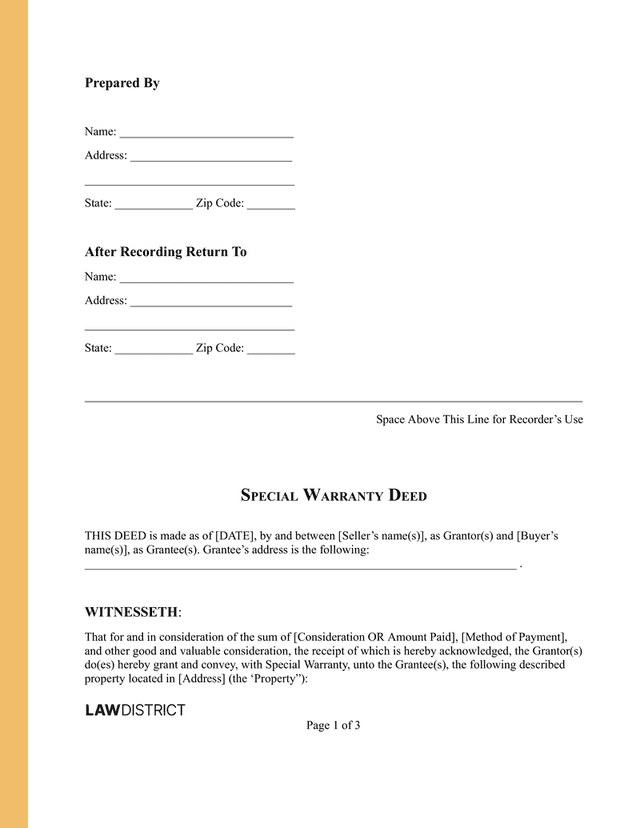
Special Warranty Deed Example
Before you start drafting your document, it's beneficial to review a well-written example.
Check out the sample below to get a clearer idea of how to structure your form.
What To Include in a Special Warranty Deed
A valid Special Warranty Deed must include the following:
- Grantor and grantee identification: Clearly state the full legal names and addresses of the seller (grantor) and the buyer (grantee).
- Property description: Include a detailed description of the property, which should have the physical address and legal description, such as lot numbers or subdivision names, or detailed metes and bounds descriptions.
- Warranty clause: Specify the scope of the warranty. The warranty should be explicitly limited to the period of the grantor's ownership, affirming that there are no known debts, liens, or encumbrances during that time*.
- Consideration: Document the consideration provided by the grantee, usually a monetary value, which legitimizes the contract under the law.
- Signatures: Ensure the deed is signed by the grantor and notarized to authenticate the identity of the signer and the voluntary nature of the signing.
- Attachments and exhibits: Attach any relevant documents that provide additional information about the property or the terms of the transaction, such as maps or more extensive legal descriptions.
*A special warranty deed can also include any specific encumbrances, debts, or liens that the grantor knows about. The grantor must specifically identify those to the grantee if they do exist.
Incorporating these elements into a Special Warranty Deed helps to accurately convey property rights with limited assurance and provides clarity on the rights and obligations of all parties involved.
How To Write a Limited Warranty Deed
To write a Limited Warranty Deed, follow these steps:
Gather information: Collect all necessary details about the parties involved (names and addresses) and the property (including a legal description).
Define the warranty terms: Specify the limitations of the warranty, focusing on what aspects of the title are covered and for which period during the grantor's ownership.
Outline the consideration: Record the compensation provided by the grantee, which legitimizes the transaction.
Execute the document: The grantor must sign the deed in front of a notary to verify its authenticity.
File the deed: Register the completed deed with the local land records office (also called the county recorder’s office) to officially record the transaction.
Use our ready-made Limited Warranty Deed template to create your document and avoid leaving important sections out.
Where To Register a Special Warranty Deed
To finalize a property transfer, you must record the deed. This step legally recognizes the transaction and updates public records.
Typically, you can file a Special Warranty of Deed at the following registration points:
- Local County Recorder’s Office: This office handles all local real estate records, keeping updated and accessible property ownership documentation.
- Registrar of Deeds: The responsibilities of recording deeds and managing property documents remain consistent across different titles.
- Online filing options: Many regions now support online deed registration, offering a quicker and more convenient filing method.
Registering your document at the appropriate local office is essential for making the property transfer official and for protecting both parties' interests in the transaction [2].
Special Warranty Deed vs General Warranty Deed
It's important to choose the correct deed. See the table below for differences between a Special Warranty Deed and a General Warranty Deed:
| Feature | Special Warranty Deed | General Warranty Deed |
|---|---|---|
| Coverage | Limited to seller's ownership period | Covers the entire history of the property |
| Protection | Guarantees no defects during seller's ownership | Guarantees against all title defects |
| Common Use | Commercial transactions, foreclosures | Residential property sales |
| Seller's Liability | Limited to the tenure of ownership | Extensive, includes all past ownership issues |
| Buyer's Security | Moderate; requires thorough due diligence | High; comprehensive protection |
| Preferred in | Quick sales, investment properties | Standard real estate transactions |
Make an informed decision based on the level of warranty and protection required during a property transaction.
Special Warranty Deed FAQs
For more clarity, check these answers to common questions about Special Warranty Deeds.
Yes, a Special Warranty Deed does transfer ownership of a property from the seller to the buyer. It guarantees that the seller has not encumbered the property during their period of ownership but does not cover any potential title issues that may have existed before they acquired it.
This makes it a secure way to transfer property rights within the specified limits of the deed.
A Special Warranty Deed specifically limits liability to the period during which the seller owned the property. The seller guarantees against any claims or encumbrances that arose only while they held the title.
Any issues or disputes from before the seller's ownership period are not covered, potentially leaving some liabilities with the buyer.
To file a Special Warranty Deed, first ensure that the deed is properly drafted, including all necessary legal descriptions and signatures. Once completed, the deed must be signed by the grantor and notarized.
The final step is to submit the deed to the county recorder's or land records office in the county where the property is located. This office will record the deed, making the transfer of property official and public.
Buying a house with a Special Warranty Deed can be a sound decision, particularly if you are aware of its limited scope of protection.
This deed guarantees that there are no known liens or encumbrances during the seller’s ownership period but does not cover issues before that. It is commonly used in specific circumstances like foreclosures or commercial transactions.
Try Lawdistrict Now
Instant and complete access to our entire library of legal forms
Edit, download and print in PDF from any device
Save time and money on legal document creation