



Key Takeaways:
- AI hallucinations in court are surging in recent years, with fake citations and false quotes as the leading error types.
- Unrepresented litigants and small practices submit most errors because they lack built-in legal review.
- Judges are penalizing unverified AI filings with heavy monetary fines, suspensions, and bar referrals.
- Model improvements will not eliminate hallucinations, making careful manual verification an essential requirement in all legal procedures.
Someone put words in Justice Antonin Scalia's mouth. ChatGPT invented a quote and attached it to a real Supreme Court opinion.
A federal judge used the line to open his sanctions order in ByoPlanet International v. Johansson and Gilstrap, where attorney James Martin Paul had submitted AI-assisted filings containing nonexistent cases and fabricated quotations.
Paul continued using unverified material even after the errors were flagged. The court ordered him to pay $85,567 in opposing counsel's fees.
This case is just one of many that demonstrates how quickly plausible AI output can become an expensive problem once it reaches a courtroom. In fact, there have been 574 documented cases in just six months, and we've spoken to an expert who is actively tracking each one to determine each case's impact.
The Case Count Is Exploding, but That Is Not the Whole Story
Lawdistrict spoke with Damien Charlotin, a senior research fellow at HEC Paris whose work focuses on AI and law. He teaches legal data analysis and the future of the legal profession at HEC Paris and Sciences Po and created the AI Hallucination Cases Database.
Charlotin's database recorded cases in the United States over a few years. There were 11 in 2023, 37 in 2024, and 526 in 2025. By the end of June 2026, it had logged another 574, more than during all of 2025.
Lawdistrict's modeling puts the full-year 2026 total at 1,200 to 1,300 if the current pace holds. If the acceleration seen in earlier years continues, our higher-growth model produces a range of 2,200 to 2,800. These are our projections, not Charlotin's forecasts.
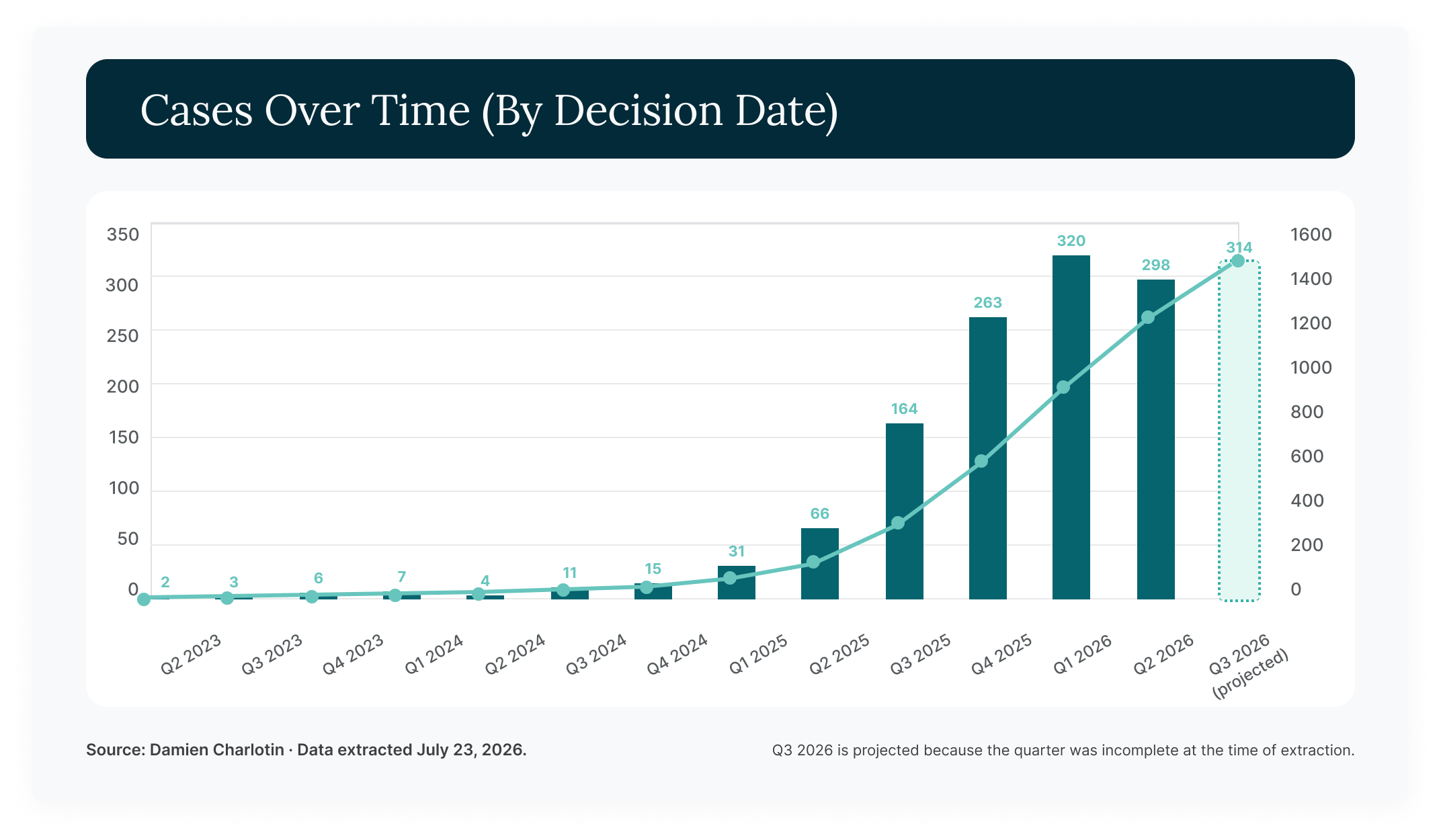
Charlotin was "not too surprised by the scale" but cautioned against treating it as proof of a widespread crisis. "Numbers are small compared to possible impact, showing that most filters work well," he said.
His point is that the rising count may reflect courts catching more errors, rather than a system failing to catch them.
What AI Actually Gets Wrong in Court
Of the 3,609 hallucinated items logged in Charlotin's database on July 23, 2026 (the date the data was extracted for this article), 53% were fabricated citations, 26% misrepresented real cases, and 20% were false quotations. These figures count individual errors, not court cases. A single filing can contain several items.
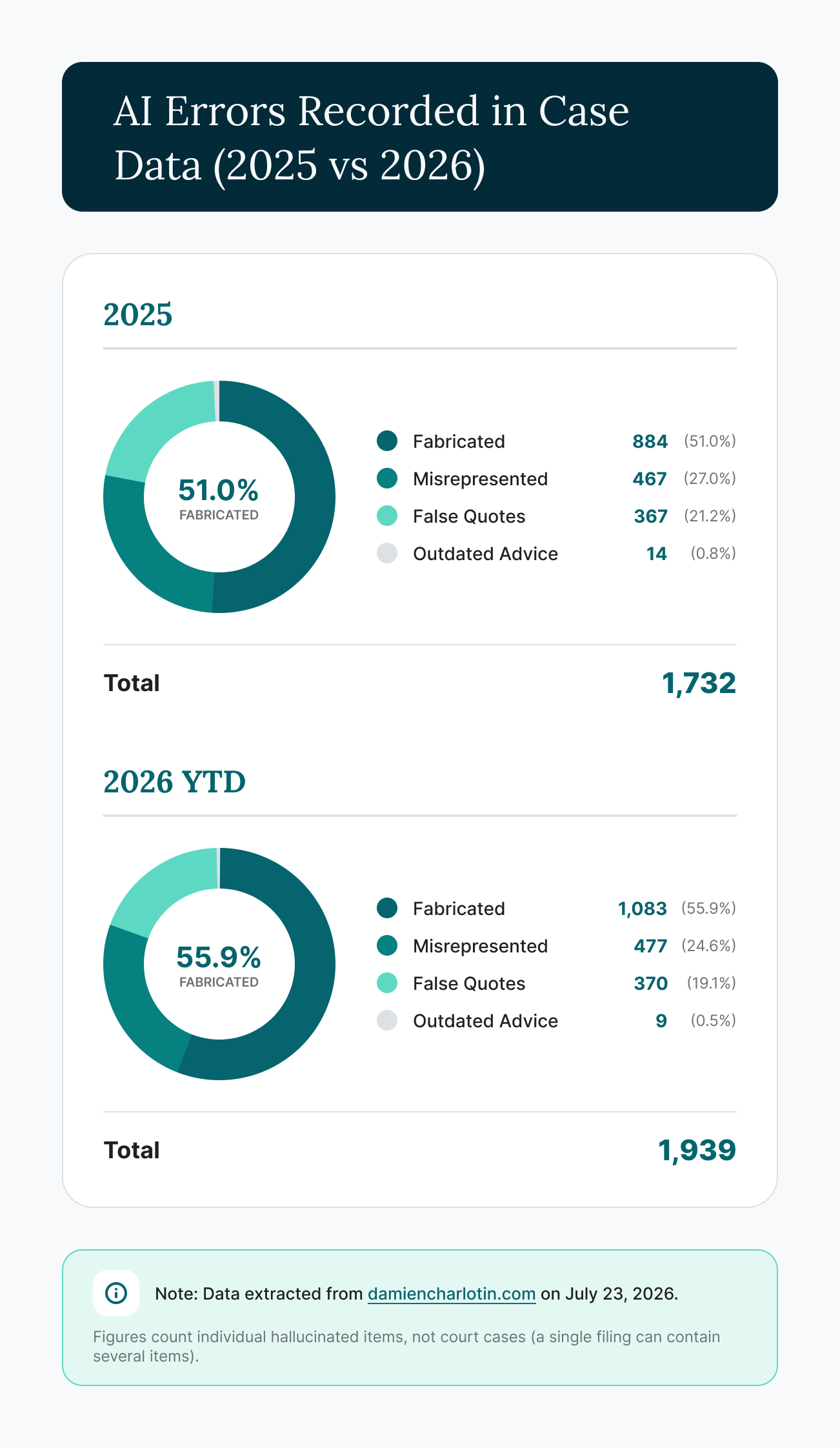
AI can do more than invent cases. It can also put words in the mouths of real judges or claim that genuine decisions reached conclusions they never did.
The overall mix has remained fairly consistent, with fake citations accounting for the largest share every year. False quotations, however, have grown from under 10% of items in 2023 to roughly one in five in 2025 and 2026.
"Because of how LLMs (large language models) work, pattern-matching is more likely to come up [with] a fake case name," Charlotin said. "To some extent, when LLMs land on a real name for a false quote or false proposition, you just got lucky the name is actually real."
That kind of luck can make the error harder to spot because the case itself will appear in a legal search.
Who Gets Caught Using AI in Court?
When it comes to the largest number of AI users in court, it is people representing themselves, accounting for 60% of the U.S. cases according to Charlotin's data, compared with 38% involving licensed attorneys.
Pro se litigants are the largest group by a wide margin, but the attorney figure shows that this cannot be dismissed as an outsider problem.
"It's mostly pro se litigants and solo/small practitioners," Charlotin said. The common factor, in his view, is the absence of built-in review. People representing themselves may have no legal training or second reader, while small practices often lack the associates, research teams, and formal citation checks available to larger firms.
Charlotin said the biggest misconception is "that it's an issue that's about to be solved or only afflict small-time attorneys."
"Many don't count properly the blessings of working in big teams where eventually someone checks and catches those issues," he added.
The data may therefore reveal who lacks a verification safety net, rather than who is most careless with AI.
Five Cases That Show What Courtroom Hallucinations Look Like
The consequences go far beyond correcting a filing. These five cases show how unverified AI output can lead to fines, suspensions, disqualification, and professional discipline.
ByoPlanet International v. Johansson and Gilstrap
The sanctions order opened with a quotation ChatGPT falsely attributed to Justice Scalia, which the judge used to demonstrate the technology's confidence. Attorney James Martin Paul's own filings contained repeated fabricated authorities.
Even after a show-cause order, later responses included more false material. Four cases were dismissed, Paul was ordered to pay $85,567 in opposing counsel's fees, and he was referred to the Florida Bar.
This shows that repeating false citations after notice transformed a verification failure into bad-faith misconduct that threatened the underlying cases themselves.
Case information: ByoPlanet International v. Johansson and Gilstrap
Lnu v. Blanche
In this immigration case, two attorneys filed briefs containing nonexistent cases, false quotes, and serious misrepresentations of real holdings. The Ninth Circuit found similar problems in their other filings, fined each attorney $2,500, suspended both for six months, and imposed notification requirements.
This shows that the concealment was more damaging than the initial hallucination, because had it been disclosed immediately, the sanctions might have been reduced, but repeated denials increased them.
Case information: Lnu v. Blanche
Mattox v. Product Innovations Research
Across 11 pleadings, plaintiffs' lawyers used fabricated citations and false quotations. The $28,495 in sanctions included fines and fee awards, public reprimands, and mandatory verification certificates for future filings.
The number of errors matters because they span 11 pleadings, showing how one unchecked workflow can systematically distort a case rather than cause an isolated mistake.
Case information: Mattox v. Product Innovations Research
Withers v. City of Aberdeen
Both sides submitted fabricated citations after using the same legal drafting tool. The court imposed $8,000 in fines, revoked two pro hac vice admissions, disqualified local counsel, and made Bar referrals.
This case shows that multiple legal teams failing reveals a widespread issue. Neither adversarial review nor local counsel works as a safeguard when no one bothers to verify the facts.
Case information: Withers v. City of Aberdeen
Rivera v. Triad Properties
The court imposed a public reprimand, a three-month suspension, disqualification, Bar referral, and publication of its order. Fees reached $35,603.90 for one defendant group, plus $11,453 for another.
The case shows how a hallucination can become a governance crisis. Concealment and weak firm controls expanded responsibility beyond the drafter and compounded the disruption.
Case information: Rivera v. Triad Properties
How Courts Are Actually Punishing AI Hallucinations: "Patchwork"
More than one in five cases involving attorneys in Charlotin's database end in a Bar referral or another professional sanction. Recorded monetary sanctions now exceed $1.15 million, while the most expensive single case reached $110,204.
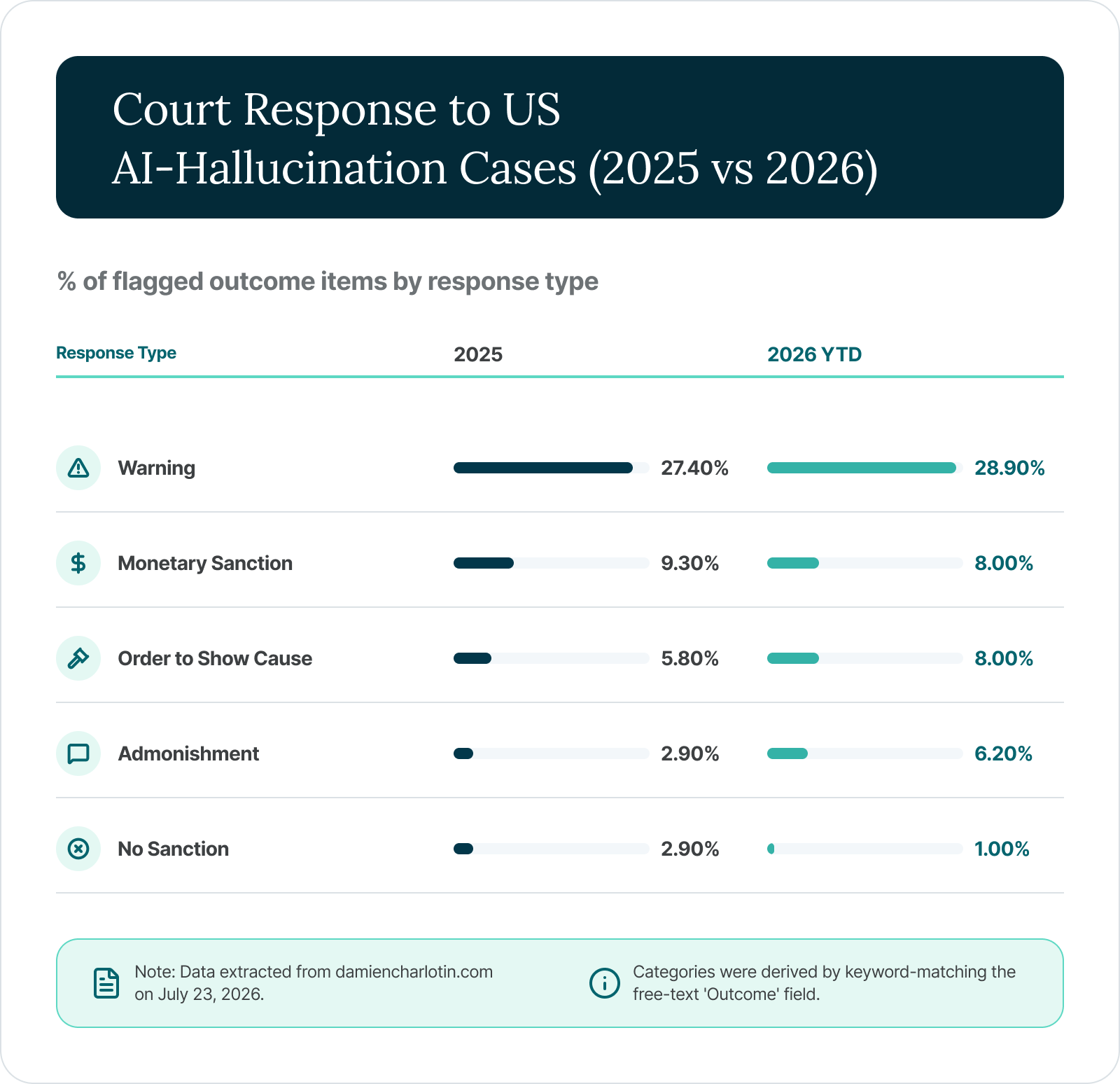
Those figures suggest serious consequences, but Charlotin describes the overall response as "relatively lenient."
"That's normal," he said. "Most cases are simply born from human errors and mistakes in using AI, not the recklessness or vexatiousness that drives most sanctions."
There is also no shared standard for deciding when an error deserves a warning, a fine, a suspension, or a referral. Charlotin had one word for whether courts have settled on a consistent approach:
"Patchwork."
The Problem Is Neither Solved nor Contained
The records Charlotin has assembled do not point to a problem that will simply disappear as models improve. Nor does the concentration among pro se litigants and smaller practices imply that larger firms are immune.
Their review systems may catch more errors before filing, but they still rely on tools that can produce them.
Charlotin said the biggest misconception is "that it's an issue that's about to be solved or only afflicts small-time attorneys."
None of these solutions will necessarily eliminate fabricated authorities altogether. When asked which of those forces will shape the next phase, Charlotin did not choose one.
"All three at the same time; hallucinations will just become a cost of doing business."
That leaves the legal system in much the same position as the Scalia quotation that opened the ByoPlanet sanctions order. The words looked authoritative until someone checked. As the number of recorded cases continues to climb, courts, firms, and litigants are building more ways to perform that check.
Errors will still reach some dockets, and the consequences will remain uneven.
Methodology
Charlotin began the project while teaching about AI and the legal profession. When discussing hallucinations with his students, he wanted to determine how often they were becoming an actual issue in court.
He does not independently determine whether an error was caused by AI rather than by careless research. "I don't make that judgment," he said. "I simply collect cases where courts themselves made that judgment."
The resulting figures in Charlotin's AI hallucination database measure documented court decisions, not every hallucinated filing that may have been submitted.
Coverage also depends on access to court records. Charlotin described the collection as "excellent and very complete for U.S. federal law" and some other English-speaking jurisdictions. Records from elsewhere can be considerably harder to access.
Cases that are not detected, discussed by a court, or made publicly available may therefore be missing from the totals.
Projections for full-year 2026 AI hallucination cases, including those involving AI models like Claude, were generated independently using Lawdistrict's predictive modeling (1,200 to 1,300 under current growth; 2,200 to 2,800 under accelerated growth).
References:
Table of Contents:
- The Case Count Is Exploding, but That Is Not the Whole Story
- What AI Actually Gets Wrong in Court
- Who Gets Caught Using AI in Court?
- Five Cases That Show What Courtroom Hallucinations Look Like
- How Courts Are Actually Punishing AI Hallucinations: "Patchwork"
- The Problem Is Neither Solved nor Contained
- Methodology
- References:
Table of Contents:
- The Case Count Is Exploding, but That Is Not the Whole Story
- What AI Actually Gets Wrong in Court
- Who Gets Caught Using AI in Court?
- Five Cases That Show What Courtroom Hallucinations Look Like
- How Courts Are Actually Punishing AI Hallucinations: "Patchwork"
- The Problem Is Neither Solved nor Contained
- Methodology
- References:
Key Takeaways:
- AI hallucinations in court are surging in recent years, with fake citations and false quotes as the leading error types.
- Unrepresented litigants and small practices submit most errors because they lack built-in legal review.
- Judges are penalizing unverified AI filings with heavy monetary fines, suspensions, and bar referrals.
- Model improvements will not eliminate hallucinations, making careful manual verification an essential requirement in all legal procedures.
Someone put words in Justice Antonin Scalia's mouth. ChatGPT invented a quote and attached it to a real Supreme Court opinion.
A federal judge used the line to open his sanctions order in ByoPlanet International v. Johansson and Gilstrap, where attorney James Martin Paul had submitted AI-assisted filings containing nonexistent cases and fabricated quotations.
Paul continued using unverified material even after the errors were flagged. The court ordered him to pay $85,567 in opposing counsel's fees.
This case is just one of many that demonstrates how quickly plausible AI output can become an expensive problem once it reaches a courtroom. In fact, there have been 574 documented cases in just six months, and we've spoken to an expert who is actively tracking each one to determine each case's impact.
The Case Count Is Exploding, but That Is Not the Whole Story
Lawdistrict spoke with Damien Charlotin, a senior research fellow at HEC Paris whose work focuses on AI and law. He teaches legal data analysis and the future of the legal profession at HEC Paris and Sciences Po and created the AI Hallucination Cases Database.
Charlotin's database recorded cases in the United States over a few years. There were 11 in 2023, 37 in 2024, and 526 in 2025. By the end of June 2026, it had logged another 574, more than during all of 2025.
Lawdistrict's modeling puts the full-year 2026 total at 1,200 to 1,300 if the current pace holds. If the acceleration seen in earlier years continues, our higher-growth model produces a range of 2,200 to 2,800. These are our projections, not Charlotin's forecasts.
Charlotin was "not too surprised by the scale" but cautioned against treating it as proof of a widespread crisis. "Numbers are small compared to possible impact, showing that most filters work well," he said.
His point is that the rising count may reflect courts catching more errors, rather than a system failing to catch them.
What AI Actually Gets Wrong in Court
Of the 3,609 hallucinated items logged in Charlotin's database on July 23, 2026 (the date the data was extracted for this article), 53% were fabricated citations, 26% misrepresented real cases, and 20% were false quotations. These figures count individual errors, not court cases. A single filing can contain several items.
AI can do more than invent cases. It can also put words in the mouths of real judges or claim that genuine decisions reached conclusions they never did.
The overall mix has remained fairly consistent, with fake citations accounting for the largest share every year. False quotations, however, have grown from under 10% of items in 2023 to roughly one in five in 2025 and 2026.
"Because of how LLMs (large language models) work, pattern-matching is more likely to come up [with] a fake case name," Charlotin said. "To some extent, when LLMs land on a real name for a false quote or false proposition, you just got lucky the name is actually real."
That kind of luck can make the error harder to spot because the case itself will appear in a legal search.
Who Gets Caught Using AI in Court?
When it comes to the largest number of AI users in court, it is people representing themselves, accounting for 60% of the U.S. cases according to Charlotin's data, compared with 38% involving licensed attorneys.
Pro se litigants are the largest group by a wide margin, but the attorney figure shows that this cannot be dismissed as an outsider problem.
"It's mostly pro se litigants and solo/small practitioners," Charlotin said. The common factor, in his view, is the absence of built-in review. People representing themselves may have no legal training or second reader, while small practices often lack the associates, research teams, and formal citation checks available to larger firms.
Charlotin said the biggest misconception is "that it's an issue that's about to be solved or only afflict small-time attorneys."
"Many don't count properly the blessings of working in big teams where eventually someone checks and catches those issues," he added.
The data may therefore reveal who lacks a verification safety net, rather than who is most careless with AI.
Five Cases That Show What Courtroom Hallucinations Look Like
The consequences go far beyond correcting a filing. These five cases show how unverified AI output can lead to fines, suspensions, disqualification, and professional discipline.
ByoPlanet International v. Johansson and Gilstrap
The sanctions order opened with a quotation ChatGPT falsely attributed to Justice Scalia, which the judge used to demonstrate the technology's confidence. Attorney James Martin Paul's own filings contained repeated fabricated authorities.
Even after a show-cause order, later responses included more false material. Four cases were dismissed, Paul was ordered to pay $85,567 in opposing counsel's fees, and he was referred to the Florida Bar.
This shows that repeating false citations after notice transformed a verification failure into bad-faith misconduct that threatened the underlying cases themselves.
Case information: ByoPlanet International v. Johansson and Gilstrap
Lnu v. Blanche
In this immigration case, two attorneys filed briefs containing nonexistent cases, false quotes, and serious misrepresentations of real holdings. The Ninth Circuit found similar problems in their other filings, fined each attorney $2,500, suspended both for six months, and imposed notification requirements.
This shows that the concealment was more damaging than the initial hallucination, because had it been disclosed immediately, the sanctions might have been reduced, but repeated denials increased them.
Case information: Lnu v. Blanche
Mattox v. Product Innovations Research
Across 11 pleadings, plaintiffs' lawyers used fabricated citations and false quotations. The $28,495 in sanctions included fines and fee awards, public reprimands, and mandatory verification certificates for future filings.
The number of errors matters because they span 11 pleadings, showing how one unchecked workflow can systematically distort a case rather than cause an isolated mistake.
Case information: Mattox v. Product Innovations Research
Withers v. City of Aberdeen
Both sides submitted fabricated citations after using the same legal drafting tool. The court imposed $8,000 in fines, revoked two pro hac vice admissions, disqualified local counsel, and made Bar referrals.
This case shows that multiple legal teams failing reveals a widespread issue. Neither adversarial review nor local counsel works as a safeguard when no one bothers to verify the facts.
Case information: Withers v. City of Aberdeen
Rivera v. Triad Properties
The court imposed a public reprimand, a three-month suspension, disqualification, Bar referral, and publication of its order. Fees reached $35,603.90 for one defendant group, plus $11,453 for another.
The case shows how a hallucination can become a governance crisis. Concealment and weak firm controls expanded responsibility beyond the drafter and compounded the disruption.
Case information: Rivera v. Triad Properties
How Courts Are Actually Punishing AI Hallucinations: "Patchwork"
More than one in five cases involving attorneys in Charlotin's database end in a Bar referral or another professional sanction. Recorded monetary sanctions now exceed $1.15 million, while the most expensive single case reached $110,204.
Those figures suggest serious consequences, but Charlotin describes the overall response as "relatively lenient."
"That's normal," he said. "Most cases are simply born from human errors and mistakes in using AI, not the recklessness or vexatiousness that drives most sanctions."
There is also no shared standard for deciding when an error deserves a warning, a fine, a suspension, or a referral. Charlotin had one word for whether courts have settled on a consistent approach:
"Patchwork."
The Problem Is Neither Solved nor Contained
The records Charlotin has assembled do not point to a problem that will simply disappear as models improve. Nor does the concentration among pro se litigants and smaller practices imply that larger firms are immune.
Their review systems may catch more errors before filing, but they still rely on tools that can produce them.
Charlotin said the biggest misconception is "that it's an issue that's about to be solved or only afflicts small-time attorneys."
None of these solutions will necessarily eliminate fabricated authorities altogether. When asked which of those forces will shape the next phase, Charlotin did not choose one.
"All three at the same time; hallucinations will just become a cost of doing business."
That leaves the legal system in much the same position as the Scalia quotation that opened the ByoPlanet sanctions order. The words looked authoritative until someone checked. As the number of recorded cases continues to climb, courts, firms, and litigants are building more ways to perform that check.
Errors will still reach some dockets, and the consequences will remain uneven.
Methodology
Charlotin began the project while teaching about AI and the legal profession. When discussing hallucinations with his students, he wanted to determine how often they were becoming an actual issue in court.
He does not independently determine whether an error was caused by AI rather than by careless research. "I don't make that judgment," he said. "I simply collect cases where courts themselves made that judgment."
The resulting figures in Charlotin's AI hallucination database measure documented court decisions, not every hallucinated filing that may have been submitted.
Coverage also depends on access to court records. Charlotin described the collection as "excellent and very complete for U.S. federal law" and some other English-speaking jurisdictions. Records from elsewhere can be considerably harder to access.
Cases that are not detected, discussed by a court, or made publicly available may therefore be missing from the totals.
Projections for full-year 2026 AI hallucination cases, including those involving AI models like Claude, were generated independently using Lawdistrict's predictive modeling (1,200 to 1,300 under current growth; 2,200 to 2,800 under accelerated growth).
References:
Most Popular Posts
Some states require a motor vehicle bill of sale form; others do not. Even if only for your personal records, anyone who buys or sells a vehicle needs
If you plan to travel with a minor, whether or not you are their parent, you can minimize inconveniences by carrying a few necessary documents...