


Key Takeaways:
- Purely AI-generated content lacks human authorship and cannot be protected by copyright in the United States.
- Creators can only copyright AI-assisted projects that feature substantial human editing or original arrangement.
- Using copyrighted material to train AI models is currently a fiercely debated legal issue regarding fair use.
- Timely registration with the U.S. Copyright Office is the best way for creators to legally protect their work.
AI now allows us to create images, essays, and songs in seconds. You just enter a prompt describing the output you want and instantly receive it.
But who owns this output? Can you copyright it? We spoke with patent attorney Steven Schlackman to find out.
What a Monkey Selfie Can Tell Us About Copyright
In 2011, wildlife photographer David Slater left his camera unattended in an Indonesian nature reserve. A crested macaque named Naruto picked it up and took several selfies, which instantly went viral.
Slater later published the selfies in his photography book "Wildlife Personalities," leading PETA to sue on Naruto's behalf. They argued that the monkey owned the copyright to the images, as he was the photographer in this case, not Slater.
In 2018, the Court of Appeals for the Ninth Circuit ruled that animals cannot bring claims under the Copyright Act.
Seven years later, the same basic question sits at the center of a much bigger debate: what happens when the creator of an image, article, or song isn't human?
What if it's a machine?
For purely AI-generated work, U.S. law currently gives a clear answer: copyright requires sufficient human authorship. In 2025, the D.C. Circuit upheld that principle in Thaler v. Perlmutter.
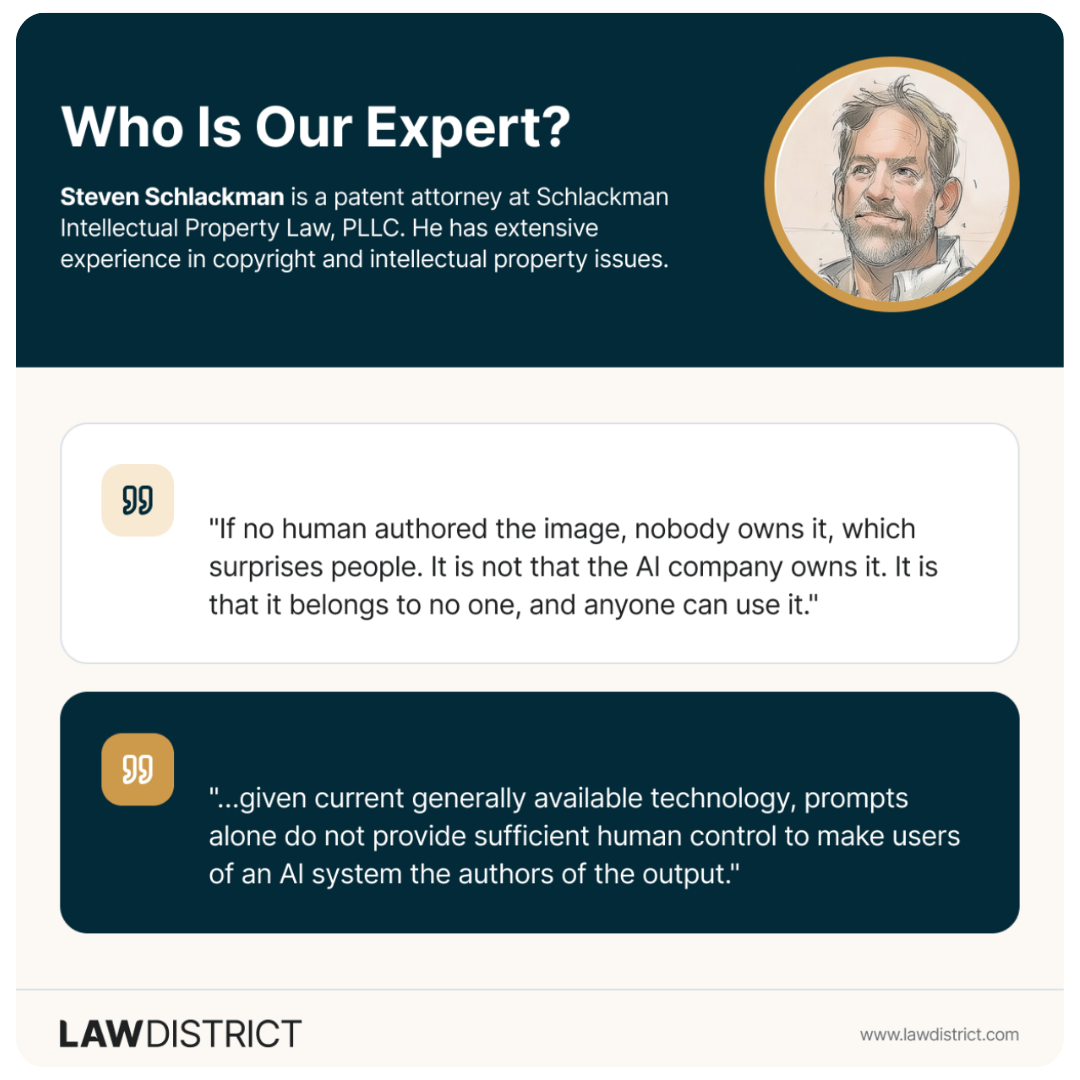
As copyright lawyer Steven Schlackman told us, that leads to a result many AI users may not expect:
Why a Detailed Prompt Does Not Give You Copyright of AI Art
Some argue that making a long, detailed prompt is similar to the efforts made by human artists. They point out that constantly updating the prompt and asking for changes to be made so that the art fits their vision is "demonstrable human effort."
The U.S. Copyright Office decided to put this to the test, as explained in a report they published on copyright and artificial intelligence. They asked an AI image generator to create a very specific scene featuring a cat reading a newspaper, providing detailed instructions about the setting, lighting, and composition.
While it did generate an image similar to what they described, the AI ignored some directions and added details of its own. The Copyright Office concluded that:
In short, they maintain that copyright depends on human control over the final expression, not simply how much effort went into giving instructions.
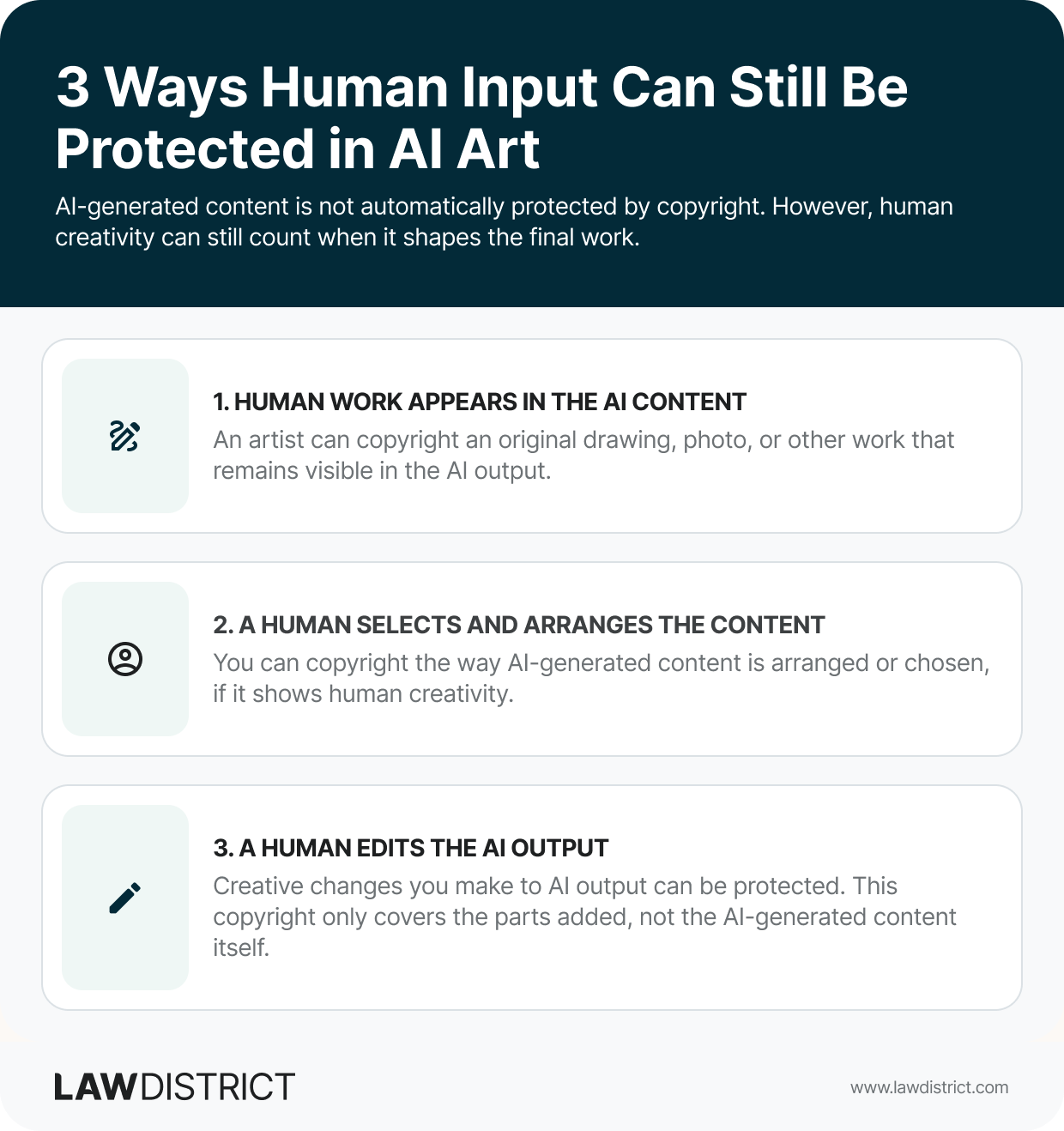
However, there are still ways human contributions to AI-assisted work can be protected, as asserted by the Copyright Office:
-
Your own work appears in the result: If copyrightable material you created remains clearly visible in the final work, that part may still be protected.
-
You choose and arrange the content: The selection and arrangement of AI-generated material can be protected. The Zarya of the Dawn case illustrated this, with protection for the text and layout of a graphic novel, but not the AI images.
-
You substantially edit the result: Creative changes made after generation may qualify for protection if they reflect enough human authorship.
So the key question is not how detailed your prompt was. It's how much of the finished work was actually created or controlled by you.
Can AI Companies Train Their Models Using Your Work?
If you can't own AI-generated art, can you at least stop AI companies from training their models using your work? That depends on whether this qualifies as fair use.
As Schlackman explains:
Whether using copyrighted material to train AI models passes that test is still being fiercely debated.
Courts have started ruling on individual AI copyright disputes, but there is still no clear rule covering every use of copyrighted material for training AI models.
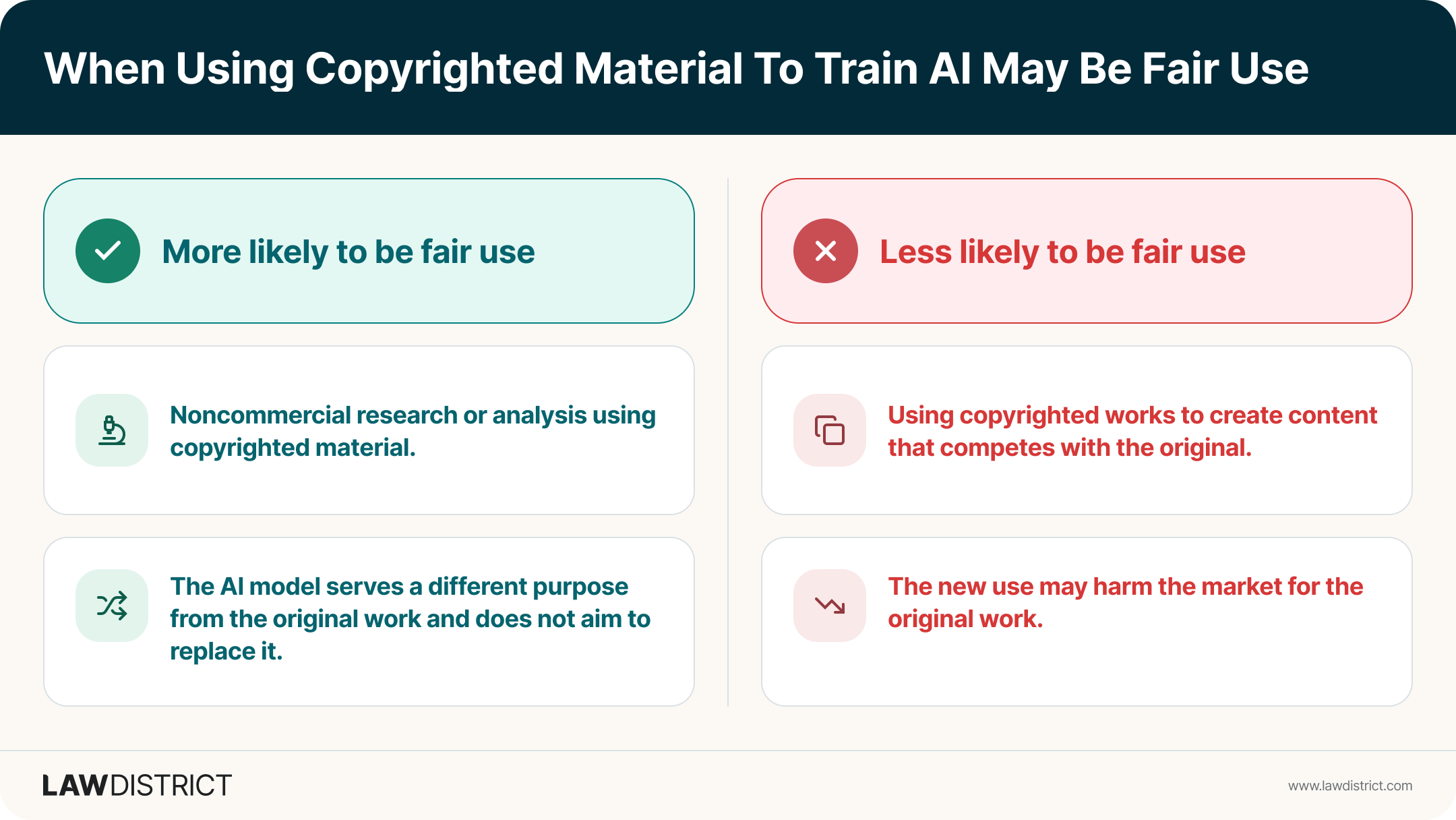
AI companies already have useful case law to point to. In Authors Guild v. Google, Google copied millions of books to build a searchable database. The court found that use was fair because the search tool served a different purpose and did not replace the books themselves.
The Copyright Office applies a similar fair use framework to AI training. Rather than saying AI training is always fair use or always infringement, it said in another report on generative AI that the circumstances matter:
In simple terms, training a model for noncommercial research is very different from using pirated material to build a commercial product that competes with the original work.
Is AI learning really the same as human learning?
Another part of the debate is whether AI training is really comparable to human learning in the first place. AI companies argue that training a model is similar to how a human artist learns by studying other people's work.
Schlackman does not think that comparison holds, saying that it's "...not really a true comparison because the artist generally isn't copying the works, they are seeing them live or in books."
He also believes that where the line will actually be drawn with regard to the use of copyrighted material to train AI models has to do with more than just legal doctrine:
If AI Training Can Be Fair Use, Why Are Companies Paying for Licenses?
In August 2026, Sony Music Publishing and Warner Chappell sued Anthropic, alleging that it illegally obtained copyrighted lyrics and sheet music to train Claude. The case seeks up to $150,000 per infringed work. Anthropic, of course, disputes the allegations.
The lawsuit focuses on how Anthropic allegedly obtained that material, including claims of illegal torrenting, scraping, and downloading.
This distinction has mattered before. In Bartz v. Anthropic, a federal judge ruled that using books to train Claude was fair use. However, the judge separately found that downloading pirated books to build a permanent library was not. A $1.5 billion settlement received final approval in July 2026.
This makes it the largest U.S. copyright settlement to date. In other words, the biggest AI copyright payout so far centered on piracy rather than a finding that AI training itself was unlawful.
This case helps explain why AI companies are increasingly signing licensing deals. They now pay for access to the copyrighted content used to train their models, hoping to reduce the risk of another piracy dispute.
But those licensing deals may also make the fair use defense harder to sustain. As Schlackman told us:
However, not every work can be easily licensed. Schlackman points out that there is no practical way to negotiate individually with millions of authors, photographers, or artists.
Instead, licensing deals usually happen through large rights holders, like publishers or record labels. Schlackman says that may eventually require a collective licensing system, similar to ASCAP, or a new statutory license, both of which are years away.
Until then, as he puts it, "the aggregators get paid and individuals won't."
Who Actually Wins?
AI companies seem to be poised to benefit most. "If nobody can own the output, the value stays with the model rather than the work," Schlackman told us. Consumers also gain, at least in the short term, because they can create content quickly and cheaply.
The longer-term impact could be very different.
Schlackman argues that AI is likely to replace the commercial work many creatives traditionally rely on while developing their skills. They can often depend on stock photography, background music, and basic illustration jobs.
If opportunities like these disappear for creatives, fewer people may enter creative careers, leading to fewer new human works being produced.
Another question is that of style. Copyright does not protect an artist's style as a separate element, and Schlackman believes that is the right approach. If nobody could paint like Pollock or photograph like Ansel Adams, he argues, new styles would struggle to develop:
But AI raises a new question: what happens when machines can imitate those styles perfectly and more quickly than any human? This is another consequence of generative AI, the scale of which remains to be seen.
What Creators Can Still Control in a New AI Market
For creators wondering what they can do now, Steven Schlackman has one practical recommendation: register your work with the U.S. Copyright Office.
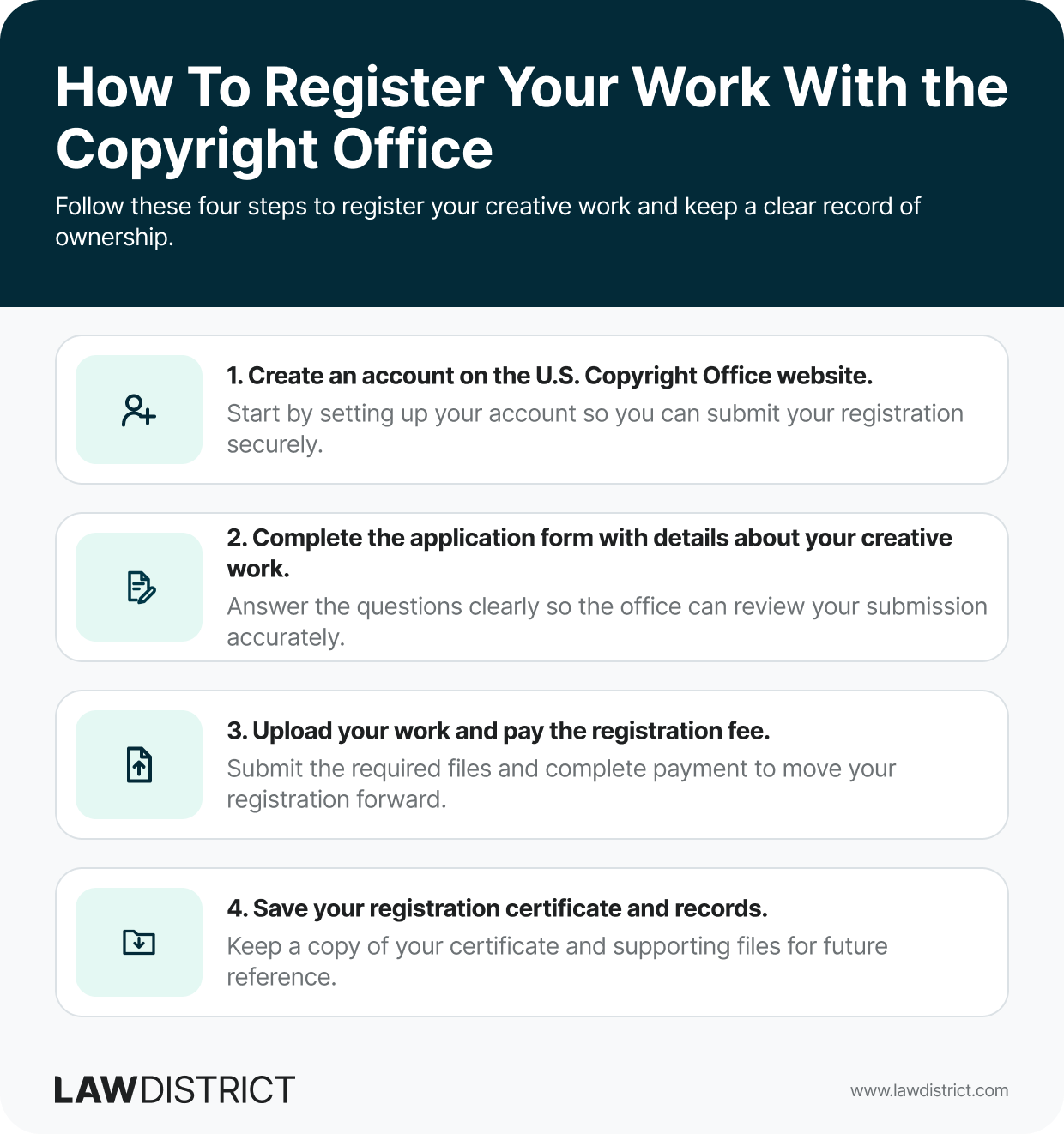
If you make a qualifying work, copyright protection exists automatically. However, timely registration can give you much stronger legal options if somebody infringes upon your copyright.
For unpublished works, registration generally needs to happen before infringement begins. If you've already published your work, you can avail of a three-month window after first publication that can preserve these remedies.
If you miss that window, you may have to rely on proving your actual losses or the infringer's profits. Schlackman points out that this may amount to little more than what a license would have cost, making a lawsuit less worthwhile.
With timely registration, 17 U.S.C. §504(c) allows statutory damages of $750 to $30,000 per work. This can go up to as much as $150,000 for willful infringement, which is what Sony and Warner are seeking for each copyright they allege Anthropic infringed.
As Schlackman stresses, registering later does not give you these remedies for infringement that has already happened. The advantage is being better protected going forward.
You can register your work directly with the Copyright Office.
Conclusion
Naruto never got the copyright to his selfie, and an AI model cannot claim copyright in what it creates either. As Schlackman puts it, purely AI-generated work can "belong to no one."
The harder question is what happens to the humans caught in the middle: the artists, writers, photographers, and musicians whose work helps fuel the system and trains these AI models.
Table of Contents:
- What a Monkey Selfie Can Tell Us About Copyright
- Why a Detailed Prompt Does Not Give You Copyright of AI Art
- Can AI Companies Train Their Models Using Your Work?
- If AI Training Can Be Fair Use, Why Are Companies Paying for Licenses?
- Who Actually Wins?
- What Creators Can Still Control in a New AI Market
- Conclusion
Key Takeaways:
- Purely AI-generated content lacks human authorship and cannot be protected by copyright in the United States.
- Creators can only copyright AI-assisted projects that feature substantial human editing or original arrangement.
- Using copyrighted material to train AI models is currently a fiercely debated legal issue regarding fair use.
- Timely registration with the U.S. Copyright Office is the best way for creators to legally protect their work.
AI now allows us to create images, essays, and songs in seconds. You just enter a prompt describing the output you want and instantly receive it.
But who owns this output? Can you copyright it? We spoke with patent attorney Steven Schlackman to find out.
What a Monkey Selfie Can Tell Us About Copyright
In 2011, wildlife photographer David Slater left his camera unattended in an Indonesian nature reserve. A crested macaque named Naruto picked it up and took several selfies, which instantly went viral.
Slater later published the selfies in his photography book "Wildlife Personalities," leading PETA to sue on Naruto's behalf. They argued that the monkey owned the copyright to the images, as he was the photographer in this case, not Slater.
In 2018, the Court of Appeals for the Ninth Circuit ruled that animals cannot bring claims under the Copyright Act.
Seven years later, the same basic question sits at the center of a much bigger debate: what happens when the creator of an image, article, or song isn't human?
What if it's a machine?
For purely AI-generated work, U.S. law currently gives a clear answer: copyright requires sufficient human authorship. In 2025, the D.C. Circuit upheld that principle in Thaler v. Perlmutter.
As copyright lawyer Steven Schlackman told us, that leads to a result many AI users may not expect:
Why a Detailed Prompt Does Not Give You Copyright of AI Art
Some argue that making a long, detailed prompt is similar to the efforts made by human artists. They point out that constantly updating the prompt and asking for changes to be made so that the art fits their vision is "demonstrable human effort."
The U.S. Copyright Office decided to put this to the test, as explained in a report they published on copyright and artificial intelligence. They asked an AI image generator to create a very specific scene featuring a cat reading a newspaper, providing detailed instructions about the setting, lighting, and composition.
While it did generate an image similar to what they described, the AI ignored some directions and added details of its own. The Copyright Office concluded that:
In short, they maintain that copyright depends on human control over the final expression, not simply how much effort went into giving instructions.
However, there are still ways human contributions to AI-assisted work can be protected, as asserted by the Copyright Office:
-
Your own work appears in the result: If copyrightable material you created remains clearly visible in the final work, that part may still be protected.
-
You choose and arrange the content: The selection and arrangement of AI-generated material can be protected. The Zarya of the Dawn case illustrated this, with protection for the text and layout of a graphic novel, but not the AI images.
-
You substantially edit the result: Creative changes made after generation may qualify for protection if they reflect enough human authorship.
So the key question is not how detailed your prompt was. It's how much of the finished work was actually created or controlled by you.
Can AI Companies Train Their Models Using Your Work?
If you can't own AI-generated art, can you at least stop AI companies from training their models using your work? That depends on whether this qualifies as fair use.
As Schlackman explains:
Whether using copyrighted material to train AI models passes that test is still being fiercely debated.
Courts have started ruling on individual AI copyright disputes, but there is still no clear rule covering every use of copyrighted material for training AI models.
AI companies already have useful case law to point to. In Authors Guild v. Google, Google copied millions of books to build a searchable database. The court found that use was fair because the search tool served a different purpose and did not replace the books themselves.
The Copyright Office applies a similar fair use framework to AI training. Rather than saying AI training is always fair use or always infringement, it said in another report on generative AI that the circumstances matter:
In simple terms, training a model for noncommercial research is very different from using pirated material to build a commercial product that competes with the original work.
Is AI learning really the same as human learning?
Another part of the debate is whether AI training is really comparable to human learning in the first place. AI companies argue that training a model is similar to how a human artist learns by studying other people's work.
Schlackman does not think that comparison holds, saying that it's "...not really a true comparison because the artist generally isn't copying the works, they are seeing them live or in books."
He also believes that where the line will actually be drawn with regard to the use of copyrighted material to train AI models has to do with more than just legal doctrine:
If AI Training Can Be Fair Use, Why Are Companies Paying for Licenses?
In August 2026, Sony Music Publishing and Warner Chappell sued Anthropic, alleging that it illegally obtained copyrighted lyrics and sheet music to train Claude. The case seeks up to $150,000 per infringed work. Anthropic, of course, disputes the allegations.
The lawsuit focuses on how Anthropic allegedly obtained that material, including claims of illegal torrenting, scraping, and downloading.
This distinction has mattered before. In Bartz v. Anthropic, a federal judge ruled that using books to train Claude was fair use. However, the judge separately found that downloading pirated books to build a permanent library was not. A $1.5 billion settlement received final approval in July 2026.
This makes it the largest U.S. copyright settlement to date. In other words, the biggest AI copyright payout so far centered on piracy rather than a finding that AI training itself was unlawful.
This case helps explain why AI companies are increasingly signing licensing deals. They now pay for access to the copyrighted content used to train their models, hoping to reduce the risk of another piracy dispute.
But those licensing deals may also make the fair use defense harder to sustain. As Schlackman told us:
However, not every work can be easily licensed. Schlackman points out that there is no practical way to negotiate individually with millions of authors, photographers, or artists.
Instead, licensing deals usually happen through large rights holders, like publishers or record labels. Schlackman says that may eventually require a collective licensing system, similar to ASCAP, or a new statutory license, both of which are years away.
Until then, as he puts it, "the aggregators get paid and individuals won't."
Who Actually Wins?
AI companies seem to be poised to benefit most. "If nobody can own the output, the value stays with the model rather than the work," Schlackman told us. Consumers also gain, at least in the short term, because they can create content quickly and cheaply.
The longer-term impact could be very different.
Schlackman argues that AI is likely to replace the commercial work many creatives traditionally rely on while developing their skills. They can often depend on stock photography, background music, and basic illustration jobs.
If opportunities like these disappear for creatives, fewer people may enter creative careers, leading to fewer new human works being produced.
Another question is that of style. Copyright does not protect an artist's style as a separate element, and Schlackman believes that is the right approach. If nobody could paint like Pollock or photograph like Ansel Adams, he argues, new styles would struggle to develop:
But AI raises a new question: what happens when machines can imitate those styles perfectly and more quickly than any human? This is another consequence of generative AI, the scale of which remains to be seen.
What Creators Can Still Control in a New AI Market
For creators wondering what they can do now, Steven Schlackman has one practical recommendation: register your work with the U.S. Copyright Office.
If you make a qualifying work, copyright protection exists automatically. However, timely registration can give you much stronger legal options if somebody infringes upon your copyright.
For unpublished works, registration generally needs to happen before infringement begins. If you've already published your work, you can avail of a three-month window after first publication that can preserve these remedies.
If you miss that window, you may have to rely on proving your actual losses or the infringer's profits. Schlackman points out that this may amount to little more than what a license would have cost, making a lawsuit less worthwhile.
With timely registration, 17 U.S.C. §504(c) allows statutory damages of $750 to $30,000 per work. This can go up to as much as $150,000 for willful infringement, which is what Sony and Warner are seeking for each copyright they allege Anthropic infringed.
As Schlackman stresses, registering later does not give you these remedies for infringement that has already happened. The advantage is being better protected going forward.
You can register your work directly with the Copyright Office.
Conclusion
Naruto never got the copyright to his selfie, and an AI model cannot claim copyright in what it creates either. As Schlackman puts it, purely AI-generated work can "belong to no one."
The harder question is what happens to the humans caught in the middle: the artists, writers, photographers, and musicians whose work helps fuel the system and trains these AI models.
Most Popular Posts
Some states require a motor vehicle bill of sale form; others do not. Even if only for your personal records, anyone who buys or sells a vehicle needs
If you plan to travel with a minor, whether or not you are their parent, you can minimize inconveniences by carrying a few necessary documents...