



Key Takeaways
- 78% of legal professionals are embracing AI and cautiously using it for some tasks, such as legal research.
- Experts in the field are more concerned about attorney-client confidentiality and how technology will address it as it advances.
- Legal AI benefits clients by enabling their attorneys to spend less time drafting documents and managing their cases.
- Use of Legal AI can lead to reduced costs and faster turnaround times.
Legal professionals are embracing AI to save time on research and drafting, but experts warn that confidentiality, accuracy, and oversight remain non-negotiable. Recent surveys show that AI adoption is growing, but legal professionals remain wary of errors.
In this piece, experts, including attorneys in family and corporate law, and a paralegal turned content strategist, weigh in on how AI is impacting the practice of law and how they feel its growing influence will impact the future of law.
The Rise of Legal AI: Current Facts and Figures
The adoption of Legal AI by professionals in the field is growing at a remarkable pace, transforming how attorneys and other legal professionals work and redefining long-established work processes.
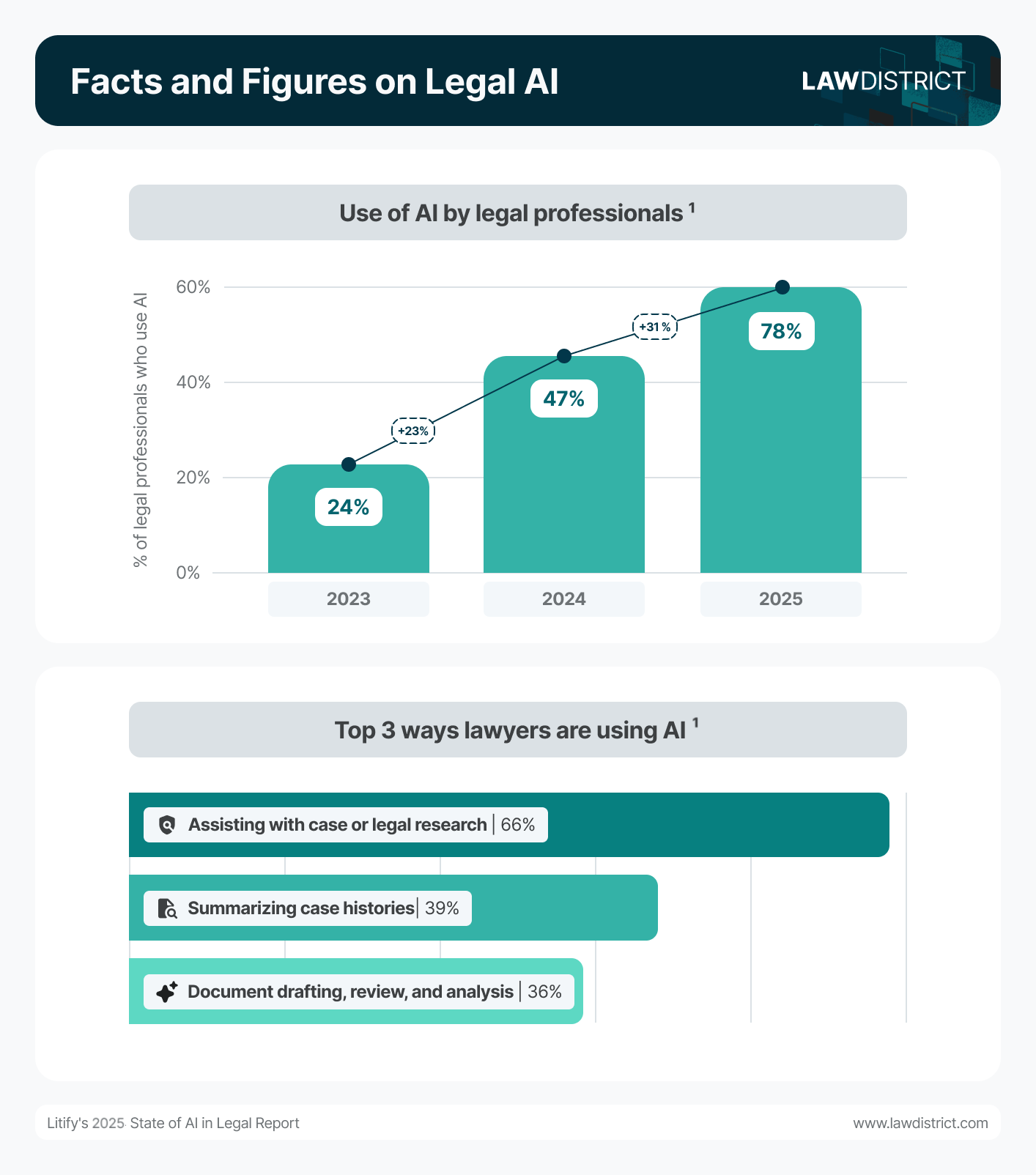
Litify’s 2025 State of AI in Legal Report found that AI use jumped up by 78% from 2023 to 2025. Of their respondents, 68% said they are using AI frequently and 37% daily.
They further reveal the most common tasks that legal professionals are performing with AI:
- 66% of respondents use AI-powered tools for legal research
- 39% for summarizing case histories
- 36% for drafting, reviewing and analyzing documents
They also commonly use AI to extract data from documents to populate case records and respond to legal service requests.
Thomson Reuters estimates that these operational improvements can save 12 hours per week, per attorney, translating to $300,000 in new billable time annually.
Despite these gains, the legal sector cites concerns about:
- Data security and privacy
- Client confidentiality
- Responsible data governance
Expert guidance is needed to ensure that AI is implemented responsibly, allowing legal practitioners to leverage its benefits while upholding the trust and integrity central to the practice of law.
How Legal Experts View AI
To get the most accurate assessment of this issue, we interviewed legal professionals who collaborate with our site to learn their thoughts on AI.
Experts Urge the Responsible Use of AI for Routine Tasks
John Roach, a Minnesota attorney specializing in family law and landlord-tenant issues, uses AI in a limited capacity in his law practice. He states that, "I use AI in my practice for limited purposes such as drafting blog articles and other content for my firm’s website and in generating topics and outlines for advertising content."
Joseph Raetzer, a corporate attorney with over 20 years of experience in mergers and acquisitions, takes a similar approach. He reports that his firm uses AI to help draft client correspondence, refine legal language for clarity, and support marketing efforts.
Dena Standley, a former paralegal turned legal writer and content strategist, works with attorneys and support staff who incorporate AI into their law practices. I use AI to draft outlines for legal blogs and service pages, and reports seeing an increase in clients using AI for document management, contract review, and client correspondence.

How Legal Experts Expect To Use AI in the Year Ahead
All three of us agree that we will still be using AI in one year.
John Roach would like to expand his use of AI to include other time-saving tasks, such as generating outlines for questions. However, he hopes the technology will keep developing and become "safer to use in the confines of attorney-client confidentiality, as this is a major concern for me and other law firms."
For my part, I would like AI to improve in providing accurate, jurisdictional-specific guidance that requires less human oversight. AI currently requires painstaking research to ensure that what it produces is accurate.
Joseph Raetzer has an interesting perspective. He participated in a project to train AI legal models, and the goal was to "fail the model" using complex legal prompts. He states, "At first, it took only a few paragraphs to trigger a failure, but within months, it required pages of nuanced scenarios to do so."
He wants AI to accurately incorporate current law and commercial realities from specific industries to bridge the gap between legal and business practices.
The Client Benefits of Legal AI
Our panel of experts agreed that AI can reduce costs as a time-saving tool. Joseph R. says that "AI helps lawyers work more efficiently by organizing, drafting, and managing matters faster and with greater precision. For clients, that often translates to reduced legal costs and faster turnaround times, without sacrificing quality."
I would add that AI can help attorneys analyze vast amounts of case law, which can help them build stronger strategies. However, AI for the legal field is still an emerging technology, and responsible attorneys know that each task must be carefully reviewed to identify errors.
How Far Is Too Far? Defining Safe AI Use in Law
The legal profession has high ethical, professional, and confidentiality standards. As a result, balancing acceptable use and staying compliant has caused it to be slow to adopt AI. Attorneys have an ethical obligation to ensure that every legal document and citation meets strict accuracy and privacy requirements that AI tools can’t guarantee.
Our experts agree that human oversight is crucial to the safe and acceptable use of AI. J. Raetzer responds by saying, "AI is best used as a drafting and language refinement tool by helping lawyers craft clear, consistent documents and agreements. While document comparison tools are improving, they’re not reliable enough to catch every key issue."
J. Roach had this to say, "Use of AI in proofreading, as an aid in drafting, and in preparing advertising materials can all be relatively safe uses of AI for legal issues." As a paralegal, I see that AI can safely automate administrative and repetitive tasks, such as:
- Document management
- Contract reviews
- Data organization in DMS and CMS
Many legal research tools now incorporate AI. However, I can’t overstate the caveat that safe/acceptable use in the legal field can only be accomplished with systems in place to ensure human oversight.
What Warnings Would You Give to Those Who Want To Use AI in Legal Issues?
Our experts had definitive warnings for those looking to use AI in legal issues. J. Roach stated that he’s "observed a growing number of self-represented parties use entirely AI-drafted material, which has often resulted in great embarrassment to them in court."
J. Raetzer gives a stark warning about AI hallucinations to "never treat AI as a substitute for real legal analysis or research. AI can be a valuable tool, but it also 'hallucinates' or fabricates information with confidence."
The consensus is that AI is a valuable tool, but it can’t replace the knowledge and experience of legal practitioners.
How Can I Use Legal AI
One of the most practical applications of AI for non-lawyers is document review and comprehension. Whether you're signing a lease agreement, reviewing an employment contract, or trying to understand court documents, reading legal text can be intimidating.
The experts noted that AI excels at organizing and summarizing information, making it an ideal tool for breaking complex documents into understandable terms.
This is where tools like Lawgenius become invaluable. Lawgenius helps users summarize and review the critical points of any document they need to understand. Instead of struggling through dense legal terminology alone, you can use Lawgenius to identify key clauses, obligations, potential risks, and important deadlines within your documents.
This gives you a clearer picture of what you're agreeing to and helps you prepare informed questions for an attorney if needed.
Methodology and sources: This article combines data from
- Litify 2024
- Rev Legal Tech 2025
- Thomson Reuters
- Interviews with experts from the US Legal Sector
Key Takeaways
- 78% of legal professionals are embracing AI and cautiously using it for some tasks, such as legal research.
- Experts in the field are more concerned about attorney-client confidentiality and how technology will address it as it advances.
- Legal AI benefits clients by enabling their attorneys to spend less time drafting documents and managing their cases.
- Use of Legal AI can lead to reduced costs and faster turnaround times.
Legal professionals are embracing AI to save time on research and drafting, but experts warn that confidentiality, accuracy, and oversight remain non-negotiable. Recent surveys show that AI adoption is growing, but legal professionals remain wary of errors.
In this piece, experts, including attorneys in family and corporate law, and a paralegal turned content strategist, weigh in on how AI is impacting the practice of law and how they feel its growing influence will impact the future of law.
The Rise of Legal AI: Current Facts and Figures
The adoption of Legal AI by professionals in the field is growing at a remarkable pace, transforming how attorneys and other legal professionals work and redefining long-established work processes.
Litify’s 2025 State of AI in Legal Report found that AI use jumped up by 78% from 2023 to 2025. Of their respondents, 68% said they are using AI frequently and 37% daily.
They further reveal the most common tasks that legal professionals are performing with AI:
- 66% of respondents use AI-powered tools for legal research
- 39% for summarizing case histories
- 36% for drafting, reviewing and analyzing documents
They also commonly use AI to extract data from documents to populate case records and respond to legal service requests.
Thomson Reuters estimates that these operational improvements can save 12 hours per week, per attorney, translating to $300,000 in new billable time annually.
Despite these gains, the legal sector cites concerns about:
- Data security and privacy
- Client confidentiality
- Responsible data governance
Expert guidance is needed to ensure that AI is implemented responsibly, allowing legal practitioners to leverage its benefits while upholding the trust and integrity central to the practice of law.
How Legal Experts View AI
To get the most accurate assessment of this issue, we interviewed legal professionals who collaborate with our site to learn their thoughts on AI.
Experts Urge the Responsible Use of AI for Routine Tasks
John Roach, a Minnesota attorney specializing in family law and landlord-tenant issues, uses AI in a limited capacity in his law practice. He states that, "I use AI in my practice for limited purposes such as drafting blog articles and other content for my firm’s website and in generating topics and outlines for advertising content."
Joseph Raetzer, a corporate attorney with over 20 years of experience in mergers and acquisitions, takes a similar approach. He reports that his firm uses AI to help draft client correspondence, refine legal language for clarity, and support marketing efforts.
Dena Standley, a former paralegal turned legal writer and content strategist, works with attorneys and support staff who incorporate AI into their law practices. I use AI to draft outlines for legal blogs and service pages, and reports seeing an increase in clients using AI for document management, contract review, and client correspondence.
How Legal Experts Expect To Use AI in the Year Ahead
All three of us agree that we will still be using AI in one year.
John Roach would like to expand his use of AI to include other time-saving tasks, such as generating outlines for questions. However, he hopes the technology will keep developing and become "safer to use in the confines of attorney-client confidentiality, as this is a major concern for me and other law firms."
For my part, I would like AI to improve in providing accurate, jurisdictional-specific guidance that requires less human oversight. AI currently requires painstaking research to ensure that what it produces is accurate.
Joseph Raetzer has an interesting perspective. He participated in a project to train AI legal models, and the goal was to "fail the model" using complex legal prompts. He states, "At first, it took only a few paragraphs to trigger a failure, but within months, it required pages of nuanced scenarios to do so."
He wants AI to accurately incorporate current law and commercial realities from specific industries to bridge the gap between legal and business practices.
The Client Benefits of Legal AI
Our panel of experts agreed that AI can reduce costs as a time-saving tool. Joseph R. says that "AI helps lawyers work more efficiently by organizing, drafting, and managing matters faster and with greater precision. For clients, that often translates to reduced legal costs and faster turnaround times, without sacrificing quality."
I would add that AI can help attorneys analyze vast amounts of case law, which can help them build stronger strategies. However, AI for the legal field is still an emerging technology, and responsible attorneys know that each task must be carefully reviewed to identify errors.
How Far Is Too Far? Defining Safe AI Use in Law
The legal profession has high ethical, professional, and confidentiality standards. As a result, balancing acceptable use and staying compliant has caused it to be slow to adopt AI. Attorneys have an ethical obligation to ensure that every legal document and citation meets strict accuracy and privacy requirements that AI tools can’t guarantee.
Our experts agree that human oversight is crucial to the safe and acceptable use of AI. J. Raetzer responds by saying, "AI is best used as a drafting and language refinement tool by helping lawyers craft clear, consistent documents and agreements. While document comparison tools are improving, they’re not reliable enough to catch every key issue."
J. Roach had this to say, "Use of AI in proofreading, as an aid in drafting, and in preparing advertising materials can all be relatively safe uses of AI for legal issues." As a paralegal, I see that AI can safely automate administrative and repetitive tasks, such as:
- Document management
- Contract reviews
- Data organization in DMS and CMS
Many legal research tools now incorporate AI. However, I can’t overstate the caveat that safe/acceptable use in the legal field can only be accomplished with systems in place to ensure human oversight.
What Warnings Would You Give to Those Who Want To Use AI in Legal Issues?
Our experts had definitive warnings for those looking to use AI in legal issues. J. Roach stated that he’s "observed a growing number of self-represented parties use entirely AI-drafted material, which has often resulted in great embarrassment to them in court."
J. Raetzer gives a stark warning about AI hallucinations to "never treat AI as a substitute for real legal analysis or research. AI can be a valuable tool, but it also 'hallucinates' or fabricates information with confidence."
The consensus is that AI is a valuable tool, but it can’t replace the knowledge and experience of legal practitioners.
How Can I Use Legal AI
One of the most practical applications of AI for non-lawyers is document review and comprehension. Whether you're signing a lease agreement, reviewing an employment contract, or trying to understand court documents, reading legal text can be intimidating.
The experts noted that AI excels at organizing and summarizing information, making it an ideal tool for breaking complex documents into understandable terms.
This is where tools like Lawgenius become invaluable. Lawgenius helps users summarize and review the critical points of any document they need to understand. Instead of struggling through dense legal terminology alone, you can use Lawgenius to identify key clauses, obligations, potential risks, and important deadlines within your documents.
This gives you a clearer picture of what you're agreeing to and helps you prepare informed questions for an attorney if needed.
Methodology and sources: This article combines data from
- Litify 2024
- Rev Legal Tech 2025
- Thomson Reuters
- Interviews with experts from the US Legal Sector
Most Popular Posts

Some states require a motor vehicle bill of sale form; others do not. Even if only for your personal records, anyone who buys or sells a vehicle needs

If you plan to travel with a minor, whether or not you are their parent, you can minimize inconveniences by carrying a few necessary documents...