
Free Assignment Agreement Template
An Assignment Agreement helps transfer contractual rights, intellectual property rights, or other transferable rights and interests. Often referred to as an Assignment of Contract, this document outlines the requirements for a transfer depend on many factors, such as any underlying agreements and applicable laws.

What type of rights are you assigning?
Fill forms in a few steps
Save, print & download
Done in 5 minutes
What Is an Assignment Agreement?
An Assignment Agreement is a legal document that transfers rights or interests from one party (the assignor) to another (the assignee). In business and real estate, this process is widely known as an Assignment of Contract.
It can be used to transfer:
- Contractual rights, such as payment, purchase, or service rights
- Copyrights
- Trademarks
- Patents or patent rights
- Other transferable rights or interests
The rights you’re assigning can be transferred in full or limited to specific rights.
Your ability to transfer those rights may depend on an underlying agreement, applicable law, consent requirements, or other restrictions.
Understanding the Parties: Assignor vs. Assignee
The assignor is the person or business transferring the contract rights or assets.
The assignee is the person or business receiving those rights.
Assigning Rights Under a Contract
You may need consent before assigning a contract or transferring rights under an existing contract. This depends on the original agreement, which may require another part’s consent or place other restrictions on the transfer.
Look for words such as:
- Assignment
- Transfer
- Consent
- Successors
If written consent is required per the original contract, make sure to get it before you sign the assignment.
Even when consent is not required, you may still need to give notice in some circumstances.
When Contract Rights May Not Be Assignable
Not all contracts can be assigned. Some transfers are restricted or completely prohibited.
A contract may not be assignable if:
- It contains an anti-assignment clause that explicitly prohibits transfers
- It involves personal services, such as contracts based on a specific person's skills, reputation, or judgment
- The assignment would materially change the other party's risk or duties
- It is a government contract that restricts assignment by law
- Applicable state law prohibits the transfer
Always review the original contract before assuming the transfer is allowed. If an anti-assignment clause exists and you assign the contract anyway, the assignment may be ineffective due to this breach. This also depends on the restriction and applicable law.
If you are unsure whether your contract can be assigned, legal advice is recommended before proceeding.
Assignment vs. Delegation vs. Novation
When transferring rights under a contract, assignment, delegation, and novation have different functions:
| Term | Explanation |
|---|---|
| Assignment | You transfer contract rights to another party. This is often used for payment rights or other contract benefits. |
| Delegation | You transfer contract duties to another party. You may still be liable if the other party does not perform. |
| Novation | A new party replaces an original party. This usually requires all parties to agree and may release you from future duties. |
Assignment Agreement Sample (Assignment of Contract)
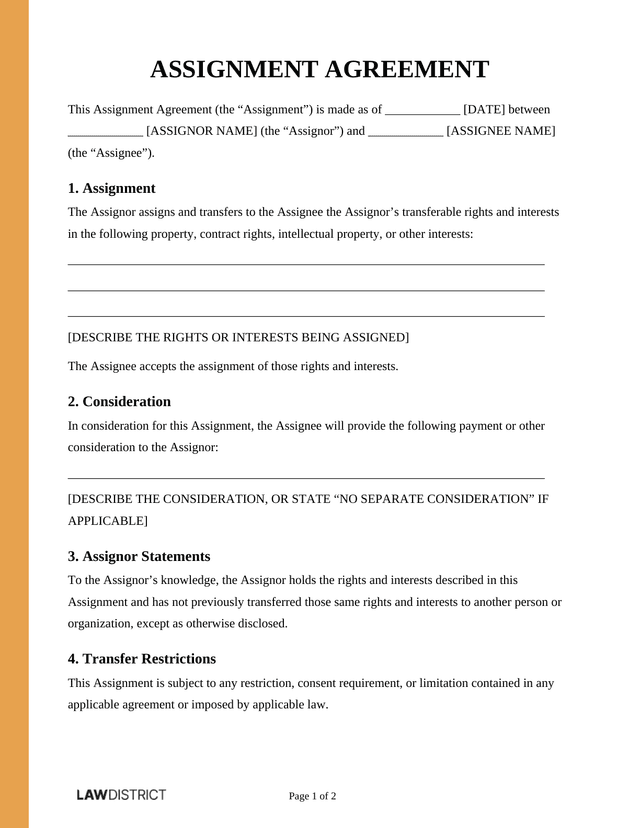
It’s a good idea to examine this document before you begin your own version, to get an idea of the typical contents and structure. Take a look at the Assignment of Contract and Agreement template below. You can use it as a guide when drafting your document:
How to Assign a Contract Step-by-Step
Before you assign a contract, make sure the transfer is allowed. Then put the terms in writing. Follow the steps below to complete assignment.
Step 1: Identify What You Are Assigning
Start by identifying the rights or interests you want to transfer.
Step 2: Identify the Scope of the Transfer
Next, you need to decide whether you want to transfer all transferable rights and interests or only specific rights.
If there are any rights that you’re transferring only in part, make sure to clearly identify these.
Step 3: Review Any Underlying Agreement or Restrictions
Make sure to check whether the rights being transferred are subject to transfer restrictions. You need to review those requirements before completing the assignment.
Step 4: Check Consent or Other Requirements
Determine whether any of the following are required:
- Consent
- Approval
- Notice
- Registration
Step 5: Prepare the Assignment Agreement
Add the relevant details, including:
- Names of the parties
- Rights or interests being assigned
- Details of any relevant contract or intellectual property
- Scope of the assignment
- Effective date
- Payment or other consideration, if applicable
Step 6: Sign the Assignment Agreement
Both the assignor and assignee should sign the document.
Step 7: Complete Any Additional Steps and Keep Records
Complete any notice, consent, filing, registration, or recording requirements. Both parties should keep the signed agreement with the relevant supporting documents.
What Can an Assignment Agreement Transfer?
An Assignment Agreement can be used to transfer intellectual property rights, including copyrights, trademarks, and patents, as well as standard contract rights:
| Type | Explanation |
|---|---|
| 1. Contract Rights | Allows you to assign all or specific rights under an existing contract. |
| 2. Copyright | Covers rights in copyright-protected works, such as written content, images, software, or other creative materials. You can assign all or only certain rights. |
| 3. Trademark | Applies to rights connected to a trademark. The assignment may also include associated goodwill and may involve additional requirements. |
| 4. Patent | Applies to rights related to a patent, patent application, or other patent interests. You can assign all or only certain rights. |
| 5. Other Rights or Interests | Includes other transferable rights or interests that are clearly described in the Assignment Agreement. |
Assignment Agreement FAQ
Still have some doubts about the use of Assignment Agreements? These answers explain common issues in simple terms.
You do not need a lawyer for every assignment. However, seeking legal advice may be helpful for complex or high-value transfers related to:
- Intellectual property
- Real estate interests
- Regulated rights
- Assignments involving significant contractual restrictions
Yes, some contracts can be assigned without consent. This depends on the original contract and applicable law.
If the contract requires written consent, the parties should get approval before assigning it. Some rights may also be non-assignable. This is usually the case if the transfer would materially change the other party’s risk or duties.
Notarization requirements depend on:
- The rights being assigned
- Applicable law
- Any relevant agreement or filing requirements
Many Assignment Agreements do not require notarization. However, additional formalities may apply to particular transfers.
While often used interchangeably, an "Assignment of Contract" refers to the actual process or legal action of transferring rights to a third party. An "Assignment Agreement" is the physical legal document or template you sign to formalize that transfer.
Try Lawdistrict Now
Instant and complete access to our entire library of legal forms
Edit, download and print in PDF from any device
Save time and money on legal document creation