Free Confidentiality Agreement Template

Use a Confidentiality Agreement form to protect your personal or business information private. Use our template to create a detailed and legally valid document in minutes.

Trusted by 4,589 users.

update icon

Last Update June 23rd, 2025

Also Known As

Non-Disclosure Agreement (NDA)

Confidential Disclosure Agreement

Fill forms in a few steps

Fill forms in a few steps

Save, print & download

Save, print & download

Done in 5 minutes

Done in 5 minutes

What Is a Confidentiality Agreement?

If you need to guarantee that another party keeps certain information private, you would use a Confidentiality Agreement.

This contract sets the amount of time certain information must be kept private and what it can be used for, which can help ensure that information will remain confidential, normally related to :

  • Business
  • Personal matters

Depending on what you would like to be kept private and whose information is disclosed, you can choose to create an agreement that contains:

  • Only 1 party’s information
  • Both parties’ information

Use our simple Confidentiality Agreement template to help you create a document that protects your private details.

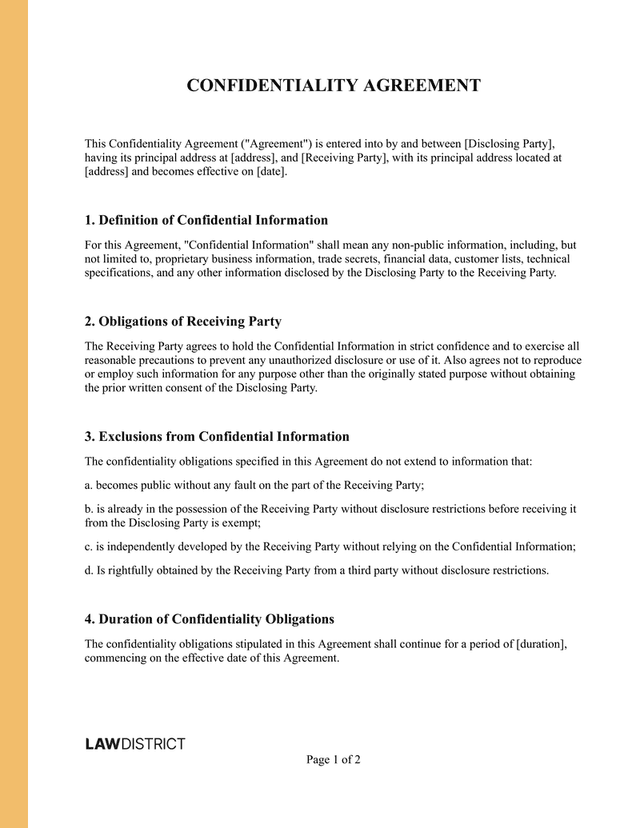
Confidentiality Agreement Sample

Not sure what exactly should be included in a Confidentiality Agreement?

If that’s the case, you can review our example below, to ensure you know how to structure your document.
view preview icon
LawDistrict's Confidentiality Agreement Template Sample

When To Use a Confidentiality Agreement

Using a Confidentiality Agreement is critical whenever you plan to share classified information. Situations like this can come up at any time.

Typically, it’s used as an important business document when you need to share confidential details of your company with other parties.

Some circumstances when using this agreement can include:

  • During and after an audit
  • After creating a new product or invention
  • Giving an employee a raise
  • When signing new employees to an employment contract
  • Hiring freelancers
  • Interviewing applicants
  • Creating a partnership with another business or company

If the other party in the contract releases any of the confidential details, they will face legal consequences.

That is why, by using this document in these cases, you can prevent competitors from getting your business details.

Confidentiality Agreement Protections

Not sure what type of information a Confidentiality Agreement will keep from getting into the wrong hands?

By creating this type of contract, you can make sure the following stays private:

  • Details regarding finances: Information regarding your taxes, profits, and losses would stay private.
  • Intellectual property: Property such as copyrights and patents will remain confidential.
  • Codes: Any original code can be included in a Confidentiality Agreement
  • Future products: Plans for a future product can stay in-house.
  • Marketing plans: Having your marketing ideas get out means they could be taken from another company, this agreement would prevent that from happening.

What To Include in a Confidentiality Agreement

When drafting a Confidentiality Agreement, it's crucial to ensure that all essential elements are included to protect sensitive information effectively. Here are the key components to mention:

  1. Each party’s details: Clearly state the full name and contact information of all parties involved in the agreement. This typically includes the disclosing party and the receiving party.
  2. Definition of confidential information: Specify what constitutes confidential information in this context. This could range from trade secrets, business strategies, and client information, to proprietary processes or technology.
  3. Obligations and duties of the receiving party: Outline the responsibilities of the party that must keep information private, regarding the handling of confidential information. This may include a non-compete or non-solicitation clause.
  4. Duration of the agreement: Set the period for which the confidentiality must be maintained. This could be an indefinite period or a specific timeframe.
  5. Exclusions: Clearly state any information that is not considered confidential. This often involves information received from another source, or information independently developed without using confidential information.
  6. Consequences of a violation: Describe the penalties or legal actions that may be taken if the confidentiality agreement is breached.
  7. Signatures: Your signature along with the party’s must be added and dated.

When adding this information to your agreement, it’s key to make certain that the document follows your state’s laws

You can take advantage of our Confidentiality Agreement template to help you draft a comprehensive and clear document that will aid in the protection of your sensitive data.

Other Business Documents

When dealing with other companies and employees, it’s essential to have all the correct business documents.

Use the following documents to protect your interests: 

Confidentiality Agreement FAQs

To further understand how to use a Confidentiality Agreement, review the answers to the following frequently asked questions.

Should I Sign a Confidentiality Agreement?

Signing a Confidentiality Agreement is crucial as it formalizes the protection of sensitive information and makes the document legally binding.

By signing, you and the other party agree to legally uphold the confidentiality of the specified information, which helps in maintaining trust and security in professional relationships. However, ensure you fully understand and agree with all terms before signing.

How Long Does a Confidentiality Agreement Last?

The duration of your Confidentiality Agreement typically depends on you and what is being kept private. Normally, these agreements last between 1 and 5 years, but they can be set for any duration agreed upon by the parties involved.

In some cases, the agreement may specify that the obligation to maintain confidentiality continues indefinitely, especially for highly sensitive or proprietary information.

Is a Non-Disclosure Agreement the Same as a Confidentiality Agreement?

While both contracts are very similar and often used interchangeably, an NDA is typically more specific to situations where only one party is disclosing confidential information.

A Confidentiality Agreement, on the other hand, can have more broad terms, covering general confidentiality obligations in various contexts, including employment or ongoing business relationships. 

However, these distinctions can vary, and in many cases, the terms are more or less the same.

view preview icon
LawDistrict's Confidentiality Agreement Template Sample

You are only a few steps away from your own Confidentiality Agreement !


Download our professional examples

Preview of your Confidentiality Agreement

CONFIDENTIALITY AGREEMENT
This Confidentiality Agreement ("the Agreement")

BETWEEN:
_________ residing at _________

(the "Client")
AND

_________ residing at _________

(the "Contractor")
1) The Contractor is currently or may be retained as an independent contractor with the Client. This Agreement covers not only this specific role (the "Retainer"), but also any other current or future positions held with the Client.
2) The Contractor will receive or develop confidential information (the "Confidential Information") from or on behalf of the Client, as part of their Retainer (the "Permitted Purpose").
WHEREAS the Client retaining the Contractor and the Client providing the Confidential Information to the Contractor, and other valuable consideration, the receipt and sufficiency of which is hereby acknowledged, the parties to this Agreement agree as follows:
Scope of Confidential Information
1) Any information or materials disclosed or provided by the Client to the Contractor whether written or oral, constitute Confidential Information, regardless of whether they were provided before or after the date of this Agreement or how they were transmitted.
2) The Contractor recognizes that, due to their Retainer by the Client, they may access or acquire confidential information that belongs exclusively to the Client.
3) "Confidential Information" includes any data and information related to the business and management of the Client, including, but not limited to, the following:
(a) Business Operations: internal personnel and financial information of the Client, names and other details about the vendors (such as their features, services, and contracts); purchasing and internal cost data; internal service and operation manuals; external business contacts, such as those kept on social media or other comparable platforms; and databases run by the Client, as well as the way and means of carrying out the Client's business;
(b) Customer Information: names of customers of the Client, their representatives, all customer contact information, contracts and their contents and parties, customer services, data provided by customers and the type, quantity and specifications of products and services purchased, leased, licensed or received by customers of the Client;
(c) Intellectual Property: information about the Client's proprietary rights prior to any public disclosure of such information, including but not limited to the nature of the proprietary rights, production data, technical and engineering data, technical concepts, test data and test results, simulation results, the status and details of research and development of products and services, and information regarding acquiring, protecting, enforcing and licensing proprietary rights (including patents, copyrights and trade secrets);
(d) Service Information: all data and information about the services provided by the Client, including but not limited to, plans, schedules, manpower, inspection, and training information;
(e) Product Information: all specifications for products of the Client as well as work product resulting from or related to work or projects performed or to be performed for the Client or for clients of the Client, of any type or form in any stage of actual or anticipated research and development;
(f) Production Processes: procedures utilized in the development, manufacture, and production of the Client, including but not limited to, formulas, patterns, molds, models, methods, techniques, specifications, processes, procedures, equipment, devices, programs, and designs;
(g) Accounting Information: all financial statements, annual reports, balance sheets, company asset information, company liability information, revenue and expense reporting, profit and loss reporting, cash flow reporting, accounts receivable, accounts payable, inventory reporting, purchasing information and payroll information of the Client;
(h) Marketing and Development Information: marketing and development plans of the Client, price and cost data, price and fee amounts, pricing and billing policies, quoting procedures, marketing techniques and methods of obtaining business, forecasts and forecast assumptions and volumes, and future plans and potential strategies of the Client which have been or are being discussed;
(i) Computer Technology: all scientific and technical information or material of the Client, concerning any machine, appliance or process, including but not restricted to, specifications, proposals, models, designs, formulas, test results and reports, analyses, simulation results, tables of operating conditions, materials, components, industrial skills, operating and testing procedures, shop practices, know how and show-how;
(j) Proprietary Computer Code: all sets of statements, instructions or programs of the Client, whether in human readable or machine readable form, that are expressed, fixed, embodied or stored in any manner and that can be used directly or indirectly in a computer ("Computer Programs"); any report format, design or drawing created or produced by such Computer Programs; and all documentation, design specifications and charts, and operating procedures which support the Computer Programs; and
(k) Confidential Information also includes any information that has been disclosed to the Client by a third party and is protected by a non-disclosure agreement between the third party and the Client.
4) Confidential Information will not include:

(a) Information that is generally known in the industry of the Client;

(b) Information that becomes publicly available through no fault of the Contractor;

(c) Information that the Contractor already possessed before receiving Confidential Information from the Client;

(d) Information that the Contractor independently developed without using the Confidential Information; or

(e) Information that the Contractor lawfully obtained from a third party who has the right to transfer or disclose it.
Obligation of Confidentiality

5) The Contractor are obligated to keep the Confidential Information confidential, except as stated otherwise in this Agreement.

6) The Confidential Information remains the sole property of the Client and can only be used by the Contractor for the Permitted Purpose. The Contractor cannot use the Confidential Information in a way that could harm the Client or any associated affiliates or subsidiaries.
7) The obligations of the Contractor to maintain the confidentiality of the Confidential Information and to provide notice under this Agreement will continue indefinitely, even after this Agreement expires or is terminated.
8) The Contractor may disclose Confidential Information:

(a) to such agents, representatives and advisors of the Contractor that have a need to know for the Permitted Purpose provided that:
          (i) the Contractor has informed such personnel of the confidential nature of the Confidential Information;
          (ii) such personnel agree to be legally bound to the same burdens of confidentiality and non-use as the Contractor;
          (iii) the Contractor agrees to take all necessary steps to ensure that the terms of this Agreement are not violated by such personnel; and
          (iv) the Contractor agrees to be responsible for and indemnify the Client for any breach of this Agreement by their personnel.

(b) A third party with written consent from the Client.

(c) As required by law or by any judicial, legislative, administrative or other governmental body.
Avoiding Conflict of Interest

9) It is acknowledged and agreed that any business opportunity related to or similar to the Client's current or anticipated business opportunities that come to the attention of the Contractor during the Contractor's Retainer belongs to the Client. Therefore, the Contractor will inform the Client of the opportunity and cannot pursue the opportunity, directly or indirectly, without the written consent of the Client.
10) Without the written consent of the Client, the Contractor further agrees to refrain from engaging in any business activities that could reasonably be considered detrimental to the best interests of the Client.
Property Rights

11) The Contractor acknowledges that all rights to Confidential Information belong exclusively to the Client. The Contractor agrees not to claim any ownership interest in Confidential Information, including know-how, copyrights, trademarks, or trade names, even if they helped create it.

12) The Contractor waives any moral rights they may have regarding Confidential Information.
13) The Confidential Information does not include anything developed by the Contractor during this agreement, including intellectual property, processes, designs, etc., that:

(a) was developed without using the Client's equipment, supplies, facilities, or Confidential Information;

(b) was developed entirely on the Contractor's own time;

(c) is not related to the Client's current or future business;

(d) is not related to the Client's current or anticipated processes, research, or development; and

(e) does not result from any work performed by the Contractor on behalf of the Client.
14) The Contractor agrees to immediately share with the Client any Confidential Information developed during the Retainer and to transfer ownership of this information to the Client. The Contractor will sign any necessary documents and take any actions requested by the Client to ensure that the Client has full ownership of this information.
Remedies

15) The Contractor acknowledges that the Confidential Information is proprietary and confidential. Any breach of confidentiality would cause irreparable harm that cannot be adequately compensated by monetary damages. Therefore, the Contractor agrees that the Client is entitled to injunctive relief. This means the Client can seek a court order to prevent the Contractor from violating any terms of this Agreement related to the Confidential Information.
Confidential Information Return

16) The Contractor agrees that, at the request of the Client, or if the Contractor no longer needs to use the Confidential Information, or when this Agreement or the Retainer ends, the Contractor will return to the Client all documents, disks, or other computer media, or any other materials that the Contractor has or controls, including:

(a) materials that may contain or be derived from ideas, concepts, creations, or trade secrets and other proprietary and Confidential Information as defined in this Agreement; or

(b) materials that are connected with or derived from the Contractor's services to the Client.
Notices

17) If the Contractor is required to disclose Confidential Information in a legal proceeding, they must immediately notify the Client. This allows the Client to seek a remedy or waive the Contractor's obligation to keep the information confidential in that specific case.

18) If the Contractor accidentally discloses Confidential Information, they must immediately notify the Client and try to get the information back.
19) All notices or deliveries under this Agreement must be made in person, by courier, or by prepaid mail. A notice is considered delivered seven days after it's mailed. Please use the addresses listed in this Agreement or any updated address provided in writing.

20) Any notice to any of the parties must be delivered in the following addresses:
(a) Name: _________
Address: _________

(b) Name: _________
Address: _________
Warranties

21) The Client provides the Confidential Information without any warranty or guarantee. This means they do not promise that the information is accurate, complete, or free from errors or legal issues like patent or trademark infringements.
Termination of Agreement

22) This Agreement will automatically end on the date that the Contractor's Retainer with the Client terminates or expires. Unless stated differently in this Agreement, all rights and responsibilities under this Agreement will also end at that time.
Assignment and Transfer

23) Unless a company changes its name or merges with another company, neither party can transfer nor assign this Agreement without the other party's written permission.
Changes to the Agreement

24) Only a written agreement signed by both the Client and the Contractor can change or modify this Agreement.
Governing Law

25) This Agreement is governed by the laws of _________.
General Provisions

26) Time is of the essence in this Agreement.

27) This Agreement may be signed in multiple copies.

28) The headings are for reference only and do not affect the meaning of the Agreement. Words in the singular also mean the plural, and vice versa. Words referring to one gender also include the other gender.

29) Each part of this Agreement should be read separately. If a part is found to be invalid, it will not affect the rest of the Agreement.
30) If the Contractor breaks this Agreement, they must pay all costs and expenses the Client incurs to enforce it.

31) Both parties agree this Agreement is fair and reasonable. If a court decides any part of it is too broad, the court should only change that part to make it fair and reasonable. The goal is to give the Client the best possible protection for the Confidential Information.

32) No failure or delay by the Client in exercising any power, right or privilege provided in this Agreement will operate as a waiver, nor will any single or partial exercise of such rights, powers or privileges preclude any further exercise of them or the exercise of any other right, power or privilege provided in this Agreement.

33) This Agreement applies to the heirs, executors, administrators, successors, and assigns of the Client and the Contractor.
34) This Agreement is the complete and final agreement between the parties. There are no other agreements, either written or spoken.
IN WITNESS WHEREOF _________ and _________ have duly affixed their signatures under hand and seal on this ________ day of ________________, ________.
CLIENT

_______________________________
Address

_______________________________
Witness


Per _________________ (Seal)
_________

CONTRACTOR

_______________________________
Address

_______________________________
Witness


Per _________________ (Seal)
_________

Try Lawdistrict Now

Instant and complete access to our entire library of legal forms

Edit, download and print in PDF from any device

Save time and money on legal document creation