
Living Trust Amendment Form
A Trust Amendment is a legal document used to change specific terms of an existing trust. It is most commonly used with a revocable living trust, which allows changes during your lifetime.

How many grantors signed the original trust?
Fill forms in a few steps
Save, print & download
Done in 5 minutes
What Is a Trust Amendment?
A Trust Amendment is a document that modifies parts of an existing trust without replacing the entire trust.
This legal document identifies the original trust by name and date. It then states exactly which sections are being changed and what the new terms are.
Once signed correctly, the amendment becomes part of the living trust and must be read together with the original document.
A Trust Amendment changes the legal instructions in the trust. It does not automatically transfer property or update external accounts. Assets still need to be titled correctly in the name of the trust.
Why You Would Use a Living Trust Amendment
If you have a revocable living trust, an amendment is often the most efficient way to make updates.
You do not need to recreate the trust. You change only the sections that are no longer accurate. All other provisions remain in effect.
An amendment is commonly used for limited and clear changes. It is not designed for full rewrites. In many cases, it requires less drafting work than a complete restatement.
When You Should Use a Trust Amendment
You should consider a Trust Amendment when the trust still works overall, but specific details have changed.
The table below includes some situations when it is appropriate:
| Category | Common situations |
|---|---|
| Life changes | Marriage or divorce
Birth or adoption of a child Death of a beneficiary or trustee |
| Beneficiary updates | Adding a new beneficiary
Removing a beneficiary Changing distribution percentages or conditions |
| Trustee updates | Changing a successor trustee
Updating incapacity instructions Adjusting who has authority to act |
| Asset distribution changes | Revising how certain [assets are divided for best interest](https://www.lawdistrict.com/articles/high-tax-state-residents-need-a-trust-amendment)
Updating specific gifts listed in the trust |
When a Trust Amendment Is Not Appropriate
A Trust Amendment is not always the right solution. In certain situations, using one can create legal or practical problems instead of solving them.
Irrevocable Trusts
If your trust is irrevocable, you usually cannot amend it using a standard Trust Amendment. Changes often require one or more of the following:
- Special permission in the trust
- Consent from beneficiaries
- Court approval
You should not assume that an amendment is allowed.
Major or Widespread Changes
If you are changing many sections of the trust, an amendment can become confusing.
Multiple amendments can also conflict with each other. In these cases, a trust restatement is often more appropriate.
Trust Amendment vs Trust Restatement
Trust Amendments and Trust Restatements serve different purposes, depending on how much you need to change in your trust. The table below shows the key differences so you can quickly decide which option fits your situation.
| Trust Amendment | Trust Restatement |
|---|---|
| Best used for one or a few specific changes | Best used for large or repeated changes |
| Only selected sections of the trust are modified | Most or all trust terms are replaced |
| The original trust remains mostly unchanged | All instructions appear in one updated document |
What Does a Trust Amendment Include
A properly drafted Trust Amendment typically contains:
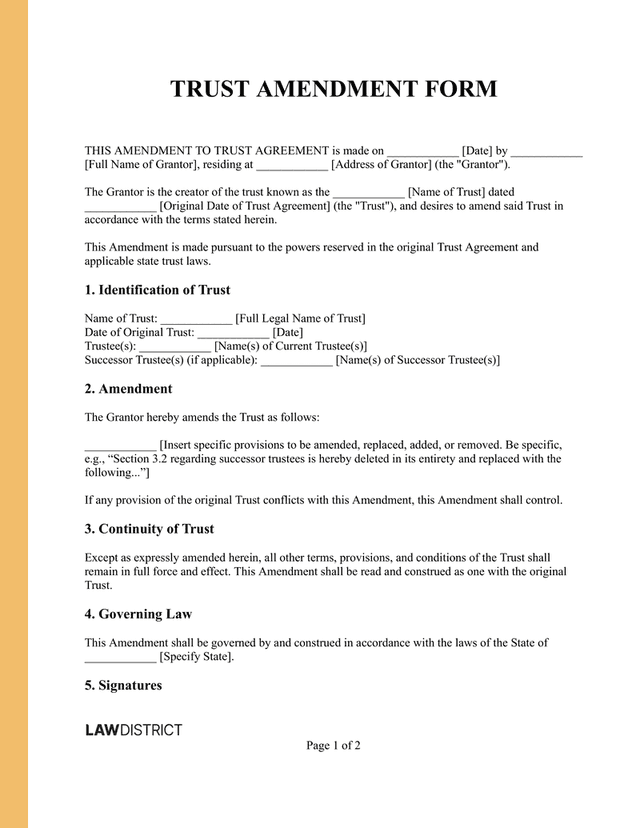
- The full name and date of the original trust
- Your name and role as the settlor
- A statement confirming your authority to amend
- Clear language describing each change
- An effective date
- Your signature, completed according to trust and state requirements
Each amendment should stand on its own. It should be easy to understand and easy to connect to the original trust.
How to Make a Trust Amendment
Follow these steps to reduce errors and avoid confusion.
Step 1: Confirm That Your Trust is Revocable
Review the trust document. Look for language stating that the trust is revocable. If the trust says it is irrevocable, different rules apply.
Step 2: Review the Amendment Instructions in the Trust
Most trusts explain how amendments must be made. This section may specify who must sign and how the document must be delivered. You should follow these instructions exactly.
Step 3: Write the Amendment as a Precise Change
Identify the article or section being changed. State whether it is replaced, removed, or added. Include the full updated language. Avoid general or vague wording.
Step 4: Check for Conflicts With Earlier Amendments
If you have prior amendments, review them carefully. Make sure the new amendment does not contradict earlier changes. If several amendments exist, a restatement may be clearer.
Step 5: Sign and Store the Amendment Correctly
Sign the document as required by the trust. Keep it with the original trust and any previous amendments. All documents should be stored together.
You can use our customizable Trust Amendment template to instantly draft your own. Enter your details and receive a structured document ready for review and signing.
Trust Amendment FAQs
Below are the answers to some of the most common questions people have before drafting this document.
No, Trust Amendments are not appropriate for all trusts. This document is intended for revocable living trusts. Irrevocable trusts follow different rules and usually cannot be amended in this way.
Not always. If you are changing many provisions, a trust restatement is often more practical. It reduces confusion and consolidates all updates into one document.
The most common mistake is writing unclear amendment language or ignoring the trust's amendment instructions. Always reference specific sections and follow the required signing method.
You can use our Trust Amendment template to quickly draft a comprehensive version of this document. Simply enter your details, and you will have a Trust Amendment in just a few minutes.
Try Lawdistrict Now
Instant and complete access to our entire library of legal forms
Edit, download and print in PDF from any device
Save time and money on legal document creation