
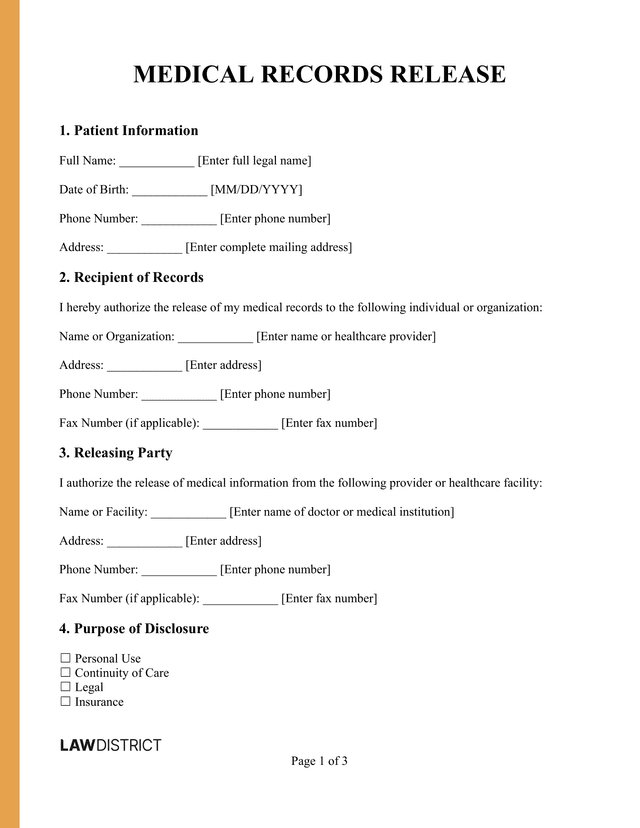
Medical Records Release Form
A Medical Records Release Form is a legal document that authorizes a healthcare provider to disclose a patient's protected health information (PHI) to a designated third party or directly to the patient. This helps make sure that they comply with HIPAA when transferring medical history.

What is the purpose of this disclosure?
Fill forms in a few steps
Save, print & download
Done in 5 minutes
What Is a Medical Records Release?
A Medical Records Release Form is a legal document that gives you control over who can access your protected health information.
By signing this form, you give permission to a healthcare provider, such as a hospital or physician, the explicit authorization to share your medical history.
This data can then be sent to you or another party, like a new doctor, employer, insurance company, or legal representative.
In the United States, this document is required under HIPAA medical records release laws to help guarantee that your private health data is transferred securely and legally.
With our Medical Records Release Form template, you can create your document in minutes. Once it’s created, you can have it reviewed by a professional to make sure it is accurate.
Disclaimer: The information entered into this form is not stored or accessed by our company. You are responsible for verifying the accuracy of the information and delivering the completed form directly to your healthcare provider. This document does not constitute legal or medical advice.
Parties in a Medical Records Release
Several key individuals and organizations are typically involved in the transfer of health information, including a legal guardian, a medical facility, and you as the patient.
Depending on the situation, a Medical Records Release Form will involve up to four parties:
| Party | Role and description |
|---|---|
| Patient | The individual whose medical records and health history are being requested or released. |
| Legal representative | A parent, legal guardian, or an individual with a medical power of attorney who authorizes the release. |
| Disclosing party | The healthcare provider, clinic, hospital, or facility that is currently holding the medical records. |
| Receiving party | The individual or organization authorized to receive medical records, such as a new physician or the patient. |
When To Use a Medical Records Release
Making sure your medical data is kept secure is critical when you need to send your Protected Health Information to another party.
That’s why it’s a great idea to use an Authorization to Release Medical Records when you want to proactively:
- Coordinate your healthcare: Transfer your medical history to a new healthcare provider or a specialist, so they have the information needed for follow-up care.
- Expand your support system: Grant record access to a trusted caregiver to make sure they are better equipped to help manage your health and advocate for you.
- Optimize your personal affairs: Easily and securely share your details with an insurance company to process billing and claims, or with an attorney for a legal case.
Using this document, it can help guarantee your confidential information works for you while remaining protected.
How To Write a Medical Records Release Form
To make sure your request is processed quickly and accurately, combine our printable Medical Records Release form template with the steps below to complete your document:
- Add patient details: Provide the patient's full name, date of birth, address, and Social Security Number.
- Identify the requester: Explain if you are requesting your own records or acting as a patient’s legal representative.
- State the purpose: Briefly explain why the records are needed. For example, getting insurance or seeing a new doctor.
- Specify the records: Detail exactly what files, test results, or other details you want released.
- Flag sensitive data: Explicitly authorize the release of protected data, like mental health or HIV records.
- Name the parties: List the facility currently holding the files and the individual or organization receiving them.
- Sign and date: Include an expiration date for the authorization and sign the document.
When Are Medical Record Releases Required?
Under the Health Information Portability and Accountability Act, a signed form is legally required whenever a provider shares your PHI outside of standard treatment, payment, or healthcare operations.
Written authorization is typically mandatory before disclosing records to:
- Employers, schools, or life insurers
- Attorneys for legal claims
- Entities using data for marketing or sales
- Anyone requesting highly sensitive files, such as psychotherapy notes, HIV status, or substance abuse treatment records.
Understanding HIPAA: The Law Behind Medical Privacy
The Health Insurance Portability and Accountability Act (HIPAA) is a federal law. It lays out the standards for protecting your medical information.
It limits** how your protect health information can be disclosed** by:
- Healthcare providers
- Health plans
- Clearinghouses
- Other entities
It also gives you rights over your records, including the right to access them and request corrections.
The HIPAA does not require your written permission for every disclosure.
Your healthcare provider may share relevant information without authorization for treatment, payment, healthcare operations, and certain situations permitted by law.
Other Personal Documents
On lawdistrict, you can find and download other personal documents to help keep your data safe and avoid issues sharing sensitive information, such as:
FAQs About Release of Medical Records
A Release Form for Medical Records remains in effect until the expiration date that you include on the document.
Although it can remain valid for years, it is strongly recommended to limit it to two years or less for privacy. If there is no explicit date on the document, some forms automatically expire.
The failure for a covered entity to comply with the HIPAA can result in strict financial penalties.
The maximum penalty for a HIPAA violation is $50,000 per incident, and up to $1.5 million, per violation category per year.
If HIPAA violations continue for several years or if multiple violations are discovered, fines in the multi-million-dollar range are possible. Certain HIPAA violations can also bring criminal charges.
Try Lawdistrict Now
Instant and complete access to our entire library of legal forms
Edit, download and print in PDF from any device
Save time and money on legal document creation