
Free Shareholder Agreement Template
A Sharholder Agreement is contract between a company's shareholders. It outlines different aspects of the running of the company. It generally describes the ownership structure, voting powers, rights, dividends, and management of the company.

Fill forms in a few steps
Save, print & download
Done in 5 minutes
What Is a Shareholder Agreement?
A Shareholder Agreement is a legal document and contract between a company’s shareholders. It explains their rights and duties. It’s most useful when a company has more than one owner, especially in a private company.
It’s important when the company is first set up. This agreement also helps when making major decisions or when ownership changes.
It sets rules for how the company is run. It explains how to handle disagreements, and can protect everyone involved.
When Does a Company Need a Shareholder Agreement
A company typically needs a Shareholder Agreement if there is more than one owner. This helps clearly define how the business will operate. This document is especially important at key moments for your business, such as when you:
- Start a company with co-founders
- Bringing in new investors
- Issuing new shares
- Changing the ownership structure
During these moments, you need to be able to clearly set out the structure and operation of the company. A Shareholder Agreement allows you to do this efficiently.
This document can also offer shareholders more protections than what is included in the company's Articles of Association. For example, a Shareholder Agreement can:
- Regulate share transfers
- Establish dispute resolution methods
- Protect minority shareholders
This can help prevent disputes from arising and protect everyone’s interests.
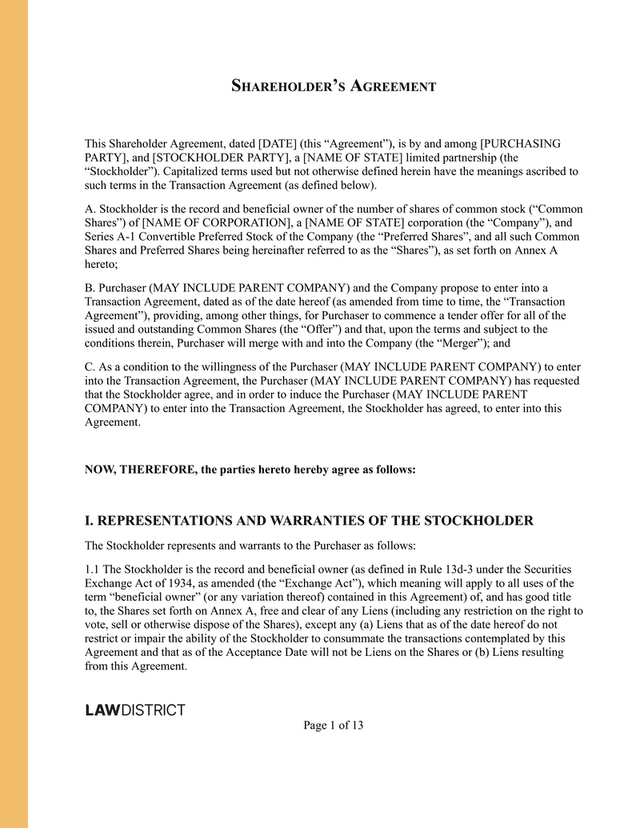
Shareholder Agreement Sample
Before you start your own Shareholder Agreement, taking a look at a finished version of the document can help you understand what’s important to include and the general structure.
Have a legal professional look over your finished document to make sure it aligns with your state’s regulations.
Key Clauses To Include In a Shareholder Agreement
A Shareholder Agreement typically includes the following elements:
- Ownership and valuation of shares
- Rights and responsibilities of shareholders
- Financial management of the company, including business operations, asset handling, capital, and dividend payouts
- Procedures for issuing new shares and restrictions on transferring shares
- Rules addressing conflicts of interest, such as non-compete and non-solicitation clauses
- Dispute resolution methods, like mediation or arbitration
The specific contents of the document can differ based on the corporation and its shareholders
How To Write a Shareholder Agreement
Here is a quick step-by-step guide to drafting your document:
1. Add Basic Details
First of all, write the company’s name and address. List each shareholder’s name, address, and how many shares they own.
2. Explain Shareholder Rights and Duties
Next, you must state how voting works. Explain how profits (dividends) are shared, and list basic responsibilities, like attending meetings.
3. Set Up Management Rules
Explain how directors are chosen, and describe their roles and duties. It’s important to state how often meetings are held and how decisions are made.
4. Outline Financial Rules
Explain how money is managed in the company. You need to cover budgeting, spending limits, loans, and dividends.
5. Plan for Disputes
Say how disagreements will be handled. For example, disputes could be resolved through mediation or arbitration.
6. List Major Decisions (Reserved Matters)
Next, you need to identify decisions that need all shareholders to agree. This may include issuing new shares or taking on large debts.
7. Set Rules for Share Transfers
Explain when shares can be sold or transferred. Include any limits or approval requirements.
8. Include Exit and Termination Terms
State when the agreement ends. Explain what happens if a shareholder leaves, dies, or becomes unable to continue.
9. Review the Document
Make sure all shareholders understand it. Update anything unclear so that there will be no doubts moving forward.
10. Sign the Agreement
All shareholders must sign the finished agreement. This makes the agreement official and legally binding.
Where Can I Get a Shareholder Agreement?
You can easily create your own version of this document using our customizable template. Simply enter all details related to your company and its shareholders, and you’ll instantly receive the finished document.
After drafting, consider having a legal professional review it. They can tell you if it meets all legal requirements.
Who Should Sign the Shareholders’ Agreement?
A Shareholder Agreement must be signed by all shareholders of the corporation.
When all shareholders sign this contract, the company can avoid potential conflicts and misunderstandings, promoting a stable and cooperative business environment.
Shareholder Agreement vs Articles of Association
Both of these documents relate to how a company is run. However, they have different uses. Here is a quick table showing you when each is useful:
| Feature | Shareholder Agreement | Articles of Association |
|---|---|---|
| What it is for? | Private contract between shareholders | Official legal document of the company |
| Is it required? | Usually optional (but strongly recommended) | Legally required to register a company |
| Who can see it? | Private (not publicly filed) | Publicly available |
| Who does it apply to? | Only the shareholders who sign it | The company and all shareholders |
| What does it cover? | Voting rights, dividends, share transfers, dispute rules, minority protections | Company structure, director powers, share classes, basic governance rules |
| Can it give extra protections? | Yes, especially for minority shareholders | Usually more general and standardized |
| Is it flexible? | Highly customizable | Can be amended, but follows company law rules |
What Happens if There Are New Shareholders?
Whenever your company gets new shareholders, you need to update your agreement.
Typically, the following details should be added:
- New shareholders’ details: For example, their name, share percentage, and voting rights.
- Show the impact on current owners: Make it clear how existing shareholders are affected. State whether they will own a smaller percentage of the company.
- Add an anti-dilution clause: This is optional. It would help protect existing shareholders. For example, they may be granted the right to buy new shares first. You should always check whether your company has any approval rules. This would require current shareholders to approve new one before they join.
Shareholder Agreement Types
You can adjust your Shareholder Agreement to fit different situations. Here are a few of the different types and when they’re most useful:
| Type | What it’s for | When it’s most useful |
|---|---|---|
| General Shareholder Agreement | Sets the main rules for all shareholders. | Any company with more than one shareholder. |
| Minority Shareholder Agreement | Adds extra protections for smaller shareholders. | When one group owns less and needs safeguards. |
| LLC Shareholder Agreement | Defines owner roles and rules in an LLC. | When the business is a Limited Liability Company (LLC). |
| Shareholder Loan Agreement | Records the terms of a loan from a shareholder. | When a shareholder lends money to the company. |
| Shareholder Transfer Agreement | Sets rules for selling or transferring shares. | When shares may change hands or ownership could shift. |
| Shareholder Buyout Agreement | Explains how a shareholder can be bought out. | When someone may leave or the company plans a buyout. |
Using the right type can help make sure that your business operations are interrupted with unnecessary disputes.
Related Business Documents
If you are drafting a Shareholder Agreement, you might also be interested in other legal documents, such as:
Shareholder Agreement FAQs
Here are the answers to some of the most common questions regarding Shareholder Agreements.
A Shareholder Agreement must be signed by all shareholders of the corporation. When all shareholders sign this contract, the company can avoid potential conflicts and misunderstandings, promoting a stable and cooperative business environment.
If the issue goes unresolved, they may face financial penalties and legal action. They may also face restrictions on share transfers.
Many Shareholder Agreements require these kinds of disputes to be settled through mediation or arbitration. This can be cheaper and quicker than going through the courts.
A Shareholder Agreement is specific to companies structured as corporations, where shareholders have limited liability and ownership is represented by shares. In contrast, a Partnership Agreement outlines the terms and conditions between parties in a partnership. It addresses issues like:
- Profit distribution
- Management responsibilities
- Partner contributions Unlike shareholders, partners typically have joint and several liability. The agreement covers the operational aspects and decision-making processes of the partnership.
Several issues may arise without this document, including disputes related to dividends and compensation. Legal battles to resolve these disputes can quickly become costly.
Different roles within the company may also be unclear without this document. Confusion related to management and who can make decisions can hinder governance.
The Shareholder Agreement can help create a strong framework for the management of your company and mitigate these risks.
Try Lawdistrict Now
Instant and complete access to our entire library of legal forms
Edit, download and print in PDF from any device
Save time and money on legal document creation