
Virginia Car Bill of Sale Template
If you're selling a motor vehicle in Virginia, a Car Bill of Sale can act as a record of the transaction. It typically includes sale and buyer and seller details. It can also support the buyer's title and tax paperwork.

Fill forms in a few steps
Save, print & download
Done in 5 minutes
When Do You Need a Motor Vehicle Bill of Sale in Virginia?
A separate Bill of Sale is not generally required to register your vehicle in Virginia, as long as the seller correctly records the sale price on the title.
Virginia DMV accepts the seller's declared price on the title, a Bill of Sale, or other qualifying documentation as proof of purchase price.
However, it's still a good idea to make a separate Bill of Sale. It acts as a record of the sale, which can be useful for tax purposes, or if a dispute with the other party arises in the future.
It's also useful if the price is missing or incorrect on the title. **For vehicles more than 5 years old, the DMV may accept a handwritten Bill of Sale or Vehicle Price Certification (SUT-1) in these situations.
For a vehicle 5 years old or less, the DMV may require a notarized Affidavit of Vehicle Purchase Price (SUT-1A) when the reported sales price differs by more than $1,500 from the applicable trade-in value.
What To Include in a Virginia Vehicle Bill of Sale
Virginia DMV specifies the information required when a handwritten Car Bill of Sale is submitted as proof of purchase price. Make sure to include:
- Purchase price
- Vehicle year, make, and model
- Vehicle Identification Number (VIN)
- Date of sale
- Buyer and seller signatures
Mileage follows separate title rules. When odometer disclosure is required, the seller normally records the reading in the assignment section of the title. The buyer then reports it during the title application process.
If an out-of-state title does not contain an assignment section, the seller may record the mileage on an Odometer Disclosure Statement (Form VSA-5).
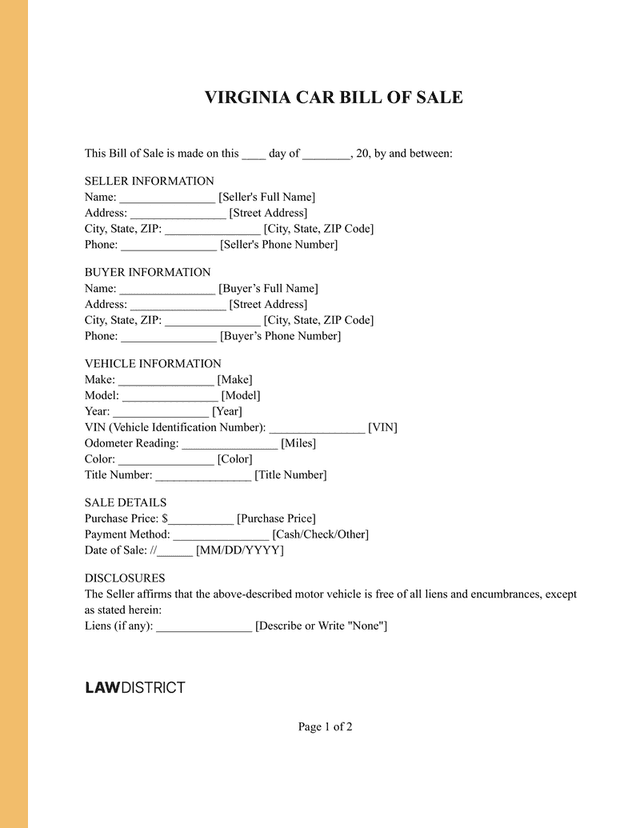
Virginia Motor Vehicle Bill of Sale Sample
The sample below shows how you can present the essential vehicle, price, date, and signature information in a clear way. You can use it as a guide when making your own version of the document.
How To Register a Car in Virginia
After a private purchase, the buyer must forward the transferred title and apply for a new title and registration within 30 days. Transactions can be completed:
- At a DMV customer service center
- At a DMV Select office
- By mail
- Through electronic titling, when eligible
The seller should complete the assignment section of the title with the buyer's information, correct mileage, sale date, and purchase price.
Required Vehicle Registration Forms in Virginia
When buying a vehicle from a private seller, you generally need the following:
- Properly assigned Virginia Certificate of Title
- Proof of address
- Proof of purchase price (price shown on the title, Bill of Sale, or SUT-1)
- Odometer information on the title
- Lien information or a lien release, when applicable
- Insurance certification when registering the vehicle
For a Virginia-titled vehicle, the buyer can complete the Application for Certificate of Title and Registration when titling and registering at the same time.
Virginia Vehicle Registration Fees
Virginia DMV currently charges a $15 title fee. Standard annual passenger registration is $30.75 for vehicles weighing 4,000 pounds or less and $35.75 for vehicles over 4,000 pounds.
Motor Vehicle Sales and Use Tax is generally 4.15% of the sale price, with a $75 minimum, unless an exemption applies. For example, vehicles given as gifts to a spouse, child, or parent and certain inherited vehicles are exempt.
A Highway Use Fee and other applicable charges may also apply depending on the vehicle.
Does a Virginia Car Bill of Sale Need to Be Notarized?
No. You usually do not need to get your Car Bill of Sale or the standard title-transfer documents notarized in Virginia.
The Virginia DMV does, however, suggest notarizing a written purchase contract as an extra protection measure. However, this is completely optional and is not part of the standard requirements for completing a private vehicle title transfer.
Form SUT-1A is an exception when it is required, as the affidavit must be notarized before submission to the DMV.
Frequently Asked Questions
No. A Bill of Sale can establish the purchase price, but it does not replace the properly assigned title required for an ordinary transfer of ownership.
Under Virginia law, the buyer has 30 days to submit the transferred title and apply for a new title and registration.
For an eligible gift or donation, the title should show "gift" as the sales price. If you're claiming an exemption from Motor Vehicle Sales and Use Tax, you may also need SUT-3, Purchaser's Statement of Tax Exemption, and supporting documentation.
Try Lawdistrict Now
Instant and complete access to our entire library of legal forms
Edit, download and print in PDF from any device
Save time and money on legal document creation