
Free Virginia Bill of Sale Forms
A Virginia Bill of Sale serves as legal proof that ownership of personal property, such as a vehicle, boat, livestock, or firearm, has changed hands. A Bill of Sale to register this item with Virginian state authorities may also be necessary.

What type of property are you selling in VA?
Fill forms in a few steps
Save, print & download
Done in 5 minutes
Virginia Bill of Sale
A Bill of Sale in Virginia serves as a legal document to record the sale, purchase, or trade of items such as vehicles, watercraft, firearms, or personal items within the state.
It includes crucial information such as the details of both parties, pricing, a description of the item being sold, payment methods, warranty specifics, and other essential terms.
These documents are particularly useful in resolving disputes concerning the ownership of an item or vehicle that was sold.
Types of Virginia Bills of Sale
Several types of Bills of Sale are commonly used in Virginia, each serving a specific purpose. Here are the main types of Bills of Sale in Virginia:
General Bill of Sale in Virginia
General Bills of Sale in Virginia can document the sale, purchase, or trade of any personal item. These documents serve as proof of purchase for items acquired through private transactions, markets, online or print listings, and garage sales.
This type of document may also be referred to as a:
- Simple Bill of Sale
- Generic Bill of Sale
To ensure its legal validity and acceptance, the Bill of Sale must be signed by the seller. Depending on the type of item being transferred, the document may also require notarization.
Sample Bill of Sale in Virginia
When drafting a Virginia Bill of Sale, it's key to understand the structure and content of a legally valid document.
Review our sample Bill of Sale below to see the appropriate format, language, and essential details that need to be included in the final document.
Our templates can help you during the writing process of your document, but should be reviewed by a legal professional to ensure it complies with your jurisdiction’s laws.
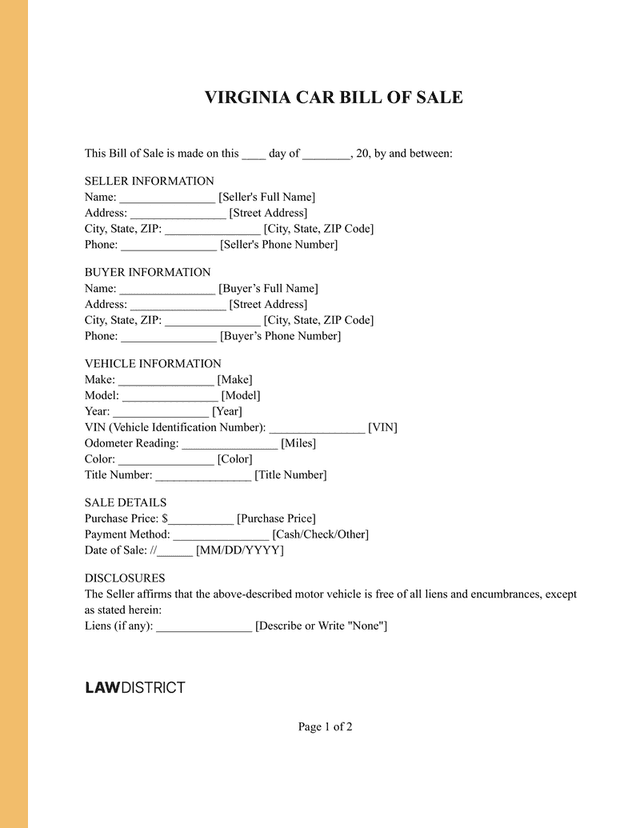
Virginia Car Bill of Sale
A Virginia car Bill of Sale is a crucial document used to formalize the transfer of ownership of a motor vehicle from the seller to the buyer within the state of Virginia.
This document is typically required for the legal registration of the vehicle under the new owner's name at the Virginia Department of Motor Vehicles (DMV).
Other names include:
- DMV Bill of Sale
- Virginia vehicle Bill of Sale
- Motor vehicle Bill of Sale
How To Register a Car
To register a car in Virginia, you’ll need to include the following details in the Bill of Sale:
- Names and addresses of both the buyer and the seller.
- A detailed description of the vehicle, including its make, model, year, and body style.
- The vehicle identification number (VIN).
- The date of sale.
- Specifics of the transaction, such as the purchase price, and terms like trade or gift.
- Warranty information, generally indicating the vehicle is sold "as-is, where-is".
- An Odometer Disclosure Statement is required by federal law (under 49 U.S. Code § 32705) to verify the mileage stated is accurate. Exemptions apply to vehicles older than 10 years or weighing over 16,000 pounds.
These details ensure that all aspects of the vehicle’s sale are clearly documented and legally acknowledged, facilitating future registration or dispute resolution.
Virginia Boat Bill of Sale
In Virginia, a Boat Bill of Sale is essential for transferring ownership of a vessel. This document should include detailed information about the boat such as make, model, age, condition, engine specifics, and the Hull Identification Number (HIN).
It verifies the legality of the purchase and is necessary for the registration of the boat in Virginia waters, ensuring the new owner can legally operate the vessel.
How to Register a Boat
In Virginia, all boats operating on state waters must be registered. Visitors can use a boat registered in another state for up to 90 consecutive days without registering it in Virginia.
A boat can operate under its previous registration for 30 days if it has a copy of that registration and the Bill of Sale onboard. Boat registrations last for 3 years and can be renewed through mail or online.
- Where to register: Boat registration is handled at Virginia Department of Wildlife Resources offices, either in person or by mail.
- Required documents: You'll need to provide an application for a watercraft certificate of title and registration, a Bill of Sale, and proof of payment for taxes and fees.
- Additional documents: Previous title or registration for boats transferred from other states, or a manufacturer’s certificate of origin for first-time registrations.
Virginia Firearm Bill of Sale
The Virginia Firearm Bill of Sale is a legally binding document that facilitates the sale and purchase of a firearm between private parties or between a dealer and an individual in Virginia.
Individuals who fall under the following categories are barred from purchasing, possessing, or transporting firearms:
- Acquitted by reason of insanity
- Legally incompetent
- Mental health treatment
- Subject to protective orders
- Drug convictions
- Emergency risk orders
- Illegal aliens
How to Register a Firearm
Virginia does not mandate the registration of firearms. However, to legally carry a concealed firearm in Virginia, the new owner must possess a valid Weapons Carry License.
Virginia Motorcycle Bill of Sale
A Motorcycle Bill of Sale is a legal document essential for recording the sale of a motorcycle, containing all necessary details to finalize the transaction.
In Virginia, the format of a motorcycle Bill of Sale and its registration is similar to that used for car sales.
Frequently Asked Questions (FAQs) About Virginia Bill of Sale Forms
Virginia Bills of Sale are fairly straightforward legal documents, but it's crucial to comprehend them accurately to prevent errors.
To write a Bill of Sale in Virginia, start by including the full names and addresses of both the buyer and the seller. Specify the item being sold, detailing its make, model, and any identifying numbers (like VIN for vehicles).
State the sale date, purchase price, and any conditions of the sale, such as "as is" status. Lastly, both parties should sign and date the document to make it legally binding.
In Virginia, a Bill of Sale does not need to be notarized for most private sales. However, including a notarization can add a layer of validity and help protect both parties by verifying the identity of the signatories.
This can be particularly useful for high-value transactions or when required by a lending institution or insurance company. For specific items like vehicles and boats, consulting local regulations or legal advice can ensure all necessary legal requirements are met.
A Bill of Sale becomes valid when it clearly lists the full names and addresses of both the buyer and the seller, a detailed description of the item being sold (including identifiers like VIN for vehicles), the sale price, and the date of sale.
Both parties must sign the document. Additional steps such as registration of the item, especially for vehicles and boats, may be required to complete the transaction legally.
Try Lawdistrict Now
Instant and complete access to our entire library of legal forms
Edit, download and print in PDF from any device
Save time and money on legal document creation