
Maryland Rental Application Form
The Maryland Rental Application Form is a formal document used to screen applicants before a lease is signed. It covers everything from employment history to income verification. Using this form allows you to vet candidates thoroughly while staying within the bounds of federal housing laws.

Fill forms in a few steps
Save, print & download
Done in 5 minutes
What Is a Maryland Residential Rental Application?
A Maryland rental application is a legal document used by landlords and property managers to assess and choose an appropriate tenant for a rental property.
Having a rental application can prove highly important to make sure you get the right tenant into your property.
The process of screening prospective residents in this way allows you to discover any issues such as their inability to pay rent or the likelihood to cause a nuisance before signing a contract.
Maryland Rental Application Sample
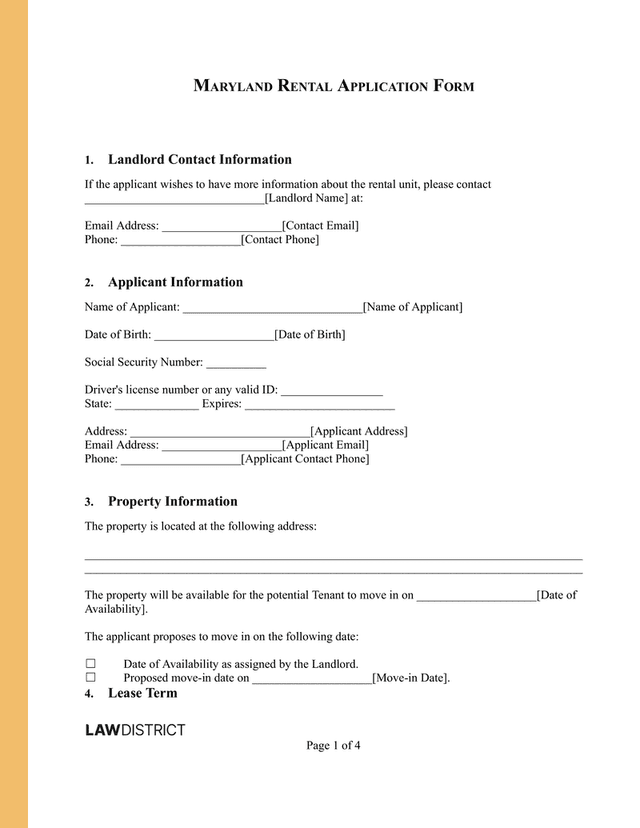
Looking over a readily prepared template of a rental application can make it much easier to create your own. Review our document sample below to get more familiar with what your application form will look like when it’s completed.
What To Include in a Maryland Rental Application Form
When you fill in a simple rental application form for Maryland you’ll need to ask for some crucial details from the tenant to make the vetting process as effective as possible.
When you create your own application for a rental property you should request the following information:
- Personal data
- Rental history
- Employment details
- Income information
- Credit history
- Personal references
- Permission for background checks
Additionally, the landlord must provide several legal disclosures on a standard rental application. They must report information on:
- The property’s condition
- Potential hazards to the tenant
- Shared utility arrangements
- Rent control rules
- Smoking policy
- The security deposit
- Associated fees
Maryland Rental Application Laws
Maryland state has various laws regarding the use of Rental Applications. If your document is not compliant with MD law, you may get sued by the applicant and face legal consequences.
Application Fee
There is no limit on application fees in Maryland for landlords who rent out five or more units at one location. However, they can only use this money for credit checks or other expenses actually arising out of the application. If the fee exceeds $25 and there is unspent money, you must return the balance to the applicant within 15 days (§ 8-213).
Security Deposit
Maryland landlords can charge up to 2 months' rent as a security deposit for unfurnished apartments (MD Code, Real Property 8-203).
They must provide a receipt and return the deposit with interest (for deposits of $50 or more held for at least six months), minus damages, within 45 days after the lease ends. Overcharging penalties apply (§ 8-203(4)(b)).
Housing Discrimination Law
Maryland has comprehensive state-level protections under the Maryland Fair Housing Act. In addition to the federal Fair Housing Act (FHA), state law prohibits discrimination based on:
- Race and Color
- National Origin
- Religion
- Sex, Sexual Orientation, and Gender Identity
- Marital Status
- Familial Status
- Disability
- Source of Income
As a consequence, you are not allowed to use these details as a basis for rejection on a Maryland Rental Application form, nor to include them in the decision-making process.
Notice of Eligibility
Potential tenants must be informed about the screening criteria and reasons for denial or approval. To prove that these facts were shared, a signature of acknowledgment must be provided within the application or alongside it.
Consent Credit Check
Within Maryland, federal law is in effect that requires potential renters to provide written consent for a credit history check during the application process. This is known as the Federal Credit Reporting Act (FCRA).
Other Real Estate Documents
There are various other legal documents that landlords must take into account when considering new tenants. Get expert guidance on preparing other personalized property forms with our other printable templates for the following legal forms:
FAQs About Maryland Rental Application Form
Understanding what your Maryland rental application can and cannot do is vital before you create your own from scratch. Find out more about how these screening documents work and what you need to know when writing them.
Creating an MD rental application can be easily done with the help of our contract maker and template tools. When you fill out a rental application form you will usually request the following information from the tenant:
- Personal data
- Rental history
- Employment details
- Income information
- Credit history
- Personal references
- Permission for background checks
You must also include important legal disclosures on the property and the lease agreement being proposed. This will outline details on the condition of the property, any hazards, and information on details such as security deposit and fees. Our template designer will help you add the data that must be added.
A Maryland rental application gives you the opportunity to learn more about your tenant before committing to a legal contract with them. The application lets you collect data on your prospective rental resident so you may carry out important checks to:
- Review their rental history
- Verify their employment and income
- Learn of any criminal history or credit issues
You cannot ask tenants a number of questions when you are vetting them with a Maryland rental application document. You must not request any of the following information from the applicant during this process:
- Race or ethnicity
- Religion
- Sexuality
- Immigration or citizenship status
- Arrest records
- Marital or familial status
- Whether they have children or not
Try Lawdistrict Now
Instant and complete access to our entire library of legal forms
Edit, download and print in PDF from any device
Save time and money on legal document creation