
Survivorship Deed
A Survivorship Deed can transfer real estate to two or more co-owners with a right of survivorship. When one owner dies, their interest generally passes automatically to the surviving owner or owners.

Fill forms in a few steps
Save, print & download
Done in 5 minutes
What Is a Survivorship Deed?
A Survivorship Deed is a legal document that gives co-owners a right of survivorship.
If one of the co-owners of a property dies, their ownership interest usually automatically passes to surviving co-owner.
A deed with right of survivorship can establish different forms of survivorship ownership, depending on state law:
- Joint tenancy with right of survivorship
- Tenancy by the entirety
- Community property with right of survivorship, where available
How Does a Survivorship Deed Work?
A Right of Survivorship Deed generally works in four simple steps:
- Create the deed: Start by drafting the document, clearly stating the co-owners. You should use the survivorship language required by your state's law.
- Sign and record it: Complete any required signatures, notarization, witnesses, and recording with the appropriate local office.
- Own the property together: Once the transfer takes effect, each co-owner has a current ownership interest in the property.
- Pass ownership to the survivor: When one co-owner dies, their interest passes automatically to the surviving owner or owners.
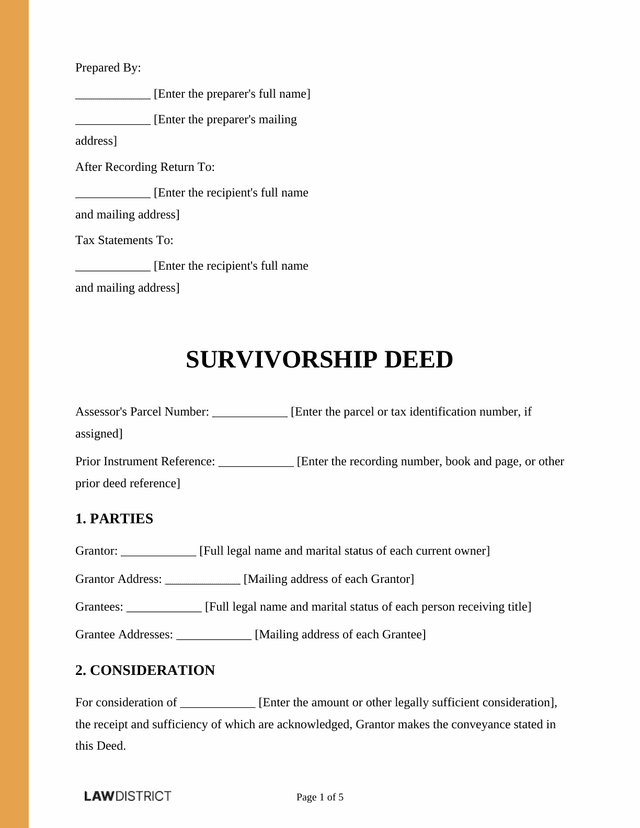
Survivorship Deed Sample
You can use the example Survivorship Deed below as a guide when drafting your own deed:
What to Include in a Survivorship Deed?
Your deed typically includes the parties and property involved, and a clear statement of the survivorship arrangement. If drafting your own, make sure to include the following:
| Element | What to Include |
|---|---|
| 1. Grantor | The legal name of the person or people transferring the property interest. |
| 2. Grantees | The legal names of each person who will become a co-owner. |
| 3. Survivorship language | Clear wording establishing the right of survivorship permitted under your state's law. |
| 4. Legal description | The property's complete legal description from the current deed or land records. |
| 5. Property details | Include any parcel information or other property identifiers required for recording. |
| 6. Consideration | State the consideration or other transfer wording required under applicable law. |
| 7. Existing interests | Include relevant reservations, exceptions, easements, or other interests when required. |
| 8. Prior deed information | Add the prior recorded instrument reference when required by state or county rules. |
| 9. Signatures | Obtain all signatures required to make the transfer legally effective. |
| 10. Acknowledgment | Complete the required notarization, witnesses, or other execution formalities. |
Co-Owner Rights in a Survivorship Deed
While each co-owner is still alive, each generally has a current ownership interest in the property.
This means that you both have the right to possess and use the property.
A co-owner may also be able to:
- Transfer an interest
- Ask a court to divide the property
- End the right of survivorship
Special rules can also apply if the co-owners are married to each other.
Advantages and Disadvantages of a Survivorship Deed
Making a joint Survivorship Deed comes with a range of both advantages and disadvantages.
Here's what you should know before signing:
| Advantages | Disadvantages |
|---|---|
| Avoids probate for the property interest. The deceased owner's share generally passes directly to the survivor. | You share ownership during your lifetime. The other co-owner gains legal rights to the property. |
| Provides a clear succession plan. The deed determines which surviving owner receives the property interest when a co-owner dies. | Your will generally cannot change the transfer. The survivorship arrangement usually controls who receives the property. |
| Simplifies the process after death. The survivor may be able to update the property records using proof of death and any required local forms. | Financial and tax issues may arise. Creditors, divorce, gift taxes, or tax-basis rules can affect the property or owners. |
Survivorship Deed vs. Tenancy in Common
Both of these arrangements allow two or more people to own the same property at the same time. However, they handle an owner's death differently.
A Survivorship Deed is designed to give the surviving co-owner the deceased owner's interest automatically.
Tenancy in common generally has no right of survivorship. When a tenant in common dies, their share can pass under their will or state inheritance law. Tenants in common can also own different percentages of the same property.
Survivorship Deed FAQs
Learn how survivorship rights can be changed and what legal or tax issues you should consider.
You may be able to end the right of survivorship, but the process depends on your state and how the property is owned. You may need:
- A new deed
- A written agreement
- A court partition
- Another type of legal filing
Yes, a Survivorship Deed may be challenged for legal reasons such as:
- Fraud
- Incapacity
- Improper execution
A Survivorship Deed can affect gift, estate, and capital gains taxes.
Adding another owner for little or no payment may count as a gift. Tax treatment after an owner dies can also depend on how the property is owned and who paid for it.
Try Lawdistrict Now
Instant and complete access to our entire library of legal forms
Edit, download and print in PDF from any device
Save time and money on legal document creation