



Are you a homeowner who just signed a lease agreement with a tenant? Or a property owner going away for an extended period of time?
If so, it’s normal if you are a bit worried about finding a squatter living on your property with all that’s going on in 2024.
With a record rise in housing prices, many people around the country have turned to squatting as a way to keep a roof over their heads.
Squatting is a complex issue that often leaves property owners frustrated and unsure of their legal rights.
In Atlanta alone, around 1200 homes have had squatters recently occupying the property illegally.
Understanding when and how the police can legally remove squatters is crucial if you ever need to reclaim your property. In most cases, you cannot simply call 911 and have police remove squatters in minutes without a court order.
However, you can resolve this issue by following the correct legal process.
Keep reading to learn more about squatter rights, removing squatters, differences between squatting and breaking and entering, and more.
Is Squatting A Crime in the US?
The legality of squatting in the United States is complex, as it varies significantly by state and even local jurisdiction.
Many property owners ask if squatters can be arrested or can be evicted.
While squatting may be considered a form of trespassing in many areas, specific laws and their enforcement can be diverse.
We interviewed legal expert Tony Toepfer, an attorney who is head of a law firm that specializes in landlord and real estate law from Toepfer at Law in Minnesota.
As someone who has extensive knowledge of squatting issues, Toepfer explained, “I can’t speak for all jurisdictions, but there comes a point where a “squatter” gains rights akin to a tenant without a lease in Minnesota. You’re really looking at whether the person will be treated as a trespasser or a squatter.”
In some states, squatters who have established a certain level of residency may actually gain some legal rights that differentiate them from typical trespassers.
Ultimately, the legality of squatting often hinges on the specific circumstances, the duration of the squatter's occupation, and the applicable state and local laws.
Can you go to jail for squatting?
There are a number of states where squatting is seen as criminal trespassing. Squatting can be seen as a crime, such as:
- Illegal occupancy
- Criminal trespassing
Most states do prosecute squatting as criminal trespassing. For example, in Tuscon, squatting can be prosecuted as a criminal offense. However, it will ultimately depend on your local laws.
Why Can’t You Physically Remove Squatters?
As a property owner, you may want to take the law into your own hands or want the police to quickly intervene. If you’ve asked yourself “Can squatters be forcibly removed?” unfortunately, again, the answer is complicated.
It’s essential to know how to get rid of squatters correctly if you want to get your property back legally.
Physically removing squatters without following legal procedures can lead to serious legal consequences. The primary reason is that squatters may gain certain legal protections over time, making them akin to tenants rather than trespassers.
According to Tony Toepfer, “Whether a squatter may be forcibly removed is going to vary primarily by state statute, but also the length of time the squatter has been present.”
In many states, such as California and New York, property owners must go through a formal eviction process, which involves serving an eviction notice and obtaining a court order.
For example, in New York, the law requires property owners to follow the formal eviction process outlined in the Real Property Actions and Proceedings Law.
Toepfer adds, “There comes a point where a squatter gains rights akin to a tenant without a lease. Law enforcement may err on the side of caution to avoid unintentionally violating these rights.”
It would be a good idea to use an eviction notice as the first step to get any squatter out of your home who has set up a residence there.
Public opinion on squatting: should laws be changed?
Surveys reveal overwhelming public support for stricter measures against squatters. A LawDistrict survey of nearly 3,000 respondents highlighted the following key opinions:
- 97% of respondents believe squatters in residential areas should be removed immediately, with many suggesting they should also face arrest.
- 97% of respondents also strongly supported the right of property owners to remove squatters without needing to undergo lengthy legal proceedings.
These results reflect the widespread frustration among property owners who view squatting as a direct violation of private property rights.
Many comments equated squatting with breaking and entering, advocating for it to be treated as a criminal offense.
However, public opinion is less unified when it comes to solutions for addressing homelessness through vacant properties.
Only 15% of respondents supported government programs to convert vacant properties into legal housing for those in need. Many emphasized the importance of protecting private property over implementing such measures.
These statistics underscore the growing demand for legislative changes.
Recent changes in squatter legislation
Based on the number of squatters taking over properties, and the resounding negative public opinion of squatting, laws have changed in different areas of the country.
In fact, a Manhattan real estate lawyer mentioned that he’s seen a 10% to 20% rise in squatter cases over the past two years.
Recent legislative changes have impacted how squatters are dealt with in states like Florida and New York.
- Florida: Governor Ron DeSantis signed a law allowing police to arrest squatters without a court order under certain conditions, such as immediate occupancy after a property is vacated.
- New York: A new state law signed by Governor Kathy Hochul redefines tenant laws to prevent squatting, making it easier for property owners to evict squatters.
These changes are a couple of examples that reflect ongoing efforts to address squatting more effectively across different jurisdictions.
| States With New Squatter Laws | New Law |
|---|---|
| Alabama | HB 182 |
| Florida | HB 621 |
| Georgia | HB 1017 (Georgia Squatter Reform Act) |
| New York | FY25 (2025 State Budget) |
How Squatters Take Over Houses and Other Property
Squatters typically target vacant or abandoned properties, gradually asserting their presence until they can claim certain legal rights.
Once inside, they may change locks or make minor renovations to establish a semblance of legitimacy.
Steps squatters often take to take over a house:
- Gaining Entry: Squatters enter through unlocked doors or windows or even break in discreetly. They often choose times when the property is least monitored.
- Establishing Residency: To strengthen their claim, squatters might set up utilities in their name or receive mail at the address, creating a record of occupancy.
- Avoiding Detection: Squatters often try to remain unnoticed by neighbors and law enforcement, keeping a low profile to avoid confrontation.
In some states, if squatters occupy a property openly and continuously for a specific period, they can claim ownership through adverse possession. This legal principle requires meeting certain conditions, such as maintaining the property and paying property taxes.
You should regularly inspect and maintain their properties to prevent squatters from establishing residency.
If squatters claim to be tenants, Toepfer explains that “The safest choice would be to follow your local laws regarding an eviction and begin the process immediately.”
For actual tenants you suspect may become squatters, apart from an eviction notice, a lease termination letter or late rent notice can be helpful in preventing a squatting situation.
Get an Lease Termination Letter
Squatters vs. Breaking and Entering
While squatting and breaking and entering may seem similar, there are important legal distinctions between the two.
Attorney Toepfer mentions that “If the person has been there long enough that they have, for example, been receiving bills to the address, you're almost certainly going to be dealing with an eviction rather than removal by force.”
This suggests that squatters who have established some form of residency, even if unlawfully, may have certain rights that differentiate them from typical trespassers.
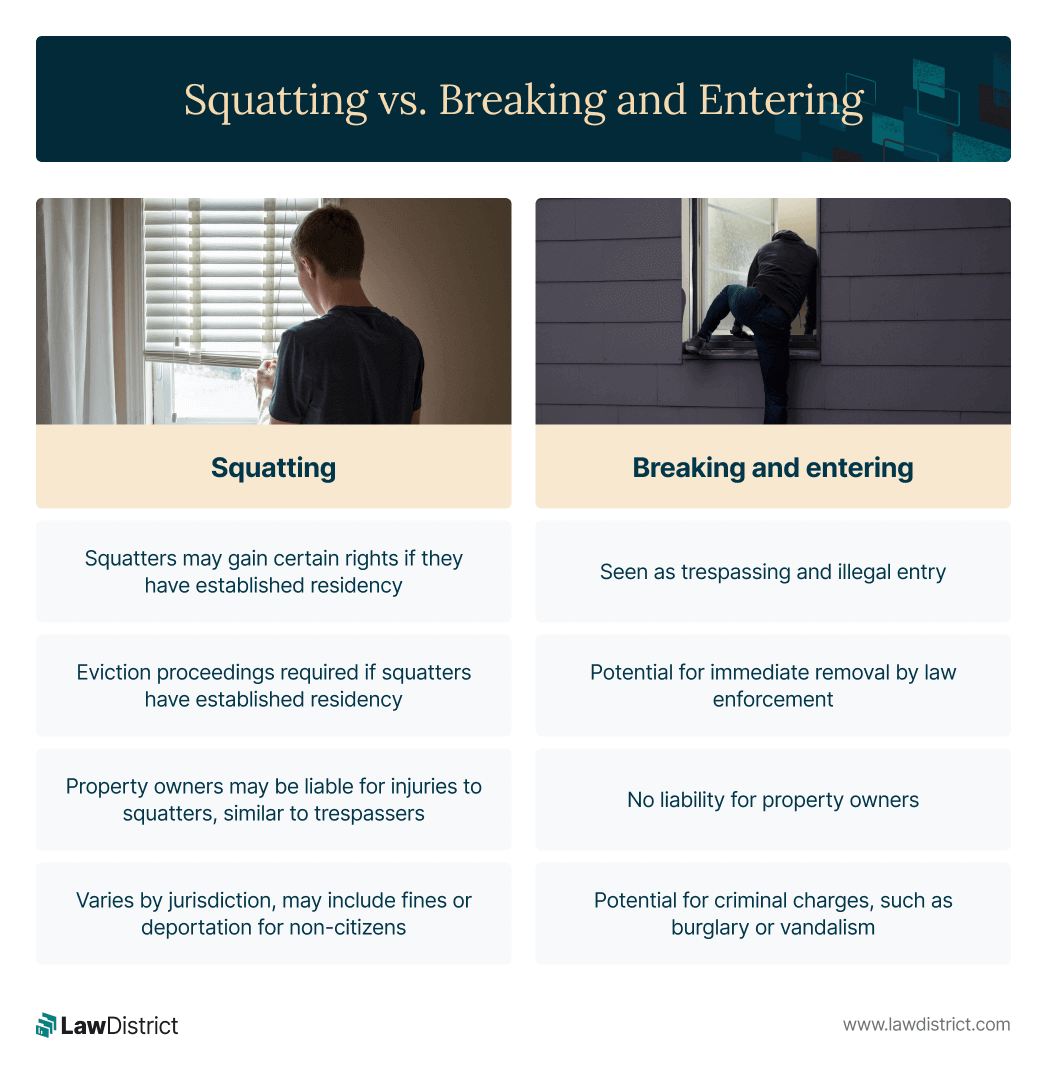
Toepfer notes that “the practical implication of this is depending on what law enforcement office you engage with, the police may or may not elect to eject a trespasser without a court order, as the officer you get on the phone may or may not have a complete understanding of when someone gains those rights and whether they legally can eject someone.”
Based on this, if you’re at the point that you’re dealing with a squatter instead of breaking and entering, you must follow the proper legal channels.
For example, depending on your situation, you may want to legally increase rent and use an eviction notice to eventually remove the squatters rather than attempting to have them forcibly removed.
To lawfully raise prices on squatters, you can use our rent increase notice template. You can then speak to a legal professional to make sure it’s the right strategy for you and that your document is ready to use.
Squatters and Airbnb
Squatters aren’t the only people who break into properties. If you’re an Airbnb host, you’ll need to be careful.
Squatters in Airbnb properties can be either those who move in between guests or guests who refuse to leave at the end of their stay. To prevent this, you should:
- Screen guests: Use software that flags suspicious profiles and analyzes them thoroughly
- Monitor stays: Be cautious with longer bookings and monitor guest behavior
- Secure deposits: Require a security deposit to cover potential damages and discourage overstaying
- Communicate: Contact guests to address any issues promptly
Migrant Squatting in 2024
The U.S. Border Patrol recorded 124,220 encounters with migrants at ports of entry along the southwest border. While this number has fluctuated month to month, homeowners have become concerned about migrant squatting.
A new bill has been proposed, the Shield Act, that would make squatting a deportable offense for undocumented migrants.
On the positive side, Toepfer mentioned, “It’s entirely possible that enforcement of this act could indirectly have a positive impact on the reduction of sex trafficking as stronger enforcement against the dissemination of such images online may make it harder for traffickers to “market” and hopefully make sex trafficking a less profitable crime, leading to a reduction in such overall.”
As the issue of migrant squatting and growing numbers of domestic squatters continues to grow, it will be crucial for property owners, law enforcement, and policymakers to find a balanced approach that respects the rights of all parties involved.
Information About Tony Toepfer
We asked attorney Tony Toepfer about squatter rights and laws in the United States. His credentials include:
- Juris Doctor, cum laude, from the University of St. Thomas; MBA from Texas A&M; BA from the University of Texas at Dallas.
- Licensed to practice in Minnesota and the United States District Court for the District of Minnesota.
- Member of the Minnesota State Bar Association (MSBA) and its Family Law Section, and the Stearns-Benton County Bar Association (SBBA).
Are you a homeowner who just signed a lease agreement with a tenant? Or a property owner going away for an extended period of time?
If so, it’s normal if you are a bit worried about finding a squatter living on your property with all that’s going on in 2024.
With a record rise in housing prices, many people around the country have turned to squatting as a way to keep a roof over their heads.
Squatting is a complex issue that often leaves property owners frustrated and unsure of their legal rights.
In Atlanta alone, around 1200 homes have had squatters recently occupying the property illegally.
Understanding when and how the police can legally remove squatters is crucial if you ever need to reclaim your property. In most cases, you cannot simply call 911 and have police remove squatters in minutes without a court order.
However, you can resolve this issue by following the correct legal process.
Keep reading to learn more about squatter rights, removing squatters, differences between squatting and breaking and entering, and more.
Is Squatting A Crime in the US?
The legality of squatting in the United States is complex, as it varies significantly by state and even local jurisdiction.
Many property owners ask if squatters can be arrested or can be evicted.
While squatting may be considered a form of trespassing in many areas, specific laws and their enforcement can be diverse.
We interviewed legal expert Tony Toepfer, an attorney who is head of a law firm that specializes in landlord and real estate law from Toepfer at Law in Minnesota.
As someone who has extensive knowledge of squatting issues, Toepfer explained, “I can’t speak for all jurisdictions, but there comes a point where a “squatter” gains rights akin to a tenant without a lease in Minnesota. You’re really looking at whether the person will be treated as a trespasser or a squatter.”
In some states, squatters who have established a certain level of residency may actually gain some legal rights that differentiate them from typical trespassers.
Ultimately, the legality of squatting often hinges on the specific circumstances, the duration of the squatter's occupation, and the applicable state and local laws.
Can you go to jail for squatting?
There are a number of states where squatting is seen as criminal trespassing. Squatting can be seen as a crime, such as:
- Illegal occupancy
- Criminal trespassing
Most states do prosecute squatting as criminal trespassing. For example, in Tuscon, squatting can be prosecuted as a criminal offense. However, it will ultimately depend on your local laws.
Why Can’t You Physically Remove Squatters?
As a property owner, you may want to take the law into your own hands or want the police to quickly intervene. If you’ve asked yourself “Can squatters be forcibly removed?” unfortunately, again, the answer is complicated.
It’s essential to know how to get rid of squatters correctly if you want to get your property back legally.
Physically removing squatters without following legal procedures can lead to serious legal consequences. The primary reason is that squatters may gain certain legal protections over time, making them akin to tenants rather than trespassers.
According to Tony Toepfer, “Whether a squatter may be forcibly removed is going to vary primarily by state statute, but also the length of time the squatter has been present.”
In many states, such as California and New York, property owners must go through a formal eviction process, which involves serving an eviction notice and obtaining a court order.
For example, in New York, the law requires property owners to follow the formal eviction process outlined in the Real Property Actions and Proceedings Law.
Toepfer adds, “There comes a point where a squatter gains rights akin to a tenant without a lease. Law enforcement may err on the side of caution to avoid unintentionally violating these rights.”
It would be a good idea to use an eviction notice as the first step to get any squatter out of your home who has set up a residence there.
Public opinion on squatting: should laws be changed?
Surveys reveal overwhelming public support for stricter measures against squatters. A LawDistrict survey of nearly 3,000 respondents highlighted the following key opinions:
- 97% of respondents believe squatters in residential areas should be removed immediately, with many suggesting they should also face arrest.
- 97% of respondents also strongly supported the right of property owners to remove squatters without needing to undergo lengthy legal proceedings.
These results reflect the widespread frustration among property owners who view squatting as a direct violation of private property rights.
Many comments equated squatting with breaking and entering, advocating for it to be treated as a criminal offense.
However, public opinion is less unified when it comes to solutions for addressing homelessness through vacant properties.
Only 15% of respondents supported government programs to convert vacant properties into legal housing for those in need. Many emphasized the importance of protecting private property over implementing such measures.
These statistics underscore the growing demand for legislative changes.
Recent changes in squatter legislation
Based on the number of squatters taking over properties, and the resounding negative public opinion of squatting, laws have changed in different areas of the country.
In fact, a Manhattan real estate lawyer mentioned that he’s seen a 10% to 20% rise in squatter cases over the past two years.
Recent legislative changes have impacted how squatters are dealt with in states like Florida and New York.
- Florida: Governor Ron DeSantis signed a law allowing police to arrest squatters without a court order under certain conditions, such as immediate occupancy after a property is vacated.
- New York: A new state law signed by Governor Kathy Hochul redefines tenant laws to prevent squatting, making it easier for property owners to evict squatters.
These changes are a couple of examples that reflect ongoing efforts to address squatting more effectively across different jurisdictions.
| States With New Squatter Laws | New Law |
|---|---|
| Alabama | HB 182 |
| Florida | HB 621 |
| Georgia | HB 1017 (Georgia Squatter Reform Act) |
| New York | FY25 (2025 State Budget) |
How Squatters Take Over Houses and Other Property
Squatters typically target vacant or abandoned properties, gradually asserting their presence until they can claim certain legal rights.
Once inside, they may change locks or make minor renovations to establish a semblance of legitimacy.
Steps squatters often take to take over a house:
- Gaining Entry: Squatters enter through unlocked doors or windows or even break in discreetly. They often choose times when the property is least monitored.
- Establishing Residency: To strengthen their claim, squatters might set up utilities in their name or receive mail at the address, creating a record of occupancy.
- Avoiding Detection: Squatters often try to remain unnoticed by neighbors and law enforcement, keeping a low profile to avoid confrontation.
In some states, if squatters occupy a property openly and continuously for a specific period, they can claim ownership through adverse possession. This legal principle requires meeting certain conditions, such as maintaining the property and paying property taxes.
You should regularly inspect and maintain their properties to prevent squatters from establishing residency.
If squatters claim to be tenants, Toepfer explains that “The safest choice would be to follow your local laws regarding an eviction and begin the process immediately.”
For actual tenants you suspect may become squatters, apart from an eviction notice, a lease termination letter or late rent notice can be helpful in preventing a squatting situation.
Get an Lease Termination Letter
Squatters vs. Breaking and Entering
While squatting and breaking and entering may seem similar, there are important legal distinctions between the two.
Attorney Toepfer mentions that “If the person has been there long enough that they have, for example, been receiving bills to the address, you're almost certainly going to be dealing with an eviction rather than removal by force.”
This suggests that squatters who have established some form of residency, even if unlawfully, may have certain rights that differentiate them from typical trespassers.
Toepfer notes that “the practical implication of this is depending on what law enforcement office you engage with, the police may or may not elect to eject a trespasser without a court order, as the officer you get on the phone may or may not have a complete understanding of when someone gains those rights and whether they legally can eject someone.”
Based on this, if you’re at the point that you’re dealing with a squatter instead of breaking and entering, you must follow the proper legal channels.
For example, depending on your situation, you may want to legally increase rent and use an eviction notice to eventually remove the squatters rather than attempting to have them forcibly removed.
To lawfully raise prices on squatters, you can use our rent increase notice template. You can then speak to a legal professional to make sure it’s the right strategy for you and that your document is ready to use.
Squatters and Airbnb
Squatters aren’t the only people who break into properties. If you’re an Airbnb host, you’ll need to be careful.
Squatters in Airbnb properties can be either those who move in between guests or guests who refuse to leave at the end of their stay. To prevent this, you should:
- Screen guests: Use software that flags suspicious profiles and analyzes them thoroughly
- Monitor stays: Be cautious with longer bookings and monitor guest behavior
- Secure deposits: Require a security deposit to cover potential damages and discourage overstaying
- Communicate: Contact guests to address any issues promptly
Migrant Squatting in 2024
The U.S. Border Patrol recorded 124,220 encounters with migrants at ports of entry along the southwest border. While this number has fluctuated month to month, homeowners have become concerned about migrant squatting.
A new bill has been proposed, the Shield Act, that would make squatting a deportable offense for undocumented migrants.
On the positive side, Toepfer mentioned, “It’s entirely possible that enforcement of this act could indirectly have a positive impact on the reduction of sex trafficking as stronger enforcement against the dissemination of such images online may make it harder for traffickers to “market” and hopefully make sex trafficking a less profitable crime, leading to a reduction in such overall.”
As the issue of migrant squatting and growing numbers of domestic squatters continues to grow, it will be crucial for property owners, law enforcement, and policymakers to find a balanced approach that respects the rights of all parties involved.
Information About Tony Toepfer
We asked attorney Tony Toepfer about squatter rights and laws in the United States. His credentials include:
- Juris Doctor, cum laude, from the University of St. Thomas; MBA from Texas A&M; BA from the University of Texas at Dallas.
- Licensed to practice in Minnesota and the United States District Court for the District of Minnesota.
- Member of the Minnesota State Bar Association (MSBA) and its Family Law Section, and the Stearns-Benton County Bar Association (SBBA).
Most Popular Posts

Some states require a motor vehicle bill of sale form; others do not. Even if only for your personal records, anyone who buys or sells a vehicle needs

If you plan to travel with a minor, whether or not you are their parent, you can minimize inconveniences by carrying a few necessary documents...