



Key Takeaways:
- Squatter rights: Squatters can gain legal rights after occupying a property without permission, and owners must follow local eviction procedures.
- Adverse possession: Squatters can claim ownership by paying taxes and living on the property for 5 to 21 years, depending on the state.
- Prevention: Regular property inspections, secure locks, and formal agreements help prevent squatters.
- Act fast: Delays in eviction can lead to squatters gaining full ownership through adverse possession.
As a property owner, knowing squatter rights is crucial. These aren’t your ordinary delinquent tenants, and knowing how the law treats them is vital before taking action against them.
Squatters are every landlord’s nightmare. These unauthorized residents don’t pay rent, can cause serious damage, and can be legally tricky to remove due to adverse possession laws.
In many cases, you may need an eviction notice, a notice to vacate letter or to follow other legal processes to get them out
Many laws guard squatter rights and mean that real estate owners cannot take certain actions to remove them. This brings up a few big questions:
- What are squatter rights?
- Which states have squatter rights?
- What can I do if squatters move in?
We’re going to help you answer all these questions in this article.
What Are Squatters?
A conventional squatters definition covers people who live on your property without permission. Of course, that includes quite a lot of possible parties.
A couple typical examples of squatters can include:
- Tenants who refuse to leave after a lease has ended or has been canceled
- Airbnb guests who overstay in some situations
There are now even Airbnb squatter rights of sorts that must be considered.
In most areas, anyone who lives on your property for more than 30 days with permission can claim rights as, in the eyes of the law, they become your tenants. When this happens, you will usually need to carry out an eviction procedure.
However, in the case where permission was never given, and an unoccupied property is forcibly entered and lived in, there are still rules you must follow.
What Are Squatter Rights?
Squatter rights dictate how you must approach removing unwanted residents.
If your vacant property is occupied without permission for a long enough period, these rights will be conferred on the residents.
Squatting or "adverse possession" is part of the legal code (§1068) in most states. These rules protect the inhabitants from being removed forcibly. They also require you to follow a legal eviction procedure to compel them to leave.
Mark Miller from the Pacific Legal Foundation highlights the difficulties of removing squatters when they have stayed a certain period of time in a property:
Squatter rights can ultimately allow the residents to become the legal owners of the property, too. In this case, squatters can be granted the title to the property if they live in it undisturbed and pay local property taxes for a number of years.
Why do squatters have rights?
Occupants of any property have the right not to be displaced without notice, whether or not they have permission to live somewhere.
The rights squatters enjoy today were originally brought over from British property law and were created to protect and distinguish those who owned and used land.
We can see this in laws like the Homestead Act of 1862, which let settlers develop unclaimed land. This also developed over time, and as the land was settled across the states, ownership of that land was shared out.
Despite the current legal framework protecting squatters, a LawDistrict survey found that 97% of respondents want squatters in residential areas to be removed immediately. Some even commented that they should be arrested.
97% of respondents also believed that squatters should be removed without having to go through lengthy legal proceedings. Nevertheless, property owners must follow their state laws if they want to legally evict squatters.
Legal Rights and Penalties for Squatters
Squatters are protected by law from illegal removal, but they are not considered tenants unless local law grants that status. Squatters can face civil or criminal penalties if they cause damage or act unlawfully on the property. Owners must follow proper eviction procedures to avoid legal trouble. Delaying action can make it harder to remove squatters and may eventually allow them to claim ownership under adverse possession laws.
States With 30-day Squatters' Rights
In certain states, squatters can claim rights after just 30 days of occupying a property. Once squatters have been in residence for 30 days, they may be considered tenants under the law, requiring formal eviction processes to remove them.
Some of the states that have provisions that allow squatters to establish tenancy rights after this short period include:
- Arizona
- Colorado
- North Carolina
- Maryland
Each state has its own procedures and laws; for example, squatters' rights for 30 days in Arizona can differ from squatters' rights for 30 days in Colorado. So, it will be important to check with your local requirements.
Keep in mind, while this rule does not mean a squatter has a claim to your property within 30 days, it is crucial to take timely action to prevent such claims.
Several states have introduced new laws to override these 30-day provisions, such as New York or Texas.
How To Get Rid of Squatters
The precise procedure for removing squatters from a property ultimately relies on your state and municipality. Local rules and regulations have different specificities depending on where you live.
What to do when evicting squatters: Step-by-step guide
However, there are a few things you should do first, no matter where you reside. In most cases, you should at the very least take the following steps:
| Step | Action |
|---|---|
| 1. Identify the occupant | Determine if they are a squatter (unauthorized, long-term occupant) or a trespasser (short-term, easily removable). |
| 2. Notify authorities | Call local law enforcement if the occupant is a trespasser. Police can remove them immediately. |
| 3. Serve eviction notice | For squatters, provide a formal eviction notice according to your state's law. Use a process server or attorney for accuracy. |
| 4. File a civil case | If the squatter ignores the notice, file an unlawful detainer or eviction case with the local court. |
| 5. Law enforcement removal | Once the court rules, law enforcement can remove the squatter and their belongings legally. |
| 6. Avoid illegal actions | Never change locks, shut off utilities, intimidate, or attempt self-help eviction. This can lead to legal consequences. |
What not to do when evicting squatters
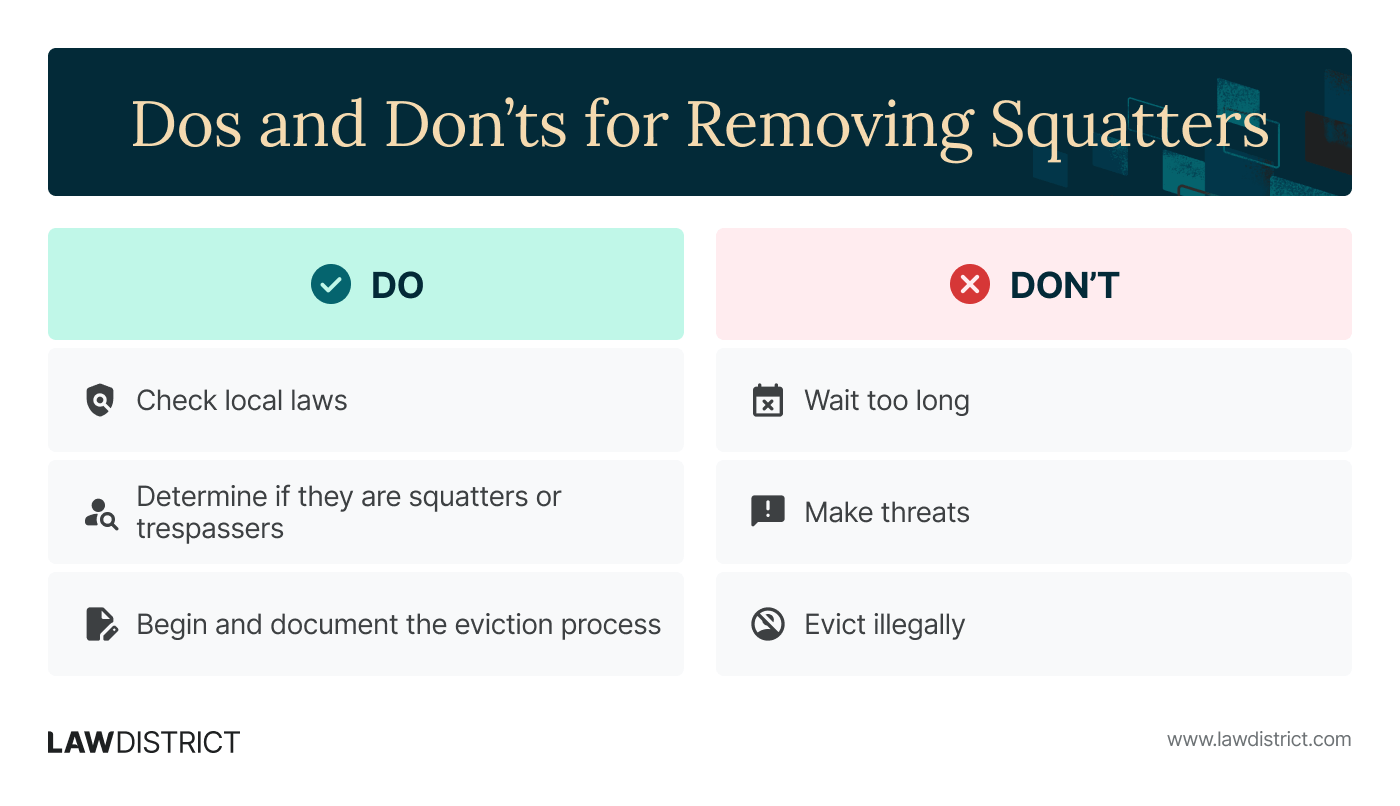
There are plenty of mistakes that can be made when removing squatters from your property. Make sure to avoid the following common errors:
- Don’t wait too long. Under adverse possession laws, the squatters could claim full ownership rights if they had lived continuously on the property for a few years.
- Don’t evict illegally. As tempting as it may be, you mustn’t forcibly evict squatters. Make sure to follow a legal eviction process to avoid additional issues down the line.
How to Prevent Squatters Moving In
Prevention is ultimately the best cure when it comes to squatters. There are a few things you can do to stop unwanted inhabitants from moving in, which include:
- Make it clear that you own the property by maintaining bordering fences, door locks, and documentation proving you are the owner.
- Formalize agreements with people who will live on the property temporarily with our online legal documents such as lease agreements. These should outline the rules and duration of the use of the property that you've agreed to.
- Regularly visit and inspect the vacant property to make sure no one is occupying it.
- Contact the police or a local sheriff if you discover trespassers.
- Keep up to date with your property taxes. You should also check your local records to ensure that no one unknown to you is paying these taxes.
Common Misconceptions About Squatter Rights
There are some common misconceptions about squatters and the rights they have.
Squatters cannot automatically claim your property. Short-term visitors, Airbnb guests, or neighbors usually have no ownership rights.
Even if a squatter claims a lease or payment arrangement, it may not be legally valid.
Acting quickly is essential. Delays increase the risk of adverse possession claims.
What Different Squatter Rights Exist in Different States?
Squatter rights exist in almost every state in some form. Under these adverse possession laws, squatters will gain ownership rights to the property after a certain amount of time has passed. However, the duration depends on the state you are in.
This is how it works in some of the most populated states:
- California: Squatters who pay taxes on your property for 5 years will gain the title to the property (Cal. Civ. Proc. Code §318 and Code §325).
- Florida: Unauthorized residents paying taxes for your property for 7 years will be granted ownership (Fla. Stat. Ann. § 95.18). However, owners are authorized to immediately remove squatters through the sheriff's office (House Bill 621), while commercial property owners have other specific protections (SB 322).
- New York: In most of the state, squatters need to live for 10 years on a property openly and illegally before claiming ownership. NYC had a rule that let squatters be considered as tenants 30 days after a lease had ended (NPA § 501, et seq), but the 2025 State Budget has changed this, clearly defining squatters that trespass are not tenants.
- Ohio: Squatters in Ohio must live on a property for 21 years openly before they can claim ownership rights (Ohio Rev. Code Ann. § 2305.04).
- Texas: The law in Texas has recently changed its stance on Squatters (Texas SB 38), providing fast tracks for evictions and removing claims that squatters may have on properties.
It’s important to be cautious when dealing with squatters. Naturally, you probably want them out as soon as possible, but you have to follow the law when removing them.
In most cases, however, a properly prepared eviction notice template can be enough to get things moving in the process. This is something you can easily create today to start the clock ticking on removing your unwanted occupants.
Squatter Rights by State
Adverse possession statutes vary from state to state. Depending on the specific area in which the property is located, different legal forms will be required, as well as varying amounts of possession years.
First, let’s look at how many years of possession each state requires in the map below:
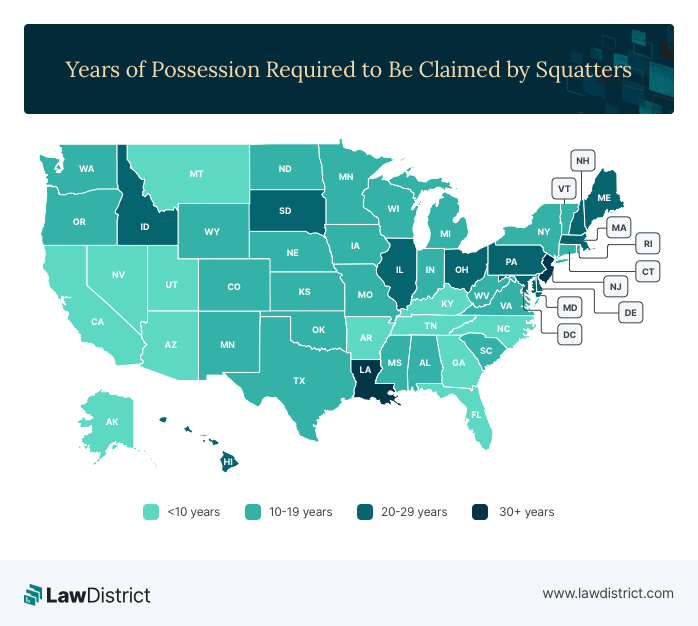
For a full overview of squatter rights across different US states, consult the following table:
| State | Adverse Possession Statute | Years Required | Documents Required |
|---|---|---|---|
| Alabama | Ala. Code Ann. § 6-5-200, HB182 | 10 (deed or taxes) 20 (general possession) | Deed or paid property taxes |
| Alaska | Alaska Stat. Ann. § § 09.10.030, 09.45.052 | 10, 7 (deed) | If 7 years: deed |
| Arizona | Ariz. Rev. Stat. § § 12-523 and subsequent, SB 1426 | 10 (deed and taxes), 3 (deed and taxes) | Deed and paid property taxes |
| Arkansas | Ark. Code Ann. § § 18-61-103, 18-11-106 | 7 (deed, taxes) | Deed and paid property taxes |
| California | Cal. Civ. Proc. Code § 325 | 5 (taxes) | Paid property taxes |
| Colorado | Colo. Rev. Stat. § § 38-41-101, 38-41-108 | 18, 7 (deed, taxes) | If 7 years: deed and paid property taxes |
| Connecticut | Conn. Gen. Stat. Ann. § 52-575 | 15 | No documents required |
| Delaware | Del. Code Ann. tit. 10 § 7901 | 20 | No documents required |
| District of Columbia | D.C. Code Ann. § § 16-1113, 12-301 | 15 | No documents required |
| Florida | Fla. Stat. Ann. § 95.16 and subsequent, HB 621, SB 322 | 7 (deed or taxes) | Deed or paid property taxes |
| Georgia | Ga. Code Ann. § § 44-4-7, 44-5-14, 44-5-161 and subsequent, HB 1017 | 20, 7 (deed) | If 20 years: no documents required If 7 years: deed |
| Hawaii | Haw. Rev. Stat. § 657-31 to 31.5 | 20 | No documents required |
| Idaho | Idaho Code Ann. § § 5-210 and subsequent | 20 (taxes) | Paid property taxes |
| Illinois | SB 1563, 735 Ill. Comp. Stat. Ann. § § 5/13-105, 107, 109 | 20, 7 (deed or taxes) | If 20 years: no documents required If 7 years: deed or paid property taxes |
| Indiana | Ind. Code Ann. § § 32-21-7-1, 34-11-2-11 | 10 (taxes) | Paid property taxes |
| Iowa | Iowa Code Ann. § 614.17A | 10 | No documents required |
| Kansas | Kan. Stat. Ann. § 60-503 | 15 | No documents required |
| Kentucky | Ky. Rev. Stat. § § 413.010, 413.060 | 15, 7 (deed) | If 15 years: no documents required If 7 years: deed |
| Louisiana | La. Civ. Code art. 3475, 3486 | 30, 10 (deed) | If 30 years: no documents required If 10 years: deed |
| Maine | Me. Rev. Stat. tit. 14, § 801 | 20 | No documents required |
| Maryland | Md. Ann. Code [Cts. & Jud. Proc.] § 5-103 | 20 | No documents required |
| Massachusetts | Mass. Gen. Laws Ann. ch. 260, § 21 | 20 | No documents required |
| Michigan | Mich. Comp. Laws Ann. § 600.5801 | 15 | No documents required |
| Minnesota | Minn. Stat. Ann. § 541.02 | 15 (taxes) | Paid property taxes |
| Mississippi | Miss. Code Ann. § § 15-1-7, 15-1-13 | 10 | No documents required |
| Missouri | Mo. Stat. Ann. § 516.010 | 10 | No documents required |
| Montana | Mont. Code Ann. § 70-19-411 | 5 (taxes) | Paid property taxes |
| Nebraska | Neb. Rev. Stat. § 25-202 | 10 | No documents required |
| Nevada | Nev. Rev. Stat. § § 11.070, 11.110, 11.150, 40.090 | 15 (taxes), 5 (deed, taxes) | If 15 years: paid property taxes If 5 years: deed and paid property taxes |
| New Hampshire | N.H. Rev. Stat. Ann. § 508:2 | 20 | No documents required |
| New Jersey | N.J. Stat. Ann. § 2A:14-30 | 30 | No documents required |
| New Mexico | N.M. Stat. Ann. § 37-1-22 | 10 (deed) | Deed |
| New York | New York Real Prop. Acts. Law § 501, 511 | 10 | No documents required |
| North Carolina | N.C. Gen. Stat. § § 1-38, 1-40 | 20, 7 (deed) | If 7 years: deed |
| North Dakota | N.D. Cent. Code Ann. § § 28-01-04 and subsequent, 47-06-03 | 20, 10 (deed, taxes) | If 20 years: no documents required If 10 years: deed or paid property taxes |
| Ohio | Ohio Rev. Code Ann. § 2305.04 | 21 | No documents required |
| Oklahoma | Okla. Stat. Ann. tit. 12, § 93 | 15 | No documents required |
| Oregon | Or. Rev. Stat. § § 12.050, 105.620 | 10 | No documents required |
| Pennsylvania | 42 Pa. Cons. Stat. § 5530 | 21 | No documents required |
| Rhode Island | R.I. Gen. Laws Ann. § 34-7-1 | 10 | No documents required |
| South Carolina | S.C. Code Ann. § 15-67-210 | 10 | No documents required |
| South Dakota | S.D. Codified Laws Ann. § § 15-3-1, 15-3-15 | 20, 10 (deed, taxes) | If 20 years: no documents required If 10 years: deed and paid property taxes |
| Tennessee | Tenn. Code Ann. § § 28-2-101 to 28-2-103 | 7 (deed) | Deed |
| Texas | Tex. Civ. Prac. & Rem. Code Ann. § 16.025 and subsequent, Texas SB 38 | 10, 5 (deed, taxes) | If 10 years: no documents required If 5 years: deed and paid property taxes |
| Utah | Utah Code Ann. § § 78B-2-208 to 78B-2-214 | 7 (taxes) | Paid property taxes |
| Vermont | Vt. Stat. Ann. tit. 12, § 501 | 15 | No documents required |
| Virginia | Va. Code Ann. § 8.01-236 | 15 | No documents required |
| Washington | Wash. Rev. Code Ann. § § 4.16.020, 7.28.050 | 10, 7 (deed or taxes) | If 10 years: no documents required If 7 years: deed or paid property taxes |
| West Virginia | W. Va. Code § 55-2-1 | 10 | No documents required |
| Wisconsin | Wis. Stat. Ann. § § 893.25 to 893.27 | 20, 10 (deed), 7 (deed, taxes) | If 20 years: no documents required If 10 years: deed If 7 years: deed and paid property taxes |
| Wyoming | Wyo. Stat. § 1-3-103 | 10 | No documents required |
Helpful Resources: Pacific Legal - A guide to squatters- rights National Archives - Homestead Act (1862)
Squatters Rights FAQs
-
What evidence do I need for eviction?
Make sure to keep copies of:
- Records of ownership
- Property tax payments
- Communications with occupants
Any photos, written notices, and official filings strengthen your case. They can help you make sure that the eviction happens without disputes over squatter claims.
-
Can a squatter claim rent payments?
Even if a squatter claims to have paid rent or made informal agreements, this rarely grants them rights.
Legal eviction processes still apply. Any alleged payments must be verified through proper documentation.
-
Are there risks if I delay eviction?
Delaying action increases the risk of adverse possession claims. Long-term occupancy can complicate eviction, even if the squatter has no legal lease. Quick action protects your rights and prevents legal entanglements.
-
Can neighbors or witnesses help?
Yes. Neighbors can provide statements about who occupies the property and for how long. Witness testimony can support eviction filings and demonstrate that the squatter's occupation was unauthorized.
Key Takeaways:
- Squatter rights: Squatters can gain legal rights after occupying a property without permission, and owners must follow local eviction procedures.
- Adverse possession: Squatters can claim ownership by paying taxes and living on the property for 5 to 21 years, depending on the state.
- Prevention: Regular property inspections, secure locks, and formal agreements help prevent squatters.
- Act fast: Delays in eviction can lead to squatters gaining full ownership through adverse possession.
As a property owner, knowing squatter rights is crucial. These aren’t your ordinary delinquent tenants, and knowing how the law treats them is vital before taking action against them.
Squatters are every landlord’s nightmare. These unauthorized residents don’t pay rent, can cause serious damage, and can be legally tricky to remove due to adverse possession laws.
In many cases, you may need an eviction notice, a notice to vacate letter or to follow other legal processes to get them out
Many laws guard squatter rights and mean that real estate owners cannot take certain actions to remove them. This brings up a few big questions:
- What are squatter rights?
- Which states have squatter rights?
- What can I do if squatters move in?
We’re going to help you answer all these questions in this article.
What Are Squatters?
A conventional squatters definition covers people who live on your property without permission. Of course, that includes quite a lot of possible parties.
A couple typical examples of squatters can include:
- Tenants who refuse to leave after a lease has ended or has been canceled
- Airbnb guests who overstay in some situations
There are now even Airbnb squatter rights of sorts that must be considered.
In most areas, anyone who lives on your property for more than 30 days with permission can claim rights as, in the eyes of the law, they become your tenants. When this happens, you will usually need to carry out an eviction procedure.
However, in the case where permission was never given, and an unoccupied property is forcibly entered and lived in, there are still rules you must follow.
What Are Squatter Rights?
Squatter rights dictate how you must approach removing unwanted residents.
If your vacant property is occupied without permission for a long enough period, these rights will be conferred on the residents.
Squatting or "adverse possession" is part of the legal code (§1068) in most states. These rules protect the inhabitants from being removed forcibly. They also require you to follow a legal eviction procedure to compel them to leave.
Mark Miller from the Pacific Legal Foundation highlights the difficulties of removing squatters when they have stayed a certain period of time in a property:
Squatter rights can ultimately allow the residents to become the legal owners of the property, too. In this case, squatters can be granted the title to the property if they live in it undisturbed and pay local property taxes for a number of years.
Why do squatters have rights?
Occupants of any property have the right not to be displaced without notice, whether or not they have permission to live somewhere.
The rights squatters enjoy today were originally brought over from British property law and were created to protect and distinguish those who owned and used land.
We can see this in laws like the Homestead Act of 1862, which let settlers develop unclaimed land. This also developed over time, and as the land was settled across the states, ownership of that land was shared out.
Despite the current legal framework protecting squatters, a LawDistrict survey found that 97% of respondents want squatters in residential areas to be removed immediately. Some even commented that they should be arrested.
97% of respondents also believed that squatters should be removed without having to go through lengthy legal proceedings. Nevertheless, property owners must follow their state laws if they want to legally evict squatters.
Legal Rights and Penalties for Squatters
Squatters are protected by law from illegal removal, but they are not considered tenants unless local law grants that status. Squatters can face civil or criminal penalties if they cause damage or act unlawfully on the property. Owners must follow proper eviction procedures to avoid legal trouble. Delaying action can make it harder to remove squatters and may eventually allow them to claim ownership under adverse possession laws.
States With 30-day Squatters' Rights
In certain states, squatters can claim rights after just 30 days of occupying a property. Once squatters have been in residence for 30 days, they may be considered tenants under the law, requiring formal eviction processes to remove them.
Some of the states that have provisions that allow squatters to establish tenancy rights after this short period include:
- Arizona
- Colorado
- North Carolina
- Maryland
Each state has its own procedures and laws; for example, squatters' rights for 30 days in Arizona can differ from squatters' rights for 30 days in Colorado. So, it will be important to check with your local requirements.
Keep in mind, while this rule does not mean a squatter has a claim to your property within 30 days, it is crucial to take timely action to prevent such claims.
Several states have introduced new laws to override these 30-day provisions, such as New York or Texas.
How To Get Rid of Squatters
The precise procedure for removing squatters from a property ultimately relies on your state and municipality. Local rules and regulations have different specificities depending on where you live.
What to do when evicting squatters: Step-by-step guide
However, there are a few things you should do first, no matter where you reside. In most cases, you should at the very least take the following steps:
| Step | Action |
|---|---|
| 1. Identify the occupant | Determine if they are a squatter (unauthorized, long-term occupant) or a trespasser (short-term, easily removable). |
| 2. Notify authorities | Call local law enforcement if the occupant is a trespasser. Police can remove them immediately. |
| 3. Serve eviction notice | For squatters, provide a formal eviction notice according to your state's law. Use a process server or attorney for accuracy. |
| 4. File a civil case | If the squatter ignores the notice, file an unlawful detainer or eviction case with the local court. |
| 5. Law enforcement removal | Once the court rules, law enforcement can remove the squatter and their belongings legally. |
| 6. Avoid illegal actions | Never change locks, shut off utilities, intimidate, or attempt self-help eviction. This can lead to legal consequences. |
What not to do when evicting squatters
There are plenty of mistakes that can be made when removing squatters from your property. Make sure to avoid the following common errors:
- Don’t wait too long. Under adverse possession laws, the squatters could claim full ownership rights if they had lived continuously on the property for a few years.
- Don’t evict illegally. As tempting as it may be, you mustn’t forcibly evict squatters. Make sure to follow a legal eviction process to avoid additional issues down the line.
How to Prevent Squatters Moving In
Prevention is ultimately the best cure when it comes to squatters. There are a few things you can do to stop unwanted inhabitants from moving in, which include:
- Make it clear that you own the property by maintaining bordering fences, door locks, and documentation proving you are the owner.
- Formalize agreements with people who will live on the property temporarily with our online legal documents such as lease agreements. These should outline the rules and duration of the use of the property that you've agreed to.
- Regularly visit and inspect the vacant property to make sure no one is occupying it.
- Contact the police or a local sheriff if you discover trespassers.
- Keep up to date with your property taxes. You should also check your local records to ensure that no one unknown to you is paying these taxes.
Common Misconceptions About Squatter Rights
There are some common misconceptions about squatters and the rights they have.
Squatters cannot automatically claim your property. Short-term visitors, Airbnb guests, or neighbors usually have no ownership rights.
Even if a squatter claims a lease or payment arrangement, it may not be legally valid.
Acting quickly is essential. Delays increase the risk of adverse possession claims.
What Different Squatter Rights Exist in Different States?
Squatter rights exist in almost every state in some form. Under these adverse possession laws, squatters will gain ownership rights to the property after a certain amount of time has passed. However, the duration depends on the state you are in.
This is how it works in some of the most populated states:
- California: Squatters who pay taxes on your property for 5 years will gain the title to the property (Cal. Civ. Proc. Code §318 and Code §325).
- Florida: Unauthorized residents paying taxes for your property for 7 years will be granted ownership (Fla. Stat. Ann. § 95.18). However, owners are authorized to immediately remove squatters through the sheriff's office (House Bill 621), while commercial property owners have other specific protections (SB 322).
- New York: In most of the state, squatters need to live for 10 years on a property openly and illegally before claiming ownership. NYC had a rule that let squatters be considered as tenants 30 days after a lease had ended (NPA § 501, et seq), but the 2025 State Budget has changed this, clearly defining squatters that trespass are not tenants.
- Ohio: Squatters in Ohio must live on a property for 21 years openly before they can claim ownership rights (Ohio Rev. Code Ann. § 2305.04).
- Texas: The law in Texas has recently changed its stance on Squatters (Texas SB 38), providing fast tracks for evictions and removing claims that squatters may have on properties.
It’s important to be cautious when dealing with squatters. Naturally, you probably want them out as soon as possible, but you have to follow the law when removing them.
In most cases, however, a properly prepared eviction notice template can be enough to get things moving in the process. This is something you can easily create today to start the clock ticking on removing your unwanted occupants.
Squatter Rights by State
Adverse possession statutes vary from state to state. Depending on the specific area in which the property is located, different legal forms will be required, as well as varying amounts of possession years.
First, let’s look at how many years of possession each state requires in the map below:
For a full overview of squatter rights across different US states, consult the following table:
| State | Adverse Possession Statute | Years Required | Documents Required |
|---|---|---|---|
| Alabama | Ala. Code Ann. § 6-5-200, HB182 | 10 (deed or taxes) 20 (general possession) | Deed or paid property taxes |
| Alaska | Alaska Stat. Ann. § § 09.10.030, 09.45.052 | 10, 7 (deed) | If 7 years: deed |
| Arizona | Ariz. Rev. Stat. § § 12-523 and subsequent, SB 1426 | 10 (deed and taxes), 3 (deed and taxes) | Deed and paid property taxes |
| Arkansas | Ark. Code Ann. § § 18-61-103, 18-11-106 | 7 (deed, taxes) | Deed and paid property taxes |
| California | Cal. Civ. Proc. Code § 325 | 5 (taxes) | Paid property taxes |
| Colorado | Colo. Rev. Stat. § § 38-41-101, 38-41-108 | 18, 7 (deed, taxes) | If 7 years: deed and paid property taxes |
| Connecticut | Conn. Gen. Stat. Ann. § 52-575 | 15 | No documents required |
| Delaware | Del. Code Ann. tit. 10 § 7901 | 20 | No documents required |
| District of Columbia | D.C. Code Ann. § § 16-1113, 12-301 | 15 | No documents required |
| Florida | Fla. Stat. Ann. § 95.16 and subsequent, HB 621, SB 322 | 7 (deed or taxes) | Deed or paid property taxes |
| Georgia | Ga. Code Ann. § § 44-4-7, 44-5-14, 44-5-161 and subsequent, HB 1017 | 20, 7 (deed) | If 20 years: no documents required If 7 years: deed |
| Hawaii | Haw. Rev. Stat. § 657-31 to 31.5 | 20 | No documents required |
| Idaho | Idaho Code Ann. § § 5-210 and subsequent | 20 (taxes) | Paid property taxes |
| Illinois | SB 1563, 735 Ill. Comp. Stat. Ann. § § 5/13-105, 107, 109 | 20, 7 (deed or taxes) | If 20 years: no documents required If 7 years: deed or paid property taxes |
| Indiana | Ind. Code Ann. § § 32-21-7-1, 34-11-2-11 | 10 (taxes) | Paid property taxes |
| Iowa | Iowa Code Ann. § 614.17A | 10 | No documents required |
| Kansas | Kan. Stat. Ann. § 60-503 | 15 | No documents required |
| Kentucky | Ky. Rev. Stat. § § 413.010, 413.060 | 15, 7 (deed) | If 15 years: no documents required If 7 years: deed |
| Louisiana | La. Civ. Code art. 3475, 3486 | 30, 10 (deed) | If 30 years: no documents required If 10 years: deed |
| Maine | Me. Rev. Stat. tit. 14, § 801 | 20 | No documents required |
| Maryland | Md. Ann. Code [Cts. & Jud. Proc.] § 5-103 | 20 | No documents required |
| Massachusetts | Mass. Gen. Laws Ann. ch. 260, § 21 | 20 | No documents required |
| Michigan | Mich. Comp. Laws Ann. § 600.5801 | 15 | No documents required |
| Minnesota | Minn. Stat. Ann. § 541.02 | 15 (taxes) | Paid property taxes |
| Mississippi | Miss. Code Ann. § § 15-1-7, 15-1-13 | 10 | No documents required |
| Missouri | Mo. Stat. Ann. § 516.010 | 10 | No documents required |
| Montana | Mont. Code Ann. § 70-19-411 | 5 (taxes) | Paid property taxes |
| Nebraska | Neb. Rev. Stat. § 25-202 | 10 | No documents required |
| Nevada | Nev. Rev. Stat. § § 11.070, 11.110, 11.150, 40.090 | 15 (taxes), 5 (deed, taxes) | If 15 years: paid property taxes If 5 years: deed and paid property taxes |
| New Hampshire | N.H. Rev. Stat. Ann. § 508:2 | 20 | No documents required |
| New Jersey | N.J. Stat. Ann. § 2A:14-30 | 30 | No documents required |
| New Mexico | N.M. Stat. Ann. § 37-1-22 | 10 (deed) | Deed |
| New York | New York Real Prop. Acts. Law § 501, 511 | 10 | No documents required |
| North Carolina | N.C. Gen. Stat. § § 1-38, 1-40 | 20, 7 (deed) | If 7 years: deed |
| North Dakota | N.D. Cent. Code Ann. § § 28-01-04 and subsequent, 47-06-03 | 20, 10 (deed, taxes) | If 20 years: no documents required If 10 years: deed or paid property taxes |
| Ohio | Ohio Rev. Code Ann. § 2305.04 | 21 | No documents required |
| Oklahoma | Okla. Stat. Ann. tit. 12, § 93 | 15 | No documents required |
| Oregon | Or. Rev. Stat. § § 12.050, 105.620 | 10 | No documents required |
| Pennsylvania | 42 Pa. Cons. Stat. § 5530 | 21 | No documents required |
| Rhode Island | R.I. Gen. Laws Ann. § 34-7-1 | 10 | No documents required |
| South Carolina | S.C. Code Ann. § 15-67-210 | 10 | No documents required |
| South Dakota | S.D. Codified Laws Ann. § § 15-3-1, 15-3-15 | 20, 10 (deed, taxes) | If 20 years: no documents required If 10 years: deed and paid property taxes |
| Tennessee | Tenn. Code Ann. § § 28-2-101 to 28-2-103 | 7 (deed) | Deed |
| Texas | Tex. Civ. Prac. & Rem. Code Ann. § 16.025 and subsequent, Texas SB 38 | 10, 5 (deed, taxes) | If 10 years: no documents required If 5 years: deed and paid property taxes |
| Utah | Utah Code Ann. § § 78B-2-208 to 78B-2-214 | 7 (taxes) | Paid property taxes |
| Vermont | Vt. Stat. Ann. tit. 12, § 501 | 15 | No documents required |
| Virginia | Va. Code Ann. § 8.01-236 | 15 | No documents required |
| Washington | Wash. Rev. Code Ann. § § 4.16.020, 7.28.050 | 10, 7 (deed or taxes) | If 10 years: no documents required If 7 years: deed or paid property taxes |
| West Virginia | W. Va. Code § 55-2-1 | 10 | No documents required |
| Wisconsin | Wis. Stat. Ann. § § 893.25 to 893.27 | 20, 10 (deed), 7 (deed, taxes) | If 20 years: no documents required If 10 years: deed If 7 years: deed and paid property taxes |
| Wyoming | Wyo. Stat. § 1-3-103 | 10 | No documents required |
Helpful Resources: Pacific Legal - A guide to squatters- rights National Archives - Homestead Act (1862)
Squatters Rights FAQs
-
What evidence do I need for eviction?
Make sure to keep copies of:
- Records of ownership
- Property tax payments
- Communications with occupants
Any photos, written notices, and official filings strengthen your case. They can help you make sure that the eviction happens without disputes over squatter claims.
-
Can a squatter claim rent payments?
Even if a squatter claims to have paid rent or made informal agreements, this rarely grants them rights.
Legal eviction processes still apply. Any alleged payments must be verified through proper documentation.
-
Are there risks if I delay eviction?
Delaying action increases the risk of adverse possession claims. Long-term occupancy can complicate eviction, even if the squatter has no legal lease. Quick action protects your rights and prevents legal entanglements.
-
Can neighbors or witnesses help?
Yes. Neighbors can provide statements about who occupies the property and for how long. Witness testimony can support eviction filings and demonstrate that the squatter's occupation was unauthorized.
Most Popular Posts

Some states require a motor vehicle bill of sale form; others do not. Even if only for your personal records, anyone who buys or sells a vehicle needs

If you plan to travel with a minor, whether or not you are their parent, you can minimize inconveniences by carrying a few necessary documents...