


Do you have a guardianship that is not working out?
Don’t feel bad if you get to this point; there are plenty of cases, even famous ones, where an individual needs to remove or change their legal guardian.
In this article, we'll look at:
- Why guardians are removed
- Steps to removing a guardianship
- Requirements in different states
- Famous cases of guardianship removal
Understanding all of these details can help you better deal with this complex legal situation and take the hassle out of the process. Learn how to terminate a guardianship without going to court.
Reasons for Terminating a Guardianship
A guardianship can be terminated for a number of reasons. This might be changes in the ward’s (the person in the guardian’s care) condition or the guardian's ability to fulfill their duties.
The primary grounds for removal include the:
- Guardian being unable to perform their duties
- Ward moving outside the court's jurisdiction
- Ward becoming legally able to make their own decisions
- Ward's death
A guardian can also be removed for abuse or neglect.
Keep in mind, since a guardianship is arranged in court, it’s not always easy to terminate, especially if you compare it with a power of attorney.
The court must be satisfied that ending the guardianship is in the best interest of the ward, considering factors such as the ward's current condition, available support, and potential risks.
To help you avoid the hassle of terminating this legal arrangement, you can create a temporary guardianship that will end on a set date or if conditions are not met.
Create my Temporary Guardianship
Steps To Terminate Guardianship
To terminate a guardianship, you’ll need to follow a number of steps. Here is an overview of the general process to terminate a guardianship:
- File a petition with the court that established the guardianship
- Serve notice to all interested parties, including the ward, current guardian, and family members
- Gather evidence supporting the termination request, such as medical evaluations or financial records
- Attend a court hearing where a judge will review the petition and evidence
- Obtain a court order terminating the guardianship
- Complete any final accounting or reporting requirements
- Transfer assets and responsibilities back to the ward or designated parties
These are the general steps, however, your case might be different. You’ll need to check with all the legal requirements that are specific to your circumstances to make sure you can successfully remove the guardianship.
State Requirements To Terminate a Guardianship
Before you get started removing a guardianship, it’s critical to understand your state and local laws. Usually, requirements will vary depending on if the ward is an adult or a minor.
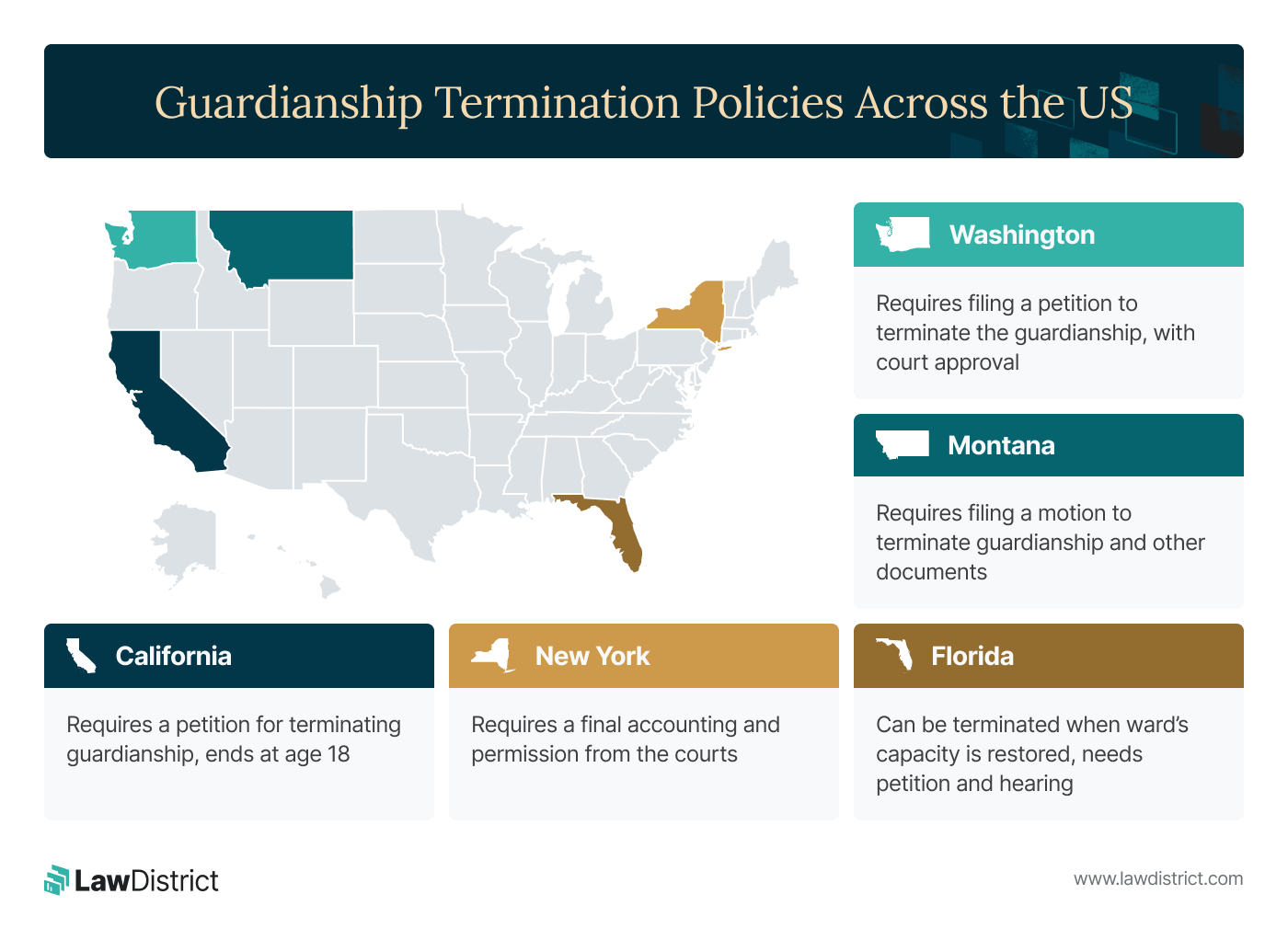
Here are some notable examples of termination policies in different states:
- California requires filing a Petition for Termination of Guardianship and attending a court hearing. It will end automatically when a minor turns 18, but a final accounting may still be required for estate guardianships.
- Florida allows for termination when the ward's capacity is restored, they move out of state, or their property is exhausted. A petition must be filed, and a hearing held before the court decides on termination.
- New York requires filing a “final accounting” explaining why the guardianship is no longer necessary and ask for permission from the courts.
- Montana requires filing a Motion to Terminate Guardianship, an Affidavit in Support, and a Proposed Order.
- Washington state law (§13.36.070) requires filing a petition to terminate guardianship, with the court issuing an order if approved.
Additionally, 36 states have adopted the Uniform Adult Guardianship and Protective Proceedings Jurisdiction Act (UAGPPJA). This act provides a standardized process for recognizing and enforcing guardianship orders across state lines, making it easier to handle cases involving multiple jurisdictions.
Famous Cases of Terminated Guardianships and Conservatorships
There are a number of child stars and adult celebrities who have had notable guardianships, or alternatively a conservatorship, which is a similar legal arrangement.
High-profile guardianship terminations have received a lot of public attention in recent years, highlighting the challenges of ending these relationships. Here are some well-known cases:
- Britney Spears: The pop star's 13-year conservatorship was terminated in November 2021 after a highly publicized legal battle. The case brought widespread attention to conservatorship abuse and reform.
- Amanda Bynes: The former child actress's 9-year conservatorship ended in March 2022 after a judge determined she had regained the capacity to make her own decisions.
- Brian Wilson: The Beach Boys co-founder was under conservatorship from the 1990s until 2007, when he successfully petitioned for termination. However, he was placed under a legal conservatorship again in 2024.
- Mickey Rooney: The late actor's conservatorship was called out due to alleged elder abuse and sparked discussions about protecting seniors.
These famous examples point to various reasons for ending a guardianship, including:
- Restoration of capacity
- Public pressure and media scrutiny
- Changes in circumstances or support systems
- Death of the ward
They also highlight the potential for both abuse and protection within guardianship systems, prompting calls for reform and greater oversight in many jurisdictions.
Ongoing celebrity guardianships
Despite recent high-profile guardianship terminations, several notable conservatorships and guardianships remain in effect. These cases can help you understand how they work, the difficulties around removing them, and why it can even be useful to keep a guardianship in effect:
- Wendy Williams: The former talk show host remains under a court-appointed financial guardian as of 2023, following concerns about her mental health and decision-making capacity.
- Casey Kasem: Though Kasem passed away in 2014, his conservatorship case gained attention due to conflicts between his wife and children. His wife, Jean, was granted conservatorship before his death.
- Peter Max: The renowned pop artist has been under guardianship since 2016 due to dementia, with ongoing disputes between family members over his care and estate.
These celebrity cases are examples of those dealing with or having dealt with issues such as dementia, family conflicts, and more.
However, it’s essential to remember, the right guardian should be selected. Looking at these ongoing cases, there are criticisms, such as with Wendy Williams, who now has very little to no autonomy when it comes to managing her finances.
If you feel a guardian or the circumstances of a guardianship needs to be changed, it would be a good idea to try to end the current arrangement as soon as possible.
If you’re ready to end your guardianship and feel it is no longer helping you or the ward, it’s essential to review your case and follow the correct steps to legally end the relationship.
Do you have a guardianship that is not working out?
Don’t feel bad if you get to this point; there are plenty of cases, even famous ones, where an individual needs to remove or change their legal guardian.
In this article, we'll look at:
- Why guardians are removed
- Steps to removing a guardianship
- Requirements in different states
- Famous cases of guardianship removal
Understanding all of these details can help you better deal with this complex legal situation and take the hassle out of the process. Learn how to terminate a guardianship without going to court.
Reasons for Terminating a Guardianship
A guardianship can be terminated for a number of reasons. This might be changes in the ward’s (the person in the guardian’s care) condition or the guardian's ability to fulfill their duties.
The primary grounds for removal include the:
- Guardian being unable to perform their duties
- Ward moving outside the court's jurisdiction
- Ward becoming legally able to make their own decisions
- Ward's death
A guardian can also be removed for abuse or neglect.
Keep in mind, since a guardianship is arranged in court, it’s not always easy to terminate, especially if you compare it with a power of attorney.
The court must be satisfied that ending the guardianship is in the best interest of the ward, considering factors such as the ward's current condition, available support, and potential risks.
To help you avoid the hassle of terminating this legal arrangement, you can create a temporary guardianship that will end on a set date or if conditions are not met.
Create my Temporary Guardianship
Steps To Terminate Guardianship
To terminate a guardianship, you’ll need to follow a number of steps. Here is an overview of the general process to terminate a guardianship:
- File a petition with the court that established the guardianship
- Serve notice to all interested parties, including the ward, current guardian, and family members
- Gather evidence supporting the termination request, such as medical evaluations or financial records
- Attend a court hearing where a judge will review the petition and evidence
- Obtain a court order terminating the guardianship
- Complete any final accounting or reporting requirements
- Transfer assets and responsibilities back to the ward or designated parties
These are the general steps, however, your case might be different. You’ll need to check with all the legal requirements that are specific to your circumstances to make sure you can successfully remove the guardianship.
State Requirements To Terminate a Guardianship
Before you get started removing a guardianship, it’s critical to understand your state and local laws. Usually, requirements will vary depending on if the ward is an adult or a minor.
Here are some notable examples of termination policies in different states:
- California requires filing a Petition for Termination of Guardianship and attending a court hearing. It will end automatically when a minor turns 18, but a final accounting may still be required for estate guardianships.
- Florida allows for termination when the ward's capacity is restored, they move out of state, or their property is exhausted. A petition must be filed, and a hearing held before the court decides on termination.
- New York requires filing a “final accounting” explaining why the guardianship is no longer necessary and ask for permission from the courts.
- Montana requires filing a Motion to Terminate Guardianship, an Affidavit in Support, and a Proposed Order.
- Washington state law (§13.36.070) requires filing a petition to terminate guardianship, with the court issuing an order if approved.
Additionally, 36 states have adopted the Uniform Adult Guardianship and Protective Proceedings Jurisdiction Act (UAGPPJA). This act provides a standardized process for recognizing and enforcing guardianship orders across state lines, making it easier to handle cases involving multiple jurisdictions.
Famous Cases of Terminated Guardianships and Conservatorships
There are a number of child stars and adult celebrities who have had notable guardianships, or alternatively a conservatorship, which is a similar legal arrangement.
High-profile guardianship terminations have received a lot of public attention in recent years, highlighting the challenges of ending these relationships. Here are some well-known cases:
- Britney Spears: The pop star's 13-year conservatorship was terminated in November 2021 after a highly publicized legal battle. The case brought widespread attention to conservatorship abuse and reform.
- Amanda Bynes: The former child actress's 9-year conservatorship ended in March 2022 after a judge determined she had regained the capacity to make her own decisions.
- Brian Wilson: The Beach Boys co-founder was under conservatorship from the 1990s until 2007, when he successfully petitioned for termination. However, he was placed under a legal conservatorship again in 2024.
- Mickey Rooney: The late actor's conservatorship was called out due to alleged elder abuse and sparked discussions about protecting seniors.
These famous examples point to various reasons for ending a guardianship, including:
- Restoration of capacity
- Public pressure and media scrutiny
- Changes in circumstances or support systems
- Death of the ward
They also highlight the potential for both abuse and protection within guardianship systems, prompting calls for reform and greater oversight in many jurisdictions.
Ongoing celebrity guardianships
Despite recent high-profile guardianship terminations, several notable conservatorships and guardianships remain in effect. These cases can help you understand how they work, the difficulties around removing them, and why it can even be useful to keep a guardianship in effect:
- Wendy Williams: The former talk show host remains under a court-appointed financial guardian as of 2023, following concerns about her mental health and decision-making capacity.
- Casey Kasem: Though Kasem passed away in 2014, his conservatorship case gained attention due to conflicts between his wife and children. His wife, Jean, was granted conservatorship before his death.
- Peter Max: The renowned pop artist has been under guardianship since 2016 due to dementia, with ongoing disputes between family members over his care and estate.
These celebrity cases are examples of those dealing with or having dealt with issues such as dementia, family conflicts, and more.
However, it’s essential to remember, the right guardian should be selected. Looking at these ongoing cases, there are criticisms, such as with Wendy Williams, who now has very little to no autonomy when it comes to managing her finances.
If you feel a guardian or the circumstances of a guardianship needs to be changed, it would be a good idea to try to end the current arrangement as soon as possible.
If you’re ready to end your guardianship and feel it is no longer helping you or the ward, it’s essential to review your case and follow the correct steps to legally end the relationship.
Most Popular Posts

Some states require a motor vehicle bill of sale form; others do not. Even if only for your personal records, anyone who buys or sells a vehicle needs

If you plan to travel with a minor, whether or not you are their parent, you can minimize inconveniences by carrying a few necessary documents...