



Key Takeaways:
- Wills and living trusts are legal estate planning tools
- Living trusts go into effect during your lifetime, while wills become active after you die
- Unlike living trusts, wills allow you to appoint guardians for minor children
- Wills go to probate, while living trusts typically skip this process.
Wills are popular estate planning tools that let you assign an executor and guide them on how to distribute your estate when you die. Living trusts allow you to assign a trustee to manage and distribute assets. However, trusts can also hold and protect your assets during your lifetime, unlike wills.
The estate planning tool you use depends on your needs. If your priority is to leave an inheritance to loved ones after passing, a will may be sufficient. However, if you are more concerned about keeping your estate distribution private, consider putting your assets in a living trust.
Due to the difference in functionality and purpose, either tool may be suitable for different estates. Early planning allows you to determine what works so you can make the best choice.
This comprehensive discussion of wills vs trusts reveals their key differences to help you choose the best one for you.
Revocable Living Trust vs Will
A revocable living trust lets you transfer personal assets into a trust, with the ability to update its terms at any time. You can keep control over the property if you assign yourself as the trustee and pass that control to a successor trustee if you are incapacitated or dead.
A will expresses your wishes regarding how to distribute your property. You may change or update a will at any time as long as you are of sound mind. A last will and testament refers to the most recent or final document you signed before dying. It typically makes previous similar documents obsolete.
Revocable living trusts basics
A living trust is a legal arrangement to manage and distribute assets. A living trust goes into effect as soon as you set it up and put assets into it. The grantor may choose to set up a revocable or irrevocable trust. Revocable living trusts can be updated at any time, while an irrevocable trust cannot be changed. Always use a professional living trust form to start your document.
A revocable living trust performs the following functions:
- Appoints a trustee to manage the assets
- Holds and manages assets during the grantor's lifetime
- Designates a successor trustee to take over when the trustee dies or is incapacitated
- Outlines how to appoint a new trustee in the absence of a successor trustee
- Names the beneficiaries
- Gives instructions on how to distribute the assets to beneficiaries
It's essential to remember that once a grantor dies, the trust becomes irrevocable. The direction of the trust document governs beneficiaries' rights.
If you leave some of your assets out of the trust, you may need a pour-over will that directs that those assets be moved into the trust when you die.
Understanding wills
A will or last will and testament is the most common estate planning tool in the US. It is a legally binding document that allows you the opportunity to make decisions regarding assets and dependents following your death.
Wills typically go into effect after you die. You may update it at any time, provided you are of sound mind. You may use a customizable last will and testament template to create your document.
You can use a will to achieve the following:
- Assign an executor to initiate probate and oversee your estate distribution
- List your assets and the beneficiaries you wish to leave them to
- Appoint a legal guardian for a minor child
- Guide on how to pay outstanding debts and taxes when you pass
- Give instructions on setting up a testamentary trust posthumously.
Your personal needs determine the estate planning documents you use.
How to Choose Between a Last Will a Living Trust
Wills and trusts are different in their functions and purposes. The answer to the question: Which one is better between a will and a living trust? lies in why you need to plan your estate.
Below is a comparison between a will and a living trust.
| Will | Living Trust | |
|---|---|---|
| Effective date | Goes into effect immediately after you set it up and fund it | Becomes active when you die |
| Asset distribution | Distributes assets to beneficiaries | Distributes assets to beneficiaries |
| Guardianship | Can be used to assign legal guardians for minor children | Does not have the provision to appoint guardians |
| Probate | Goes to probate | Assets in a trust typically avoid probate |
| Provision for incapacity | There is no provision for management if you become incapacitated | The successor trustee can manage the trust if you become incapacitated |
| Privacy | Becomes public record during probate | Assets in a trust are not made public during probate |
| Cost | Typically simple and cheaper to create | Set up and ongoing record-keeping costs can be expensive |
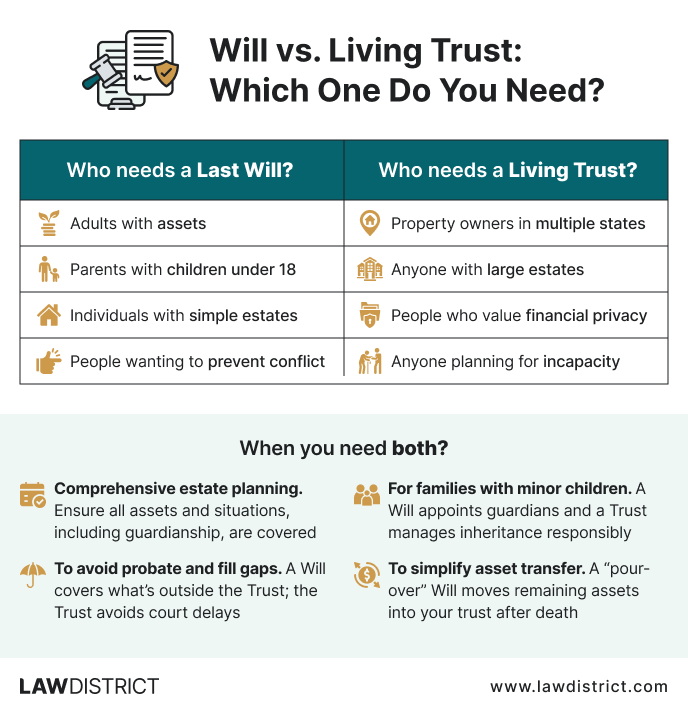
Let's look at different scenarios that may dictate which tool will best serve your estate.
Who needs a trust instead of a will?
A living trust serves you better if you have one or more of the following concerns:
- You own a large or complex estate that would take a lengthy, complicated, and expensive probate process to distribute.
- You own property in multiple states and want to prevent ancillary probate proceedings.
- You want to keep the details of your property private by avoiding probate.
- You need to hold property for a minor until they are old enough to inherit it.
- You want to appoint a successor trustee to manage your assets if you become incapacitated.
Who needs a last will rather than a trust?
You may choose a will instead of a living trust for the following reasons.
- You have a small, uncomplicated estate that will be reasonably quick to distribute through probate.
- You have minor children for whom you want to appoint guardians.
- All your assets are already out of probate, such as in a payable-on-death bank account.
- You are single, have no dependents, and feel your estate is minimal and easy to distribute.
Note that with a will, even though you write down your wishes, the final decision is up to the court.
The existence of varied estate planning tools allows you to choose what works for you. However, it is crucial to remember that living trusts and wills are not mutually exclusive. You can have both at the same time, depending on the extent of your estate and your planning needs.
Make sure you have an estate planning checklist that can help you determine how prepared you are in case you become incapacitated or pass unexpectedly.
Table of Contents:
Table of Contents:
Key Takeaways:
- Wills and living trusts are legal estate planning tools
- Living trusts go into effect during your lifetime, while wills become active after you die
- Unlike living trusts, wills allow you to appoint guardians for minor children
- Wills go to probate, while living trusts typically skip this process.
Wills are popular estate planning tools that let you assign an executor and guide them on how to distribute your estate when you die. Living trusts allow you to assign a trustee to manage and distribute assets. However, trusts can also hold and protect your assets during your lifetime, unlike wills.
The estate planning tool you use depends on your needs. If your priority is to leave an inheritance to loved ones after passing, a will may be sufficient. However, if you are more concerned about keeping your estate distribution private, consider putting your assets in a living trust.
Due to the difference in functionality and purpose, either tool may be suitable for different estates. Early planning allows you to determine what works so you can make the best choice.
This comprehensive discussion of wills vs trusts reveals their key differences to help you choose the best one for you.
Revocable Living Trust vs Will
A revocable living trust lets you transfer personal assets into a trust, with the ability to update its terms at any time. You can keep control over the property if you assign yourself as the trustee and pass that control to a successor trustee if you are incapacitated or dead.
A will expresses your wishes regarding how to distribute your property. You may change or update a will at any time as long as you are of sound mind. A last will and testament refers to the most recent or final document you signed before dying. It typically makes previous similar documents obsolete.
Revocable living trusts basics
A living trust is a legal arrangement to manage and distribute assets. A living trust goes into effect as soon as you set it up and put assets into it. The grantor may choose to set up a revocable or irrevocable trust. Revocable living trusts can be updated at any time, while an irrevocable trust cannot be changed. Always use a professional living trust form to start your document.
A revocable living trust performs the following functions:
- Appoints a trustee to manage the assets
- Holds and manages assets during the grantor's lifetime
- Designates a successor trustee to take over when the trustee dies or is incapacitated
- Outlines how to appoint a new trustee in the absence of a successor trustee
- Names the beneficiaries
- Gives instructions on how to distribute the assets to beneficiaries
It's essential to remember that once a grantor dies, the trust becomes irrevocable. The direction of the trust document governs beneficiaries' rights.
If you leave some of your assets out of the trust, you may need a pour-over will that directs that those assets be moved into the trust when you die.
Understanding wills
A will or last will and testament is the most common estate planning tool in the US. It is a legally binding document that allows you the opportunity to make decisions regarding assets and dependents following your death.
Wills typically go into effect after you die. You may update it at any time, provided you are of sound mind. You may use a customizable last will and testament template to create your document.
You can use a will to achieve the following:
- Assign an executor to initiate probate and oversee your estate distribution
- List your assets and the beneficiaries you wish to leave them to
- Appoint a legal guardian for a minor child
- Guide on how to pay outstanding debts and taxes when you pass
- Give instructions on setting up a testamentary trust posthumously.
Your personal needs determine the estate planning documents you use.
How to Choose Between a Last Will a Living Trust
Wills and trusts are different in their functions and purposes. The answer to the question: Which one is better between a will and a living trust? lies in why you need to plan your estate.
Below is a comparison between a will and a living trust.
| Will | Living Trust | |
|---|---|---|
| Effective date | Goes into effect immediately after you set it up and fund it | Becomes active when you die |
| Asset distribution | Distributes assets to beneficiaries | Distributes assets to beneficiaries |
| Guardianship | Can be used to assign legal guardians for minor children | Does not have the provision to appoint guardians |
| Probate | Goes to probate | Assets in a trust typically avoid probate |
| Provision for incapacity | There is no provision for management if you become incapacitated | The successor trustee can manage the trust if you become incapacitated |
| Privacy | Becomes public record during probate | Assets in a trust are not made public during probate |
| Cost | Typically simple and cheaper to create | Set up and ongoing record-keeping costs can be expensive |
Let's look at different scenarios that may dictate which tool will best serve your estate.
Who needs a trust instead of a will?
A living trust serves you better if you have one or more of the following concerns:
- You own a large or complex estate that would take a lengthy, complicated, and expensive probate process to distribute.
- You own property in multiple states and want to prevent ancillary probate proceedings.
- You want to keep the details of your property private by avoiding probate.
- You need to hold property for a minor until they are old enough to inherit it.
- You want to appoint a successor trustee to manage your assets if you become incapacitated.
Who needs a last will rather than a trust?
You may choose a will instead of a living trust for the following reasons.
- You have a small, uncomplicated estate that will be reasonably quick to distribute through probate.
- You have minor children for whom you want to appoint guardians.
- All your assets are already out of probate, such as in a payable-on-death bank account.
- You are single, have no dependents, and feel your estate is minimal and easy to distribute.
Note that with a will, even though you write down your wishes, the final decision is up to the court.
The existence of varied estate planning tools allows you to choose what works for you. However, it is crucial to remember that living trusts and wills are not mutually exclusive. You can have both at the same time, depending on the extent of your estate and your planning needs.
Make sure you have an estate planning checklist that can help you determine how prepared you are in case you become incapacitated or pass unexpectedly.
Most Popular Posts

Some states require a motor vehicle bill of sale form; others do not. Even if only for your personal records, anyone who buys or sells a vehicle needs

If you plan to travel with a minor, whether or not you are their parent, you can minimize inconveniences by carrying a few necessary documents...