
Corporate Resolution Form
A Corporate Resolution records important decisions made by a corporation’s board of directors or shareholders. It outlines actions such as opening bank accounts, approving contracts, or appointing officers. Having this document serves as official authorization documentation.

Excellent 4.5 out of 5
Fill forms in a few steps
Save, print & download
Done in 5 minutes
What Is a Corporate Resolution?
A Corporate Resolution is a formal legal document that binds the company and records the decisions authorized by a corporation's board of directors or shareholders. It serves as official evidence that a business decision was properly vetted and authorized under company bylaws.
Having this document serves as official authorization documentation and ensures all interested parties are aware of the company's actions.
What does a Corporate Resolution do?
This Corporate Resolution document authorizes the company to take specific actions. This can include:
- Opening bank accounts
- Appointing officers
- Approving contracts
- Issuing new shares of stock or corporate bonds
- Setting salaries, bonuses, and benefits for top executives
- Adopting or changing official company bylaws
- Merging with or acquiring another company
- Starting a joint venture or business partnership
- Selling major company assets
- Opening offices in new states or countries
- Filing for new patents or trademarks
This document helps your corporation properly document decisions.
A Corporate Resolution may be adopted during a duly called meeting or through written consent if authorized by the corporation's governing documents and applicable law. Written consents are commonly used when directors or shareholders wish to approve actions without holding a formal meeting, which can be more efficient and expedite business authorization.
⚠️ The authority required to approve a Corporate Resolution depends on the corporation's articles of incorporation, bylaws, shareholder agreements, and applicable state law. Some actions require board approval, some require shareholder approval, and certain actions may require both.
Benefits of a Corporate Resolution
A Corporate Resolution helps make sure that your corporation complies with applicable state law. It also reassures third parties like banks or investors that actions are properly authorized by providing them with written proof of authorization.
Specifically, by using a Corporate Resolution, you will get:
- Accountability
- Legal proof of authority
- Demonstrates to tax authorities that large expenditures (e.g., executive bonuses) were formally vetted and business justified
- Serves as the required background documentation when applying for specific state licenses, permits, or foreign qualification
- Organized records
- Liability protection from shareholder lawsuits
- Smoother business operations
- Maintenance of corporate formalities and good governance practices
- Evidence supporting the corporation's separate legal existence
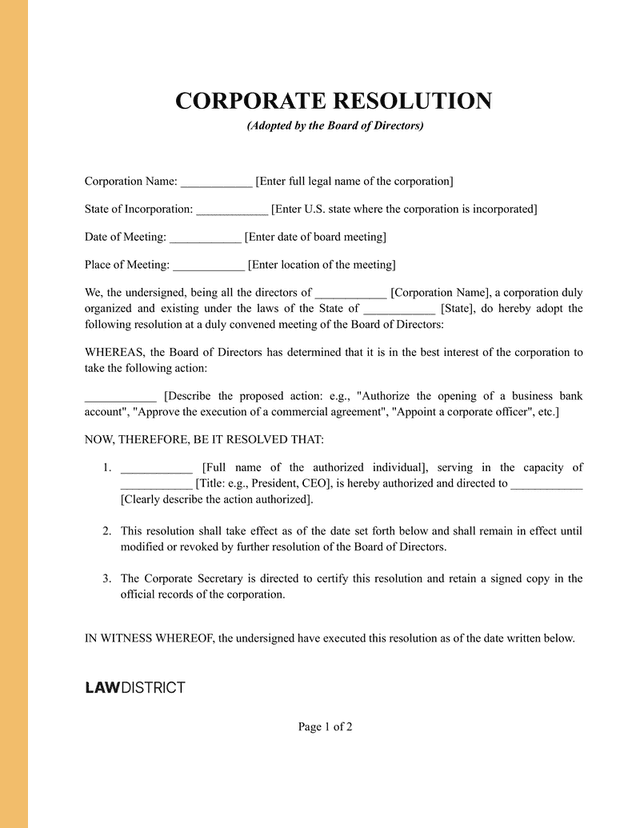
Corporate Resolution Sample
Below, you can review a Corporate Resolution example. It can help you understand what needs to be included in your document.
When Is a Corporate Resolution Required?
Corporations need a Corporate Resolution Letter when they formally approve and record an important decision.
Below are some of the typical moments when you may need this document:
Corporate Banking Resolution
Banks often require a Corporate Resolution before:
- Opening or closing a business account
- Approving loans
- Authorizing credit
- Allowing an individual to withdraw funds or obtain a checkbook and/or debit card
Banks may also require the resolution to identify specific authorized signatories, define transaction limits, authorize electronic banking access, and certify the continuing authority of designated representatives. This gives the institution written proof that the board or shareholders officially approved the transaction.
As for officer and management decisions, Corporate Resolutions are frequently used to:
- Appoint officers
- Remove officers
- Approve executive compensation
- Modify officer authority and responsibilities
These resolutions help establish a clear record of management authority within the corporation.
Corporate Resolution Signing Authority
A resolution is used to grant signing authority to specific officers or directors. It can record who can sign:
- Contracts
- Checks
- Other binding documents
This helps prevent unauthorized actions.
Stock and Ownership Decisions
A Corporate Resolution may also be used to:
- Issue or transfer shares
- Approve dividends
- Admit new investors
It creates a formal record of decisions that affect company ownership or shareholder rights.
Major Business Actions
Resolutions are also used for major decisions that affect the business, like:
- Mergers
- Acquisitions
- Property purchases or sales
- Changes to corporate bylaws
- Entering significant financing transactions
- Granting security interests or pledging corporate assets
- Issuing convertible securities or warrants
- Ratifying prior actions taken on behalf of the corporation
Ratification resolutions are often used when documentation was not prepared contemporaneously with a corporate action, but the corporation wishes to formally approve and confirm the action.
How To Write a Corporate Resolution
It's important to draft your Corporate Resolution form clearly and professionally. Follow these steps to write your document:
- Mention the corporation: Include the company's legal name and state of incorporation.
- Record meeting or consent details: Specify the date, participants, quorum status, and whether approval occurred during a meeting or through written consent.
- Effective Date: The exact calendar day the approved action becomes legally binding, which may differ from the meeting date.
- Authorized Individuals: The exact legal names and corporate titles of the specific people empowered to carry out the resolution.
- Scope of Power: Precise financial or operational limits, such as a maximum loan amount or specific geographic boundaries for a contract
- State the purpose: Use "Whereas" clauses to explain the background or reason for the resolution.
- Write the action: Add "Resolved" clauses outlining the decision being approved.
- Confirm approval requirements: State that the required quorum and voting thresholds were satisfied under the corporation's governing documents and applicable law.
- Add signatures: Make sure all the officers or the secretary sign and certify the resolution.
- Secretary certification: Where appropriate, include a certification from the corporate secretary confirming that the resolution was duly adopted and remains in effect.
You can also use our Corporate Resolution template to help you create this document in just a few minutes.
Once it's ready, we recommend having a legal professional review it. You can then store your Resolution in the corporation's records for future reference.
The resolution should be maintained with the corporation's minute book and other official records. Proper recordkeeping can be important for audits, financing transactions, due diligence reviews, regulatory examinations, and litigation matters.
Difference between Corporate Resolution and Member Resolution
Both a Corporate Resolution and a member resolution indicate formal business decisions. The key difference lies in who authorizes them:
| Corporate Resolution | Member Resolution |
|---|---|
| Used by corporations | Used by LLCs |
| Approved by the board of directors or shareholders | Approved by members |
| Guided by bylaws and state corporate law | Guided by the operating agreement |
Board resolutions vs. shareholder resolutions
Corporate actions may require approval by either the board of directors, the shareholders, or both. Routine operational matters are often approved by the board, while fundamental corporate actions such as mergers, amendments to governing documents, or significant ownership changes may require shareholder approval in accordance with applicable law and the corporation's governing documents.
Other Business Documents
There are other business documents that you can use in similar situations. Manage your company, corporation, or other type of business with the following agreements and documents:
- LLC Operating Agreement
- Corporate Bylaws
- Articles of Incorporation
- Shareholder Agreement
- Joint Venture Agreement
⚖️Legal Notice: Corporate governance requirements vary by state and may also depend on the corporation's articles of incorporation, bylaws, shareholder agreements, industry regulations, financing arrangements, and other contractual obligations. This template provides a general framework only and should not be considered legal advice.
FAQs About Corporate Resolution
Still have doubts about using a Corporate Resolution? Review the answers to the following frequently asked questions below.
In most cases, a Corporate Resolution Letter does not need to be notarized. It is usually considered valid once it's:
- Been signed by the appropriate officers, directors, or shareholders
- Entered into the company's official records
However, there are banks, government agencies, or third parties that may ask for notarization for added verification. Before using your document, you should check the specific requirements of the institution or state where the resolution will be used.
In most jurisdictions, a corporate seal is not required for a Corporate Resolution to be legally effective. Validity is generally determined by proper authorization under applicable law and the corporation's governing documents.
However, some corporations still use a seal as a traditional formality. Certain banks or agencies may also request it for an added layer of validity.
You should never backdate Corporate Resolutions. It should always reflect the actual date when the decision was approved.
Backdating may create legal or compliance issues if challenged.
If documentation was not prepared at the time an action occurred, the corporation should consider adopting a ratifying resolution that accurately states both the date of the original action and the date of the subsequent ratification. Corporate records should always accurately reflect historical events and approval dates.
Yes, for corporations (C-Corps and S-Corps), state laws mandate documenting major board-level decisions to maintain a separate legal identity.
No, most states do not legally require LLCs to use them. However, banks or lenders often demand them before approving business loans or opening accounts.
No, routine operational matters handled by management under delegated authority do not require board-level documentation. They are reserved for major structural or financial changes.
No, there is generally no legal requirement for notarization. However, doing so can provide extra credibility if the document is ever used as evidence in a court trial.
No, they are internal company documents and are not typically accessible to the general public. They are filed privately within the company's official corporate record book or board management system.
Failing to document major actions can weaken the company's limited liability protection. Opposing legal teams could exploit this lack of corporate compliance to "pierce the corporate veil," exposing owners to personal liability.
Resolutions should be stored chronologically alongside board meeting minutes. They should include a unique alphanumeric resolution tracking number for internal auditing and due diligence checks.
Try Lawdistrict Now
Instant and complete access to our entire library of legal forms
Edit, download and print in PDF from any device
Save time and money on legal document creation