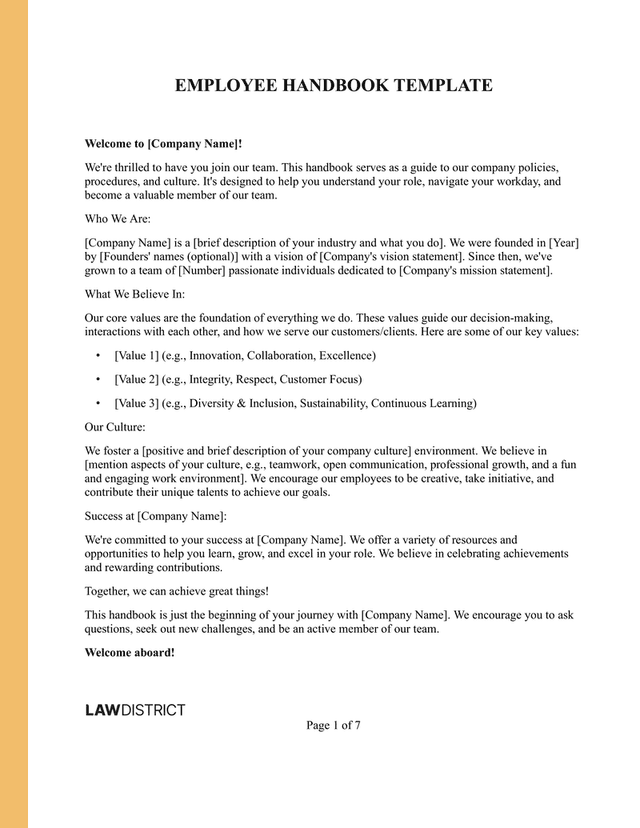
We are thrilled to have you join our team.
This Employee Handbook serves as your comprehensive guide to the company's policies, procedures, and the unique culture that defines us. It is designed to assist you in navigating your role and becoming a valuable contributor to our shared success.
Our Company
_________ is a leader in the _________ industry, specializing in _________. Founded in _________ by _________, we were driven by a vision to _________.
Today, we're a team of _________ passionate individuals dedicated to fulfilling our mission of _________.
Our Core Values
Our core values are the guiding principles that define who we are and how we operate. They influence our decision-making, interactions with colleagues, and how we serve our customers/clients.
• _________
Thriving Together: Our Culture
At _________, we cultivate a collaborative and empowering work environment. We believe in _________. We encourage our employees to be:
• Creative: We value fresh ideas and innovative approaches to problem-solving.
• Proactive: We empower our team to take initiative and ownership of their work.
• Collaborative: We foster a culture of teamwork and knowledge sharing.
Our Path to Success at _________
We invest in your success at _________. We offer a variety of resources and opportunities to help you learn, grow, and excel in your role. This includes access to key resources, training programs, and mentorship opportunities. We believe in recognizing achievements and rewarding significant contributions.
Through collaboration and dedication, we can achieve exceptional results.
This handbook is just the beginning of your journey with _________. We encourage you to ask questions, seek out new challenges, and become an active member of our team. Welcome aboard!
1. Employment Basics
Place of Work
• Remote: Employees in this role will primarily work from a remote location.
Recruitment and Selection Process
Our hiring process is designed to be fair, and efficient, and attract top talent. While specific steps may vary based on the role, here's a general outline you can expect.
Identifying the Need
Our hiring managers identify new job openings based on business needs, collaborating with HR to ensure alignment with company goals and budget.
Internal Hiring Methods
We post job openings on our intranet and encourage employee referrals with incentives.
External Hiring Methods
We use external sources such as job boards, headhunters, recruiting companies, professional organizations, and universities.
Job Description and Advertisement
We review existing job descriptions and craft clear, inclusive job ads that reflect responsibilities, qualifications, and our company culture. We avoid biased language and emphasize our diversity initiatives.
The final job description and ad are approved by the hiring manager and relevant stakeholders.
Posting the Job Opening
We select appropriate platforms to post job ads, including job boards, social media, and professional association websites.
We leverage our social media network to extend the reach of our job ads.
Defining Hiring Stages & Timeframes
We establish timelines for each stage of the hiring process, including application deadlines and interview schedules.
We determine the number of interview stages needed for each role, which may include initial screenings, phone/video interviews, panel interviews, and skills assessments.
Candidate Sourcing & Screening
We review resumes through our Applicant Tracking System (ATS) or application portal.
We use search engines and professional networks to source passive candidates who may not be actively job hunting.
Candidates are shortlisted based on predefined criteria aligned with the job description.
Interviewing & Selection
Phone interviews or video conferences are conducted as initial screenings to assess basic qualifications and cultural fit.
In-person interviews are scheduled for shortlisted candidates, involving a diverse interview panel, including the hiring manager, relevant team members, and a Human Resources representative.
We use a structured interview format with predetermined questions to ensure consistency and reduce bias.
Candidates are evaluated based on skills, experience, and cultural fit for the role and team.
Background Checks & Reference Verification
With the candidate's consent, we conduct background checks to verify employment history, education, and professional references.
We contact references provided by the candidate to gather insights into their work performance, skills, and suitability for the position.
Offer & Negotiation
We select the most qualified candidate based on the evaluation process.
A formal job offer is extended, including a clear compensation and benefits package.
We negotiate terms of employment if necessary, considering the candidate's qualifications and industry standards.
Onboarding
Once the offer is accepted, we initiate the onboarding process, which includes paperwork completion, new hire orientation, and training.
Attendance and Reporting Absences
At _________, we value punctuality and dedication. We expect employees to be present during their scheduled working hours. However, we understand that unexpected events can occur. If you are unable to come to work due to an emergency, please contact your manager as soon as possible, preferably before your scheduled shift. This allows us to make any necessary adjustments to schedules and workloads.
Unexpected Events
However, we understand that emergencies can arise. If you are unable to come to work due to an unforeseen event, please contact your manager as soon as possible – ideally before the start of your workday. This allows us to adjust schedules and workloads accordingly.
Excused Absences
In cases of unforeseen emergencies beyond your control, such as serious accidents or acute medical emergencies, unreported absences will be excused. Please provide a doctor's note upon your return, if possible.
Planned Absences
For planned absences, such as vacations or personal leave, please submit a request through our official time-off system well in advance to ensure proper scheduling and coverage.
Communication is Key
Timely communication is essential, even in unexpected situations. Notifying your manager as soon as possible demonstrates professionalism and allows us to adapt our workflow accordingly.
2. Workplace Policies
Confidentiality and Data Protection Policy
This policy outlines _________'s commitment to protecting confidential information and personal data. All employees are responsible for safeguarding the information entrusted to them.
Confidential information includes, but is not limited to:
• Trade secrets
• Proprietary information
• Financial data
• Customer information
• Employee records
• Intellectual property
• Business plans
• Marketing strategies
• Employee Obligations
Confidentiality
Employees must protect confidential information from unauthorized disclosure. Access to confidential information is limited to those with a legitimate business need. Further, employees should only share confidential information on a need-to-know basis. Lastly, employees must comply with company security procedures, such as using strong passwords, protecting physical access to information, and reporting any security breaches promptly.
Ownership
All intellectual property created by the employees belongs to the company.
External Disclosure
Employees must not disclose confidential information to third parties without written authorization.
Personal Data Protection
_________ is committed to protecting the privacy of individuals whose personal data we collect, use, and store. We comply with applicable data protection laws, including _________.
Data Collection and Use
We only collect personal data that is necessary for business operations. Personal data will only be used for specified, explicit, and legitimate purposes. We strive to ensure that personal data is accurate and up-to-date. We retain personal data only for as long as necessary to fulfill the purpose for which it was collected. We implement appropriate technical and organizational measures to protect personal data from unauthorized access, loss, or misuse.
Data Subject Rights and Data Breaches
Employees have the right to access, rectify, or erase their data. In the event of a data breach, we will notify affected individuals and take appropriate steps to mitigate the impact. Breaches of this policy may result in disciplinary action, up to and including termination of employment.
Review and Updates
This policy will be reviewed regularly to ensure its continued effectiveness.
Workplace Health and Safety Policy
_________ is committed to providing a safe and healthy work environment for all employees. This policy outlines our commitment to workplace health and safety and establishes the framework for preventing injuries and illnesses.
Compliance with Regulations
The company will comply with all applicable federal, state, and local health and safety laws, regulations, and standards.
Risk Assessment
Regular risk assessments will be conducted to identify potential hazards and implement control measures.
Accident Reporting
All accidents, injuries, and near-miss incidents must be reported immediately to a supervisor.
Emergency Procedures
Emergency procedures, including evacuation plans, fire drills, and first aid protocols, will be developed and communicated to all employees.
Employee Involvement
Employees are encouraged to participate in health and safety programs and to report any unsafe conditions or practices.
Employee Responsibilities
Compliance: Employees must comply with all safety rules and procedures.
Reporting: Employees must report unsafe conditions or practices to their supervisor immediately.
Training: Employees must attend required safety training and comply with training requirements.
Employer Responsibilities
Safe Workplace: The company will provide and maintain a safe and healthy work environment.
Hazard Control: The company will identify, assess, and control workplace hazards.
Training: The company will provide employees with necessary safety training.
Emergency Preparedness: The company will develop and implement emergency plans.
Communication: The company will communicate health and safety information to employees.
Record keeping: The company will maintain accurate records of accidents, injuries, and safety inspections.
Specific Safety Measures
The specific safety measures implemented will vary depending on the industry and workplace hazards. However, some common examples include:
Ergonomics: Providing ergonomic workstations and equipment to prevent musculoskeletal injuries.
Fire Safety: Installing fire alarms and extinguishers, conducting fire drills, and providing fire safety training.
Electrical Safety: Regular inspection and maintenance of electrical equipment.
Disciplinary Action
Failure to comply with this policy may result in disciplinary action, up to and including termination of employment.
Review and Update
This policy will be reviewed regularly to ensure its effectiveness and compliance with changing regulations.
Code of Conduct
We expect all employees to conduct themselves professionally and ethically while representing _________. This includes, but is not limited to, adhering to the guidelines on attendance, punctuality, professional communication, and appropriate use of company resources.
Respect for colleagues is essential. We maintain a workplace free from harassment, discrimination, and bullying. Any behavior that undermines a positive and productive work environment is unacceptable and may result in disciplinary action.
Substance Abuse
_________ maintains a drug-free workplace. The use, possession, distribution, or being under the influence of alcohol or illegal drugs on company property or while performing job duties is strictly prohibited. Employees found violating this policy are subject to disciplinary action, up to and including termination of employment.
We understand that employees may need to take prescription medications. However, the use of any medication that impairs an employee's ability to perform their job safely and effectively is not permitted.
Use of Company Property
Company property, including but not limited to equipment, vehicles, electronic devices, software, and intellectual property, is provided for business use only. Misuse or unauthorized access to company property is prohibited and may result in disciplinary action.
External Employment Policies
Employees are generally permitted to engage in outside employment, provided it does not interfere with their job performance, work hours, or responsibilities at _________.
3. Employee Classifications
Non-exempt and Exempt Employees
The Fair Labor Standards Act (FLSA) classifies employees in the following manner:
The FLSA minimum wage and overtime pay requirements apply to non-exempt employees. Non-exempt employees shall receive overtime pay if they work more than 40 hours a week. Conversely, the FLSA minimum wage and overtime pay requirements do not apply to exempt employees. Therefore, exempt employees shall not receive overtime pay. Who are exempt employees? Exempt employees generally occupy executive, administrative, and sales positions, as well as those who travel outside and work on the road, or highly valued professional positions and are paid a certain minimum amount.
4. Compensation, Training, and Development
Payroll Policy and Schedule
Employees are paid bi-weekly through:
If the pay date falls on a holiday or weekend, the _________ pays the employees the preceding business day before the holiday or weekend. Thus, if the pay date and holiday are on a Friday, the pay date shall be considered the Thursday.
Pay Deductions
Every employee's pay includes their salaries or wages earned in the previous period, less any deductions, mandatory, or elected. Mandatory or required deductions include federal taxes, if applicable, Federal Insurance Contributions Act (FICA) tax payments, if applicable, and any other applicable tax deductions.
Elected deductions, which the employee may authorize or choose to have deducted, may include flexible spending accounts (FSA) contributions, 401 (K) contributions, or Health insurance Contributions.
For any questions regarding paycheck, pay period, or method, please contact the Accounting Department.
Overtime
Non-exempt employees who work overtime have a right to be paid overtime following the laws of the State of Alabama. In general, all employees shall have a right to one-half times the employee's regular rate of pay for all hours worked in excess of eight working hours.
Employees should only have to work overtime with prior notice from their immediate supervisor.
Exempt employees do not receive overtime pay.
Worker Compensation
We strive to keep our workplace safe, but accidents may happen occasionally. Employees who are injured at work by accident or disease can receive wage replacement, medical care, and rehabilitation benefits according to workers' compensation laws, when appropriate. Please inform us of your injury as soon as possible. Ask Human Resources for forms that you need to file a claim, or contact your state agency for workers' compensation.
Our company has a workers' compensation policy according to the guidelines of the states we operate.
5. Breaks
The employee shall have a right to a 30-minute unpaid break for every 8 hours of work.
Lactation Break
Employees shall have reasonable unpaid breaks to breast-milk their nursing child in a private room fitted with refrigerators to store their milk.
6. Leaves and Paid Time Off
Sick and Personal Leave
The Family and Medical Leave Act (FMLA) provides eligible employees with up to 12 weeks of unpaid, job-protected leave per year for specific family and medical reasons.
Eligibility
To qualify for FMLA leave, you must:
• Have worked for the company for at least 12 months.
• Have worked at least 1,250 hours during the past 12 months.
• Work for a company with 50 or more employees within a 75-mile radius.
Qualifying Reasons for Leave
• Your serious health condition
• Caring for a spouse, child, or parent with a serious health condition
• The birth or adoption of a child, or placement of a foster child
• Qualifying for military family leave
Need More Information?
For questions about FMLA eligibility or the leave process, please contact the Human Resources department.
Note This is a condensed version of the FMLA information. Specific details and requirements may vary. Please consult the FMLA regulations or the company's Human Resources department for complete information.
We remind you that, in the U.S., employment is "at-will". This means that you or our company may terminate our employment relationship at any time and for any non-discriminatory reason(s).
Anti-Harassment Policy and Anti-Discrimination Policy
_________ prohibits harassment and discrimination of its employees in any form, including harassment and discrimination by supervisors, co-employees, commissioners, reporters, observers, and other parties. The goal of _________ is to create and maintain a work environment that promotes respect and dignity for all persons and is free of harassment, discrimination, retaliation, and other offensive behavior. Such behavior conflicts with a harmonious and productive work environment and is not tolerated.
Protected Status
_________ prohibits harassment or discrimination in any form based on a person's race, color, religion, creed, sex (including pregnancy, childbirth and related medical conditions), lactation/breastfeeding, age, national origin, ancestry, sexual orientation, gender identity or expression, marital status, handicap or disability, association with a person with a disability, the use of a guide or support animal, genetic information, protected veteran/military status, or any other characteristic protected by applicable federal, state, or local law ("Protected Status").
Harassment
Harassment is defined as conduct directed toward an individual's Protected Status that can reasonably be considered offensive, hostile, or abusive. This includes verbal, non-verbal/visual, or physical actions, as well as communications via email, text, social media, or any other means. Examples of harassment include slurs, epithets, bullying, threats, derogatory comments, unwelcome jokes, teasing, and other similar conduct.
Sexual harassment specifically includes unwelcome sexual advances, requests for sexual favors, leering, sexual gestures, unsolicited touching, references to sexual preference/stereotype, displaying sexually suggestive objects/pictures, impeding movement, or any other unwelcome sexual conduct that meets one of the following conditions:
• Submission to the conduct is explicitly or implicitly a term or condition of employment.
• Submission to or rejection of the conduct is used as a factor in decisions affecting the individual's employment.
• The conduct substantially interferes with the individual's work performance or creates an intimidating, hostile, or offensive work environment. _________ prohibits harassment in any form. Bullying, hostile, or abusive behavior that denigrates or offends another person is strictly prohibited. All employees are expected to always maintain a professional, respectful, and appropriate demeanor.
Retaliation Protection
_________ prohibits retaliation against any employee who opposes harassment, discrimination, or retaliation, or who participates in an investigation or proceeding related to such issues. Retaliation includes adverse actions such as demotion, suspension, failure to hire or promote, adverse employment recommendations, negative changes to working conditions, or denial of employment benefits.
Sanctions and Penalties
Employees who violate this policy may face disciplinary action, including suspension, demotion, or immediate termination for serious or repeated offenses. Employees suspected of violations may be subject to a temporary suspension during the investigation. This policy is intended to comply with applicable federal, state, and local laws and should not be construed as creating any contractual rights beyond those established by law.
7. Performance Reviews
Performance Reviews will be conducted on a 3 months basis as follows: _________.
8. Background checks
We understand the sensitivity of background checks and abide by all applicable laws. As a general rule, we conduct background checks only for finalist candidates, ensuring they are aware of our intentions throughout the process.
Acknowledgment Form
(Human Resources Department copy)
I acknowledge that I received a copy of the Handbook and that I understand that I am fully responsible for reading all of the contents of the Employee Handbook, as well as all other policies and procedures of the company.
I acknowledge that this Employee Handbook will not be interpreted as an Employment Contract or an inducement for employment, nor will it guarantee my employment.
Lastly, I acknowledge that my employment is "At-Will" and that I and the company have the right to terminate my employment at any time without notice or cause, as long as the reason for termination is not illegal.
Acknowledgment Form
(Employee copy)
I acknowledge that I received a copy of the Handbook and that I understand that I am fully responsible for reading all of the contents of the Employee Handbook, as well as all other policies and procedures of the company.
I acknowledge that this Employee Handbook will not be interpreted as an Employment Contract or an inducement for employment, nor will it guarantee my employment.
Lastly, I acknowledge that my employment is "At-Will" and that I and the company have the right to terminate my employment at any time without notice or cause, as long as the reason for termination is not illegal.