
Free California Quitclaim Deed Form
A Quitclaim Deed is a legal document that allows you to release your interest in real estate in California. You can use it to update ownership details or transfer property between parties.

Are you the Buyer or the Seller?
Fill forms in a few steps
Save, print & download
Done in 5 minutes
What Is a Quitclaim Deed in California?
A Quitclaim Deed can be used in California to allow a property owner (or grantor) to release their title rights to a property to another person or entity (the grantee).
It transfers whatever ownership interest the grantor has in the property.
Quitclaim deeds, however, are no-warranty deeds and do not make guarantees on a 'clear title' for these transactions.
Because it provides no warranties, quitclaim deeds are generally used when the parties already understand the property's ownership history.
Uses of a California Quitclaim Deed
California Quitclaim Deeds can be used for many different purposes. They are most often used to transfer property titles between family members, close associates and to update defects in title data.
Real estate owners in California might use a Quitclaim Deed for any of the following reasons:
- Adding or removing a spouse from the title
- Gifting the property to a family member
- Adding or removing a fellow owner from the title
- Transferring the rights to a business you own
- Placing your real estate in a living trust
- Releasing your claims to the title for legal purposes
- Updating incorrect or outdated information on the original deed
California Quitclaim Deed Sample
Reviewing a sample California Quitclaim Deed is a good way to get familiar with the contents of these crucial legal forms. Look over our example document below to learn what must be included and how the wording of your final deed will appear.
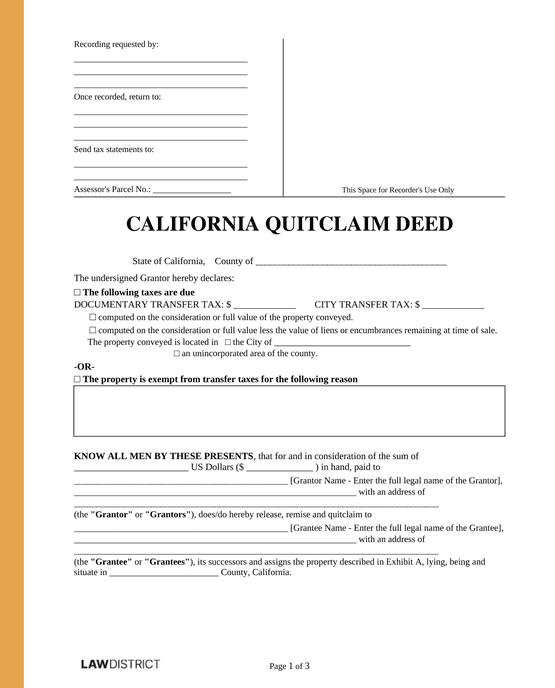
California Quitclaim Laws & Requirements
California Quitclaim Deeds must follow certain legal requirements before they can be recorded. The table below outlines some of the most important requirements to be aware of.
| Requirement | California Law | What It Means |
|---|---|---|
| 1. Proper deed execution | California Civil Code § 1092 | The deed must include the correct wording and details to transfer an interest in real property. |
| 2. Grantor signature acknowledgment | California Civil Code § 1189 | The grantor must sign the deed and have their signature notarized before recording. |
| 3. Legal property description | California Civil Code § 1092 | The deed must clearly identify the property being transferred, including its legal description. |
| 4. Preliminary Change of Ownership Report (PCOR) | California Revenue and Taxation Code § 480.3 | The PCOR provides the county assessor with information about the ownership change. |
| 5. Documentary transfer tax declaration | California Revenue and Taxation Code § 11911 | You may need to pay transfer tax or declare an exemption when recording the deed. |
How To Fill Out a Quitclaim Deed in California
When creating your own Quitclaim Deed in California you need to take care when filling in the form. The steps below outline how complete this legal document correctly.
| Step | What to Do |
|---|---|
| 1. Identify the parties | Add your full legal name and mailing address as the grantor, along with the grantee's details. |
| 2. Describe the property | Include the property's legal description and Assessor Parcel Number (APN). |
| 3. Add transfer details | State the consideration paid and how the new owner will hold the property. |
| 4. Complete required forms | Prepare any required documents, such as a Preliminary Change of Ownership Report (PCOR). |
| 5. Sign and notarize | Sign the deed and have your signature acknowledged by a notary public. |
| 6. Record the deed | Submit the completed deed to the County Recorder's Office where the property is located. |
You can easily create your own version of this document with all the required details using our customizable template. Simply enter the relevant information and download the finished form instantly.
How To File a Quitclaim Deed
In order to file a completed and signed California Quitclaim Deed you will need to visit the local county recorder's office where the property is located.
In California, you also usually need to submit a Preliminary Change of Ownership Report (PCOR) with a recorded deed. This form helps the county assessor determine whether the transfer may affect property taxes.
California Quitclaim Deed Taxes
Deed transfers in California are typically subject to transfer taxes. These vary depending on the area the property is located in as each county and jurisdiction charges its own individual rates.
The California transfer tax amount needs to be stated on the Quitclaim Deed before it is signed and notarized. It is, therefore, necessary to calculate the amount you will need to pay before putting your form into action.
Some transfers between family members may be exempt from these taxes.
Quitclaim Deed Vs. Grant Deed in California
Due to the fact that Quitclaim Deeds in California offer no warranties on the grantor's rights to the title, grant deeds ( sometimes known as warranty deeds) arepreferred in certain situations. This is especially the case when a real estate deal takes place between two unfamiliar parties.
However, when trading a property title with people in your close family or managing your estate planning by placing real estate in a trust, Quitclaim Deeds offer a faster way to handle the process.
They are also a quicker and more efficient option if you're looking to update the title. This may include adding or removing a current or former spouse from the title. It can also be used to add or remove owners when a property is held by multiple people.
California Quitclaim Deed FAQs
Quitclaim Deeds have big ramifications for those signing them and it's important to understand what they can and cannot do. Read through our FAQs below to learn more about how California Quitclaim Deeds work.
You don't need a lawyer to create your own Quitclaim Deed. However, it is sometimes wise to get legal counsel before completing and signing the form, especially if your circumstances for making the transfer are more complicated than normal for any reason.
In most cases, a Quitclaim Deed for California will only remove your name from the title of a property, not from the mortgage agreement. You will still be liable for any unpaid sums of money or principal sums owed to the lender.
Usually, Quitclaim Deeds should only be used to transfer property that doesn't have any liens or encumbrances against it. This avoids a situation where the grantor no longer holds rights to the property but is still required to pay for it.
You should talk to the new grantee and the mortgage provider to organize the transfer of debt to another person or party.
Try Lawdistrict Now
Instant and complete access to our entire library of legal forms
Edit, download and print in PDF from any device
Save time and money on legal document creation