
Lien Release Form
A Lien Release Form is a legal document that confirms a lien has been paid and officially released. It is used to remove an existing claim from a property title, restore clear ownership records, and show that the lienholder’s interest in the property has ended.

Was the contract with the owner or a third party?
Fill forms in a few steps
Save, print & download
Done in 5 minutes
What Is a Release of Lien?
A Release of Lien form is a legal document that shows a lien has been paid off and takes the claim off the title of the property.
This makes it clear who owns the property and makes it easy to sell, refinance, or transfer it by showing that the debt is no longer due.
Key terminology for Lien Releases:
- Lienor/Lienholder: The party who filed the lien (e.g., contractor or supplier)
- Lienee: The property owner
- Mechanic’s Lien: A common type of lien used to secure payment for construction work or materials
Use our Release of Lien template to help you create your own document in minutes. Then have it quickly reviewed by a legal professional and put it into effect.
Lien Release Sample
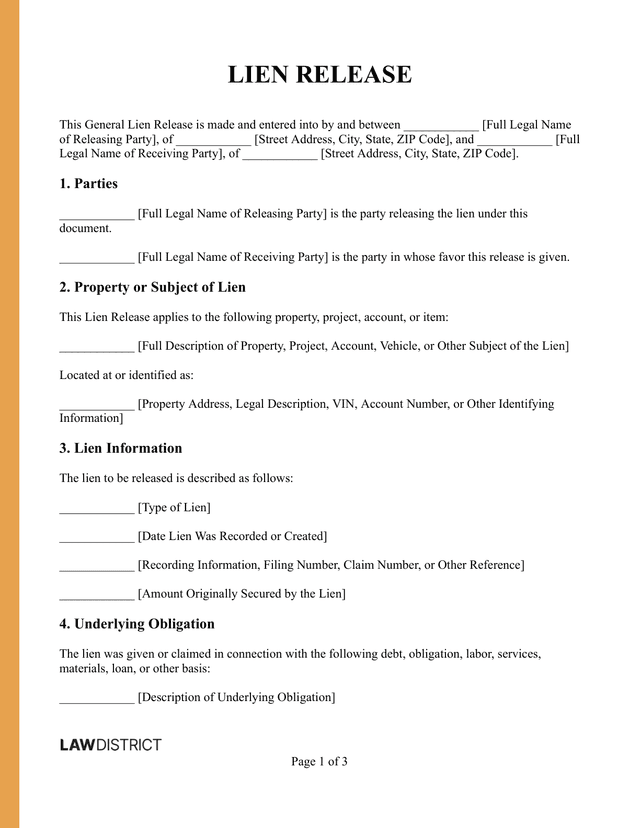
To understand what your Release of Lien should include and how it should be formatted, review the following basic example below:
When Should You Use a Lien Release?
You should use a Lien Release once the debt secured by the lien has been fully paid or otherwise resolved.
Some common situations when you should create and use this form to help prevent disputes and restore full control over the property include:
- After a contractor, subcontractor, or supplier receives the full payment for the property
- When a property owner plans to sell or refinance and needs a clear title
- If a lender or title company requests proof that the lien has been removed
Statutory Deadlines and Compliance
State laws govern the requirements and deadlines for using this release form, including setting precise deadlines for removing a lien following payment or request.
Deadlines vary by jurisdiction and are usually from a few days to a few weeks. If you fail to meet these deadlines, it can result in fines or claims for damages.
It’s a good idea to act promptly to make sure the document is completed and recorded in full compliance with all local requirements to prevent any issues.
Remember: the type of lien and type of property involved can also play a role in determining what sort of statutory law applies. Mechanics’ liens, for instance, may have different requirements than a lien like a mortgage.
Liens involving real property often have strict filing or recording requirements. It can also be a good idea to check with the County Recorder’s office, particularly when real property is involved, to determine specific recording requirements.
How To File a Lien Release
You must properly file your Lien Release to make sure it is formally removed from public records and the property title is cleared.
Follow these steps to properly file your document:
- Fill out the form: Use our template to quickly add information about the lien, the parties involved, the amount of the payment, and the property.
- Sign the document: The lienholder or their authorized agent must sign the release.
- Notarize if necessary: Check your state’s laws and have your form notarized if necessary.
- File with the correct office: Submit the document to the same county recorder or clerk’s office where the lien was originally filed.
- Pay any fees: Submit any necessary fees. These fees will vary by location.
- Distribute copies: Provide copies to the property owner and relevant parties.
Lien Release vs. Lien Waiver
Although often confused, a Release and a waiver serve different purposes at different stages of payment, making it important to understand when to use each.
Study the table below to understand when each document works best and for whom.
| Feature | Lien Release | Lien Waiver |
|---|---|---|
| Purpose | Removes an existing lien from a property | Prevents a lien from being filed |
| When it's used | After full payment has been made | Before or during payment |
| Legal effect | Confirms the debt has been satisfied | Waives the right to file a future lien |
| Timing | After a lien has already been recorded | Before a lien is filed |
| Who uses it | Contractors, suppliers, or lienholders | Contractors, subcontractors, suppliers |
| Main benefit | Clears the property title | Reduces risk of future lien claims |
| Common use case | Final payment on a completed project | Progress payments during ongoing work |
Note: Other documents may be necessary to ensure that a title to property is clear.
FAQs About Lien Releases
It is not always necessary to get your Lien Release notarized; however, some states do require notarization for the form to be valid and recorded.
Even when notarizing a Lien Release isn't required, it's a good idea to do so anyway, as it helps prove the document is real, reduces the risk of disputes, and makes it more likely that recording offices will accept it.
If a paid contractor refuses to sign the form, the property owner's primary leverage is the statutory penalty framework, as issuing a formal demand triggers a statutory clock. There may be penalties that apply to a contractor who refuses to release a lien despite the requirements of the lien having been satisfied.
This crucial legal step makes the contractor liable for financial damages if they miss the mandated deadline.
Try Lawdistrict Now
Instant and complete access to our entire library of legal forms
Edit, download and print in PDF from any device
Save time and money on legal document creation