
Free Divorce Agreement Template
A Divorce Agreement, also known as a divorce settlement, is a legal document that outlines the terms and conditions of a divorce. It includes details like property division, child custody, and support. Once finalized and signed, it becomes part of the official divorce papers filed with the court.

Trusted by 2,070 users.
Do you and your spouse have children together?

Fill forms in a few steps
Save, print & download
Done in 5 minutes
What Is a Divorce Settlement Agreement?
A Divorce Settlement Agreement is a contract used by a couple to split their property and liabilities prior to or at the time of filing for divorce.
This written agreement generally outlines:
- Alimony,
- Child support
- Child custody
Once assets have been divided and any necessary custody arrangements have been finalized, a judge will be required to approve the agreement before issuing a divorce decree.
A Divorce Settlement Agreement also goes by names such as divorce document, divorce contract, marriage settlement agreement, proposed divorce decree, and marital termination agreement.
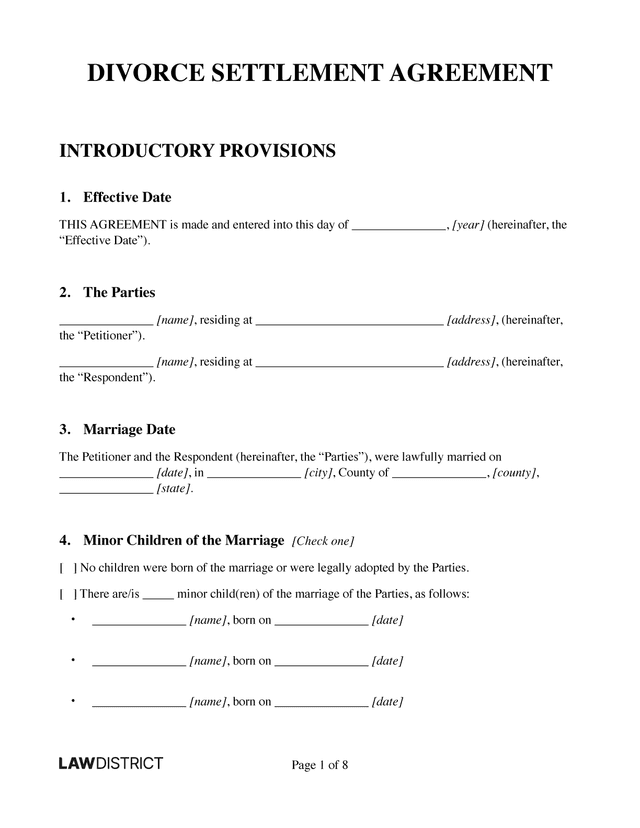
Divorce Settlement Agreement Example
It can be difficult to complete a Divorce Agreement template without first seeing a verified example.
Review our sample below before you begin to get a clearer view of what a Divorce Agreement looks like and to make the process of writing your own document simpler.
When To Use a Divorce Settlement Agreement
A Divorce Settlement Agreement should be used if you and your spouse have financial, custodial, and property issues that need to be resolved.
For example, you can use one when you need to:
- Divide bank accounts and financial assets
- Allocate debt between spouses
- Establish child custody arrangements
- Set child support payments
- Resolve property division issues
- Address any financial, custodial, or property-related matters before filing for divorce
Divorce Agreement vs. Separation Agreement
The document you should use depends oon your specific situation. It can help to see how both work so that you know which to use:
| Point of difference | Divorce Agreement | Separation Agreement |
|---|---|---|
| Main purpose | Used to settle the terms of a divorce | Used to set rules while spouses live apart |
| Marital status | Ends the marriage once approved by the court as part of the divorce | Spouses remain legally married |
| When it is used | When the spouses have decided to divorce | When the spouses want to separate but are not ready to divorce, or want to live apart first |
| Court involvement | Usually reviewed by the court as part of the divorce process | Not always filed in court unless it is part of a legal separation process |
| Key issues covered | Property division, debt, child custody, child support, and alimony | Property use, finances, living arrangements, child custody, child support, and temporary responsibilities |
| Duration | Permanent | Can be temporary or long-term |
How To Write a Divorce Agreement
A Divorce Agreement can be created by you and your spouse, by negotiating the terms in collaboration with each other.
You can use our free do-it-yourself Divorce Agreement template to help you write your document.
It should then be reviewed by a neutral party, such as a lawyer, to ensure that no important details are overlooked to avoid future disputes.
A do-it-yourself Divorce Agreement must contain the following information for it to be legally valid:
- Date of the agreement
- Full names of both spouses
- Marriage date and location
- Date of marriage end
- Child support and custody arrangements
- Spousal support terms and conditions
- Life and health insurance
- Division of spousal assets and property
- Allocation of debt and liabilities
- Name changes (if applicable)
- Retirement benefits
- Dependents
- Any required disclosures
- Additional provisions
- Signatures and dates
Generally, a judge will ultimately have to review and sign off on the do-it-yourself divorce papers to make the divorce official. However, the terms may be binding upon the parties signing the agreement.
Try our customizable template and create a solid basis for your legal journey.
What To Ask for in a Divorce Agreement
Your Divorce Settlement Agreement should mention all relevant items and responsibilities, and how they will be split up between you and your spouse.
You should make sure the following divorce-related issues are included in the contract to ensure they are taken care of down the line.
Alimony
Alimony is financial support awarded to a spouse before or after divorce or marital separation.
The amount and duration of alimony should be negotiated with your partner and established in the agreement [1].
In some jurisdictions, alimony is also called “spousal maintenance” or “spousal support”.
Child Support
Child support is a payment made by one parent to the other for the purpose of financially supporting their children.
This sum serves as a contribution to the child’s basic living expenses, and it should be included in your Divorce Agreement.
Parenting Time Schedule
Even in an amicable divorce, it’s recommended to define a parenting-time plan to avoid future disputes.
By creating a detailed schedule, both parties will be clear of their responsibilities and steer clear of issues that could end up affecting the child or children.
Marital Property and Debt Division
Dividing property and debts will depend on the specific property laws and property division model of your state.
For example, your state may use an “equitable distribution” model, whereby marital property is distributed according to the needs of each party and the facts of the case [2].
On the other hand, some states use a “community property” model. In this case, marital property is divided fairly equally regardless of whether one of the spouses is more to blame for the divorce, who contributed more to the marriage, or who has more separate property.
Life and Health Insurance
If you or your spouse will have the responsibility of making child support or alimony payments, then a provision should be included requiring the paying spouse to maintain life and health insurance for the other spouse.
This policy should name the other spouse as a beneficiary so that they will continue to receive money for themselves or their kids in case the paying spouse passes after the divorce.
How To Enforce a Divorce Agreement
A Divorce Agreement should be enforceable with agreed-upon terms, a pledge for both spouses to abide by those terms, and what penalties will be incurred if either party fails to follow through with their responsibilities.
Enforcing a Divorce Agreement can be done by filing a formal request or motion with the court and by preparing the necessary legal paperwork.
You will need to show evidence of how your ex-spouse failed to follow the agreement’s terms and conditions.
Common reasons for enforcing a Marital Settlement Agreement include:
- Your ex-spouse failed to fulfill the required child or spousal support payments
- Your ex-spouse failed to maintain insurance policies
- Your ex-spouse failed to make the necessary mortgage payments
Additionally, it is common for agreements regarding parenting time schedules and parenting details to be enforced.
What Does a Divorce Filing Typically Include
When filing for divorce, you’ll have to provide the courts with various details and documents.
This often includes:
- A divorce petition or complaint
- Basic details about both spouses
- The reason for the divorce
- Requests regarding child custody and child support
- Requests regarding alimony
- Details about property, debts, and other financial matters
- Any required financial disclosure forms
You may also need to meet residency rules in the jurisdiction you file in.
In Which Types of Divorce is This Agreement Used?
This agreement is used to put divorce terms in writing when spouses reach an agreement on key issues. Here are some of the types of divorce where it makes sense to use this document:
| Type of divorce | Explanation |
|---|---|
| Uncontested divorce | Used when both spouses agree on property, support, custody, and other divorce terms. |
| No-fault divorce | Commonly used when the spouses want to settle divorce-related issues without blaming either party. |
| Collaborative divorce | Used when both spouses and their attorneys negotiate a settlement outside of court. |
| Summary divorce | Used in some states when the couple agrees on all issues and needs to show the court their written terms. |
| Default divorce | Sometimes used if the spouses reached an agreement before one spouse stopped responding. |
| Contested divorce | Sometimes used if the spouses settle some or all issues before trial. |
This document is most useful when both spouses can agree on some or all of the terms of the divorce.
Other Personal and Family Documents
A Divorce Settlement Agreement is one of the most important legal documents that you’ll need to legally file for divorce.
However, our legal document-making tools can help you put together other helpful documents, such as:
Resources:
[2] 2025 Minnesota Statutes. 518.58 Division Of Marital Property.
FAQs About Divorce Settlements
If you still have some doubts or questions about creating your own Divorce Agreement, don’t worry. We’ve answered the most common queries about how these essential legal documents work in our FAQs below.
To create your own free do-it-yourself Divorce Agreement, you will need to determine the terms of the divorce with your spouse.
Once you have agreed on and finalized these details, you should draw up your document and sign it.
You can use a printable do-it-yourself Divorce Agreement template to help you draft your document, then have it quickly reviewed by a legal professional to make sure it’s ready to use.
In many cases, a Marital Settlement Agreement can be modified, even if the divorce is finalized. You can go back and modify the document to make things easier for both parties. However, both you and your spouse need to agree on the new changes.
There may also be certain aspects of the agreement that can no longer be changed legally, and in these cases, it’s recommended to contact an attorney to determine the best way forward.
After you have come to a general agreement with your spouse, and it has been written in the Marital Settlement Agreement, then you may sign the document.
The agreement must be signed by both spouses and will be recognized in every state.
The Settlement Agreement may then be filed with a court and reviewed by a judge, who will confirm that it is fair and reasonable to both parties. The couple may then apply for a divorce decree.
Court filing fees vary widely depending on your state and county; you can check your local court clerk for the current baseline filing fees.
Divorces that involve less conflict are typically less expensive, namely:
- Uncontested divorces
- Simplified divorces
These are usually cheaper as they may require less attorney involvement.
Contested divorces usually cost more due to court time, legal fees, and longer periods of negotiation.
Try Lawdistrict Now
Instant and complete access to our entire library of legal forms
Edit, download and print in PDF from any device
Save time and money on legal document creation