
California Promissory Note Template
A California Promissory Note records a loan between a lender and a borrower. It explains how much is owed, when it must be repaid, and whether interest or collateral applies.

Fill forms in a few steps
Save, print & download
Done in 5 minutes
What Is a California Promissory Note?
A California Promissory Note is a written promise to repay money. It is commonly used for personal loans, business financing, and other private lending arrangements.
This legal document helps both parties keep a clear record of the loan. It usually includes the following:
- Loan amount
- Repayment terms
- Interest rate
- Due date
- Signatures
Types of Promissory Notes Used in California
In California, you can create an unsecured or secured Promissory Note.
California secured Promissory Note
A secured note is backed by collateral, such as a vehicle or other property. A Promissory Note secured by a deed of trust in California also requires a separate deed of trust to create the real estate security interest.
California unsecured Promissory Note
An unsecured note is not backed by collateral, so the lender relies on the borrower's promise and ability to pay.
California unsecured Promissory Note templates can still provide useful evidence of the debt when they clearly state the payment terms and are signed by the borrower.
California Promissory Note Sample
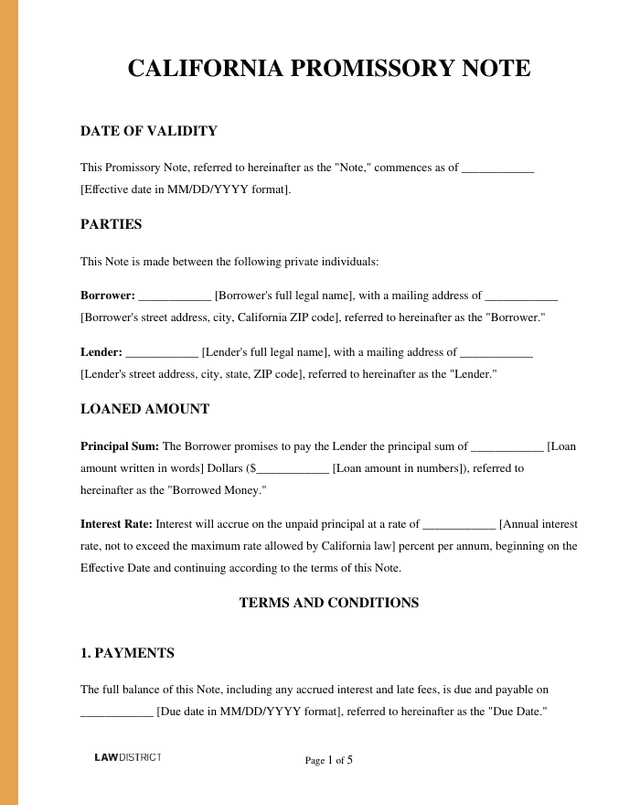
Below is a sample Promissory Note for California. You can use it as a guide when preparing your own agreement with Lawdistrict's customizable California Promissory Note template.
California Promissory Note Requirements
The State of California does not require one standard Promissory Note form.
However, a note intended to qualify as a negotiable instrument should meet California Commercial Code § 3104, including a clear promise to pay a fixed amount on demand or at a definite time.
A practical California note generally includes:
| Requirement | Explanation |
|---|---|
| 1. Lender Name | Identifies who is providing the loan. |
| 2. Borrower Name | Identifies who promises to repay it. |
| 3. Principal Amount | States the amount borrowed. |
| 4. Promise to Pay | Records the borrower's clear promise to repay. |
| 5. Interest Rate | States the annual rate or that no interest applies. |
| 6. Payment Terms | Explains installments, payment method, and timing. |
| 7. Due Date | States when payment is due or makes the note payable on demand. |
| 8. Collateral | Describes property securing the loan, if any. |
| 9. Late Fees and Default | Explains charges and remedies after missed payments. |
| 10. Governing Law | Mentions that California law applies. |
| 11. Signatures | Shows the borrower's agreement; both parties may sign for a complete record. |
California Usury Laws
California limits interest on many private loans. Before entering the rate in a Promissory Note, review these rules related to relevant state usury laws:
- California Constitution Article XV, Section 1: The constitutional rate is 7% per year unless the parties agree in writing to a different lawful rate.
- California Constitution Article XV, Section 1(1): The maximum contractual rate is generally 10% per year. Loans used primarily to purchase, construct, or improve real property are treated under the other-purpose rule instead.
- California Constitution Article XV, Section 1(2): The maximum is generally the higher of 10% per year or 5% plus the applicable Federal Reserve Bank of San Francisco rate described in the Constitution.
- California Constitution Article XV, Section 1: The constitutional limits do not apply to every lender or transaction. Banks, credit unions, certain real estate broker-arranged loans, and other listed or statutorily exempt lenders may follow different rules.
California Promissory Note Statute of Limitations
The deadline to enforce a California Promissory Note depends on how the note and claim are classified.
- California Commercial Code (§3118): An action on a negotiable note payable at a definite time generally must begin within six years after the due date or accelerated due date.
- California Code of Civil Procedure (§337): A claim based on an ordinary written contract is generally subject to a four-year period.
The exact deadline may depend on the due date, payment history, acceleration clause, and type of claim.
For a demand note, the period generally runs six years after demand. If no demand is made, a 10-year no-payment rule may apply.
Other Financial Documents
These financial documents, found on Lawdistrict, may also help you manage the loan or address missed payments:
CA Promissory Note FAQs
If you still have some doubts about creating your legal document, review the following answers to common questions about California Promissory Notes.
If you use a basic California Promissory Note, it generally does not need to be notarized or witnessed to be put into effect.
The borrower's signature is the main evidence that the borrower accepted the repayment obligation; however, notarization may help you verify identity even more.
If the loan is secured by California real estate, the separate deed of trust or mortgage generally must be acknowledged before recording under California Government Code §27287.
If you are the lender, you should review the note's default, notice, cure, late-fee, and acceleration terms. Depending on the agreement, the lender may demand payment, declare the balance due, or file a timely claim.
If the note is secured, the lender may pursue lawful remedies against the collateral. A note secured by a deed of trust must follow California's separate foreclosure procedures, including the notice requirements in California Civil Code §2924.
Try Lawdistrict Now
Instant and complete access to our entire library of legal forms
Edit, download and print in PDF from any device
Save time and money on legal document creation