
North Carolina Promissory Note Template
A Promissory Note records a loan and the borrower's promise to repay it. It sets out the amount, interest, payment terms, due date, and any collateral.

Fill forms in a few steps
Save, print & download
Done in 5 minutes
What Is a North Carolina Promissory Note?
A North Carolina Promissory Note is a written promise to repay borrowed money that's used in the state of North Carolina.
This legal document is used to:
- Identify the lender and borrower
- Record the main terms of the loan, such as the principal amount, interest rate, and payment schedule
It can reduce misunderstandings and provide evidence of the debt if the borrower does not repay.
North Carolina law generally requires a person to sign an instrument before that person can be held liable on it. You can also have an authorized representative sign on behalf of your business.
Types of Promissory Notes Used in North Carolina
A Promissory Note may require installments, one lump-sum payment, or payment on demand. Another important distinction is whether the note is secured or unsecured:
| Type | Explanation |
|---|---|
| Secured Promissory Note | The borrower pledges collateral, such as a vehicle, equipment, or other property. A separate security agreement may be needed to create an enforceable interest. |
| Unsecured Promissory Note | No specific property secures the debt. If the borrower defaults, the lender generally relies on a legal claim rather than taking identified collateral. |
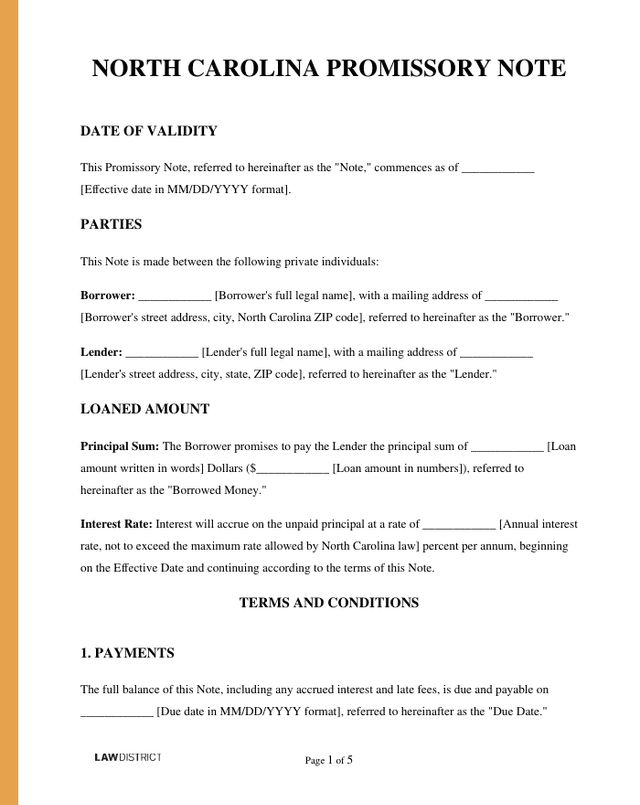
North Carolina Promissory Note Sample
Reviewing a North Carolina Promissory Note sample can help you understand the document's contents and structure. Here's an example you can use as a guide:
North Carolina Promissory Note Laws
North Carolina law defines and limits various aspects of Promissory Notes. The rules that apply in your case depend on the loan amount, among other factors:
| Law | Explanation |
|---|---|
| G.S. § 24-1 | Sets the general legal interest rate at 8% when another lawful written rate does not apply. |
| G.S. § 24-1.1 | Regulates written interest rates. Loans over $25,000 may generally use any rate agreed to in writing. |
| G.S. § 24-2 | Unlawful interest may be forfeited. Borrowers may recover twice the unlawful interest already paid. |
| G.S. § 24-10.1 | Regulates late-fee amounts, waiting periods, notices, and repeated charges. |
| G.S. § 25-3-104 | Defines when a written promise to pay qualifies as a negotiable instrument. |
| G.S. § 25-3-401 | A person is generally not liable unless they, or an authorized representative, signed the note. |
| G.S. § 25-9-203 | Explains when a security interest becomes enforceable against the borrower and third parties. |
The North Carolina Commissioner of Banks currently publishes a 16% annual maximum for certain loans of $25,000 or less. Check the official rate before signing because the statute uses a published monthly ceiling.
North Carolina Statute of Limitations
The limitation period in NC can vary based on payment dates, acceleration, formal demands, and whether the document is under seal.
- Note with a definite due date: An action must generally begin within six years after the stated due date or an accelerated due date.
- Demand note after payment is requested: The lender generally has six years from the demand to begin an enforcement action.
- Demand note without a demand: Enforcement is barred if neither principal nor interest has been paid for a continuous period of 10 years.
- Sealed note: A sealed instrument is generally subject to the 10-year period in G.S. § 1-47(2).
Both parties should keep the signed note, payment records, and default notices.
Other Financial Documents
If you are drafting a Promissory Note, the following documents also available on Lawdistrict may also be of interest to you:
NC Promissory Note FAQs
These answers address common questions about signing and enforcing a North Carolina Promissory Note.
In this case, the lender may demand payment. They can do this through the remedies allowed by the note and North Carolina law.
If the note is properly secured, collateral may be taken without court proceedings only when this can be done without breaching the peace.
No, a basic North Carolina Promissory Note does not generally need to be notarized. If the borrower signs it, it's generally considered legally valid.
Notarization may still help:
- Verify identity
- Reduce signature disputes
Different formalities may apply when the loan is secured by real estate or accompanied by a document that must be recorded.
Try Lawdistrict Now
Instant and complete access to our entire library of legal forms
Edit, download and print in PDF from any device
Save time and money on legal document creation