
New York Bill of Sale Forms
A New York Bill of Sale is used to document the sale of personal property in the state of New York, such as vehicles or firearms. It records details like buyer and seller names and the sale price and can protect both parties if a dispute arises after the sale.

What type of property are you selling in NY?
Fill forms in a few steps
Save, print & download
Done in 5 minutes
Bills of Sale in New York
A Bill of Sale is a legal document that serves as proof of the transfer of ownership between the buyer and the seller of personal property, such as a vehicle, boat, or other valuable items.
In New York, a Bill of Sale is not always required for the sale and purchase of personal property. However, it is highly recommended for both parties to protect their rights and interests.
Ensure a secure and transparent transaction by meticulously including all essential details in the form, fostering confidence and peace of mind.
Types of New York Bills of Sale
In New York, various types of Bills of Sale cater to different kinds of personal property transactions, offering tailored documentation to suit the unique needs of each sale.
Each of these forms provides a comprehensive and legally-recognized record of the operation.
General Bill of Sale
This all-purpose document can be used in a wide range of transactions, but it is generally employed for the exchange of items with considerable value.
The key elements include:
- Buyer and seller details: Full names, addresses, phone numbers, and email addresses of both parties.
- Description of the item: Detailed information about the property being sold, including make, model, year, color, identification number, and any other relevant descriptions that can help to identify the property accurately.
- Purchase price: The agreed-upon price of the property, written both in words and numbers, including the currency.
- Date of sale.
- Payment method: Indicate whether the payment is being made in cash, by check, money order, or any other agreed-upon method.
- Warranty and as-is clause: A statement that specifies whether the property is being sold with a warranty or "as-is," without any warranty or guarantee of its condition.
- Signatures: Both the buyer and the seller should sign and print their names, acknowledging their agreement to the terms and conditions stated in the document.
- Notary public (optional): While not required in New York, notarization adds another layer of protection and validity to the document.
By signing the Bill of Sale, both parties acknowledge their understanding of the terms and conditions, as well as their agreement to abide by them.
New York Bill of Sale Sample
To minimize errors and ensure that you include all necessary information in your form, it is advisable to review a sample document before drafting your own.
You may use our New York Bill of Sale example as a guide to acquaint yourself with the structure and content of the document.
You will gain a better understanding of the various sections, clauses, and key elements that should be present.
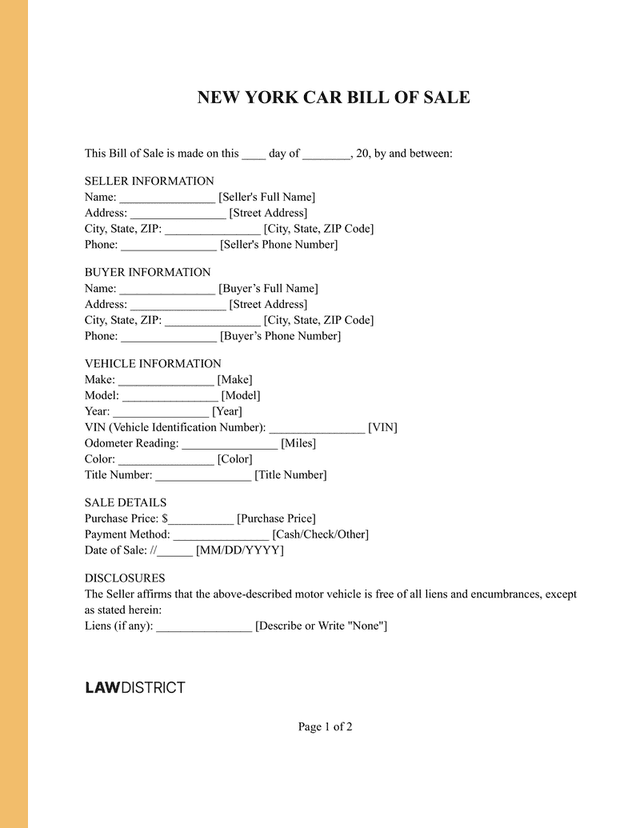
New York Vehicle Bill of Sale
Before finalizing the purchase of a vehicle, boat, snowmobile, or all-terrain vehicle (ATV), you need to obtain satisfactory proof of ownership.
Acquiring proper documentation is crucial, as you may encounter difficulties when attempting to register the vehicle, get a title certificate, or transfer the registration to your name without it.
A New York Vehicle Bill of Sale must include the information listed below:
- Year and make of the vehicle, boat, snowmobile, or ATV
- Vehicle identification number (VIN) or the hull identification number (HIN)
- Date of the sale
- Purchase price
- Names and signatures of the buyer and the seller
How To Register a Vehicle in New York
Registering a vehicle in New York is a necessary step to ensure your vehicle is legally allowed to operate on public roads.
You can do so at the New York Department of Motor Vehicles (DMV). Confirm you have the following forms with you before you go:
- New York Vehicle Bill of Sale
- Insurance
- Safety inspection
- Vehicle Registration/Title Application (MV-82)Odometer and Damage
- Disclosure Statement (MV-103)
New York Boat Bill of Sale
A Boat Bill of Sale provides evidence of the ownership transfer of a vessel that is more detailed than a receipt.
It includes the following information:
- Names and addresses of buyer and seller
- Date of sale
- Purchase price
- Detailed description of the boat or watercraft including make, model, year, color, condition, and hull identification number (HIN)
- Information on items sold along with the boat or watercraft, such as the trailer, life jackets, cover, etc.
- Any warranties the seller is making about the boat
- Signatures of the seller and buyer
A warranty on a boat represents a guarantee from the seller that the title to the boat is free from any outstanding claims against the boat, such as loans or liens, at the time of the sale.
A vessel can also be sold without any warranties. In such cases, the buyer assumes complete responsibility for any claims that may emerge after the sale.
How To Register a Boat in New York
In the state of New York, non-motorized watercraft are not required to be registered.
However, if your boat is equipped with an engine, whether electric or fuel-powered, you are obligated to register it, irrespective of the boat or motor’s size.
To register your vessel with the New York DMV, you will need the following documents:
- A Bill of Sale
- Boat Registration / Title Application (MV-82B)
- Evidence of ownership
- Information on how to transfer ownership
- Proof of identity
New York Firearm Bill of Sale
A New York Firearm Bill of Sale is a legally binding document that serves as confirmation that a firearm sale, purchase, and transfer of ownership has occurred in compliance with all applicable laws in the State of New York.
This document contains crucial identification information about the seller, buyer, and the gun involved. It can be utilized as legal validation of the change of ownership between the parties.
To further authenticate the document, it must be notarized and signed by 2 witnesses.
How To Register a Firearm in New York
According to New York Penal Law § 400.00(16-a), all handgun owners in the state must register their firearms with the New York State Police.
Private vendors who are not licensed dealers are required to perform a background check on all buyers before transferring a firearm.
These background checks must be completed through a federally licensed dealer. Transfers between direct family members are exempt from this requirement.
In New York City, buyers are required to present a license for all firearm purchases, regardless of the type of firearm being purchased. A Pistol/Revolver License Application (PPB3) form needs to be completed for this purpose.
However, in the rest of the state, a license is only required for the purchase of handguns.
FAQs About New York Bill of Sale Forms
Understanding the intricacies of a New York Bill of Sale is crucial to avoid disputes.
If you have any uncertainties about the specific aspects of this legal document, check out our frequently asked questions below to gain a better comprehension.
Yes, you can write your own Bill of Sale in New York as long as it includes specific details such as the names and addresses of both the buyer and seller, a description of the item being sold, the price, and the date when the transaction is taking place.
However, we recommend you use a professional template like ours as a base when writing your Bill of Sale. It’s also a good idea to have a legal professional review the document.
A notarized Bill of Sale form is not required in New York, except for the sale of a firearm. Notarization adds an extra level of authentication to the document and helps prevent fraud and verify proper transfer of ownership.
It is advised to use a form specifically designed for use in New York to ensure that it complies with the state's laws and regulations.
A Bill of Sale is not mandatory for selling personal property.
Having one can protect the buyer by providing evidence of the agreed-upon terms of the sale and preventing false claims by the seller.
Private sellers are not bound by the same fair marketing laws as retailers, so buyers must beware of liens or hidden defects.
Try Lawdistrict Now
Instant and complete access to our entire library of legal forms
Edit, download and print in PDF from any device
Save time and money on legal document creation